


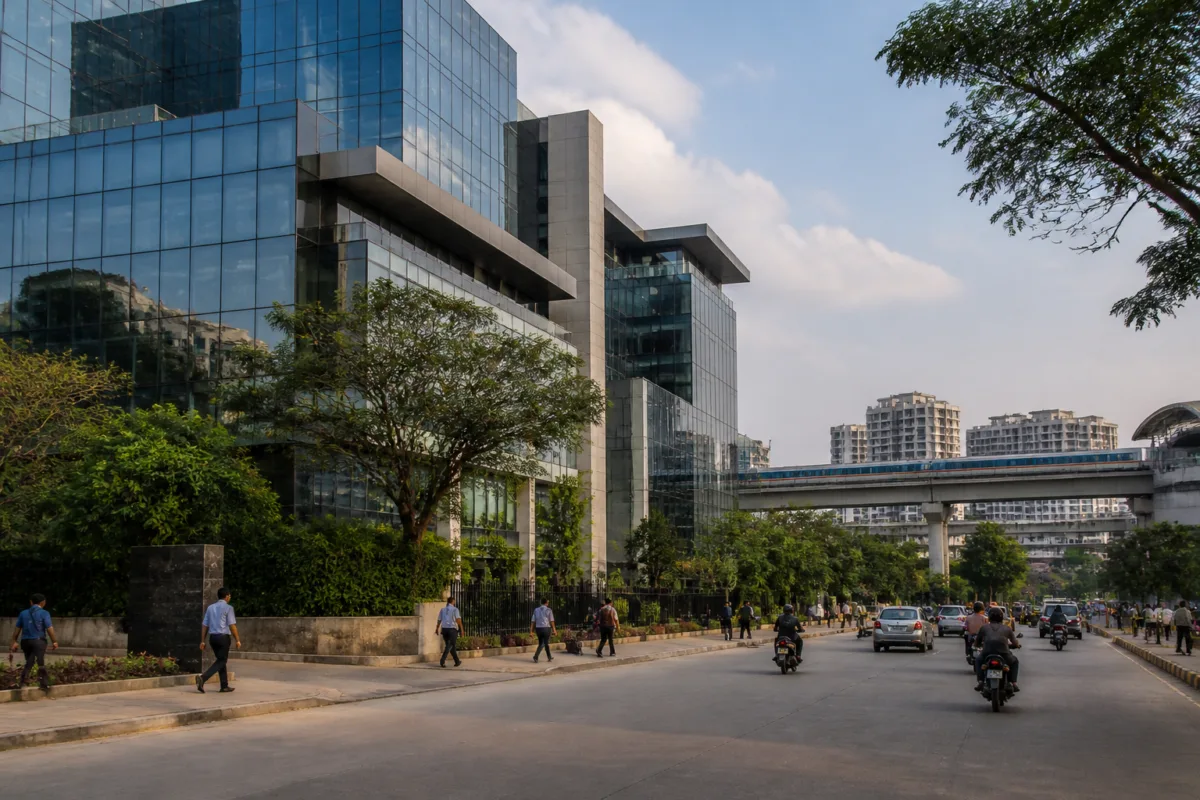
Global capability centres (GCCs) accounted for 65% of office space take-up in Bengaluru, up from 52% in the previous quarter, as demand from the information technology sector slowed, according to an Economic Times report. The shift is strengthening the case for employment hubs that combine office space with housing, transport connectivity and supporting social infrastructure.
Bengaluru has India’s largest office development pipeline, at 36.1 million sq ft, equivalent to about 16% of its existing office stock. Developers are continuing to build large office parks in anticipation of sustained demand from global enterprises and their India-based technology, innovation and research operations.
The changing leasing pattern could influence where new commercial development is concentrated. Shivam Agarwal, vice-president, strategic growth, Sattva Group, said the city’s next phase of commercial growth would be shaped by well-connected employment hubs. He said companies and GCCs were placing greater emphasis on talent accessibility, commute efficiency, infrastructure and long-term costs when selecting locations.
West Bengaluru is identified in the report as one area positioned to benefit from this shift. Its advantages include established residential catchments, improving connectivity and a growing base of global occupiers. Recent leasing activity indicates that companies are considering costs, proximity to residential areas and metro connectivity together when choosing office locations.
This relationship between office demand and urban mobility also affects the performance of individual assets. Sudarshan Lodha, CEO and co-founder of Strata, said multinational companies were seeking infrastructure, scalability and the flexibility to support future growth. He added that the benefits of GCC demand would not be uniform across all office properties, with established business corridors and well-connected buildings likely to attract stronger interest.
The expansion of GCCs may also affect housing demand in corridors that offer access to major employment centres. Srinivas Moramchetty, director-sales and marketing at Sumadhura Group, said the growth of a skilled, high-income workforce could support demand for premium homes in well-connected locations. The report links this opportunity to the combined provision of workplaces, housing, mobility and social infrastructure rather than to office development alone.
According to Cushman & Wakefield data cited by Economic Times, Bengaluru and Seoul are expected to remain viable markets for new office development through 2035, while Singapore, Tokyo and Sydney face feasibility constraints. Bengaluru has remained viable over the past decade and is expected to retain that position through 2035.
The same data indicates that prime market rents in Bengaluru are currently 16% above economic rents. Prime rents are projected to grow by 5% annually, compared with 2.5% annual growth in economic rents. The gap is projected to widen to about 29% by 2030 and 44% by 2035, giving the city one of the strongest development outlooks in the region, according to the cited analysis.
For Bengaluru, the figures point to continued commercial construction but also underline the importance of location and connectivity. The ability of new office districts to integrate with residential areas, public transport and supporting infrastructure will influence how evenly the benefits of GCC-led growth are distributed across the city.

