


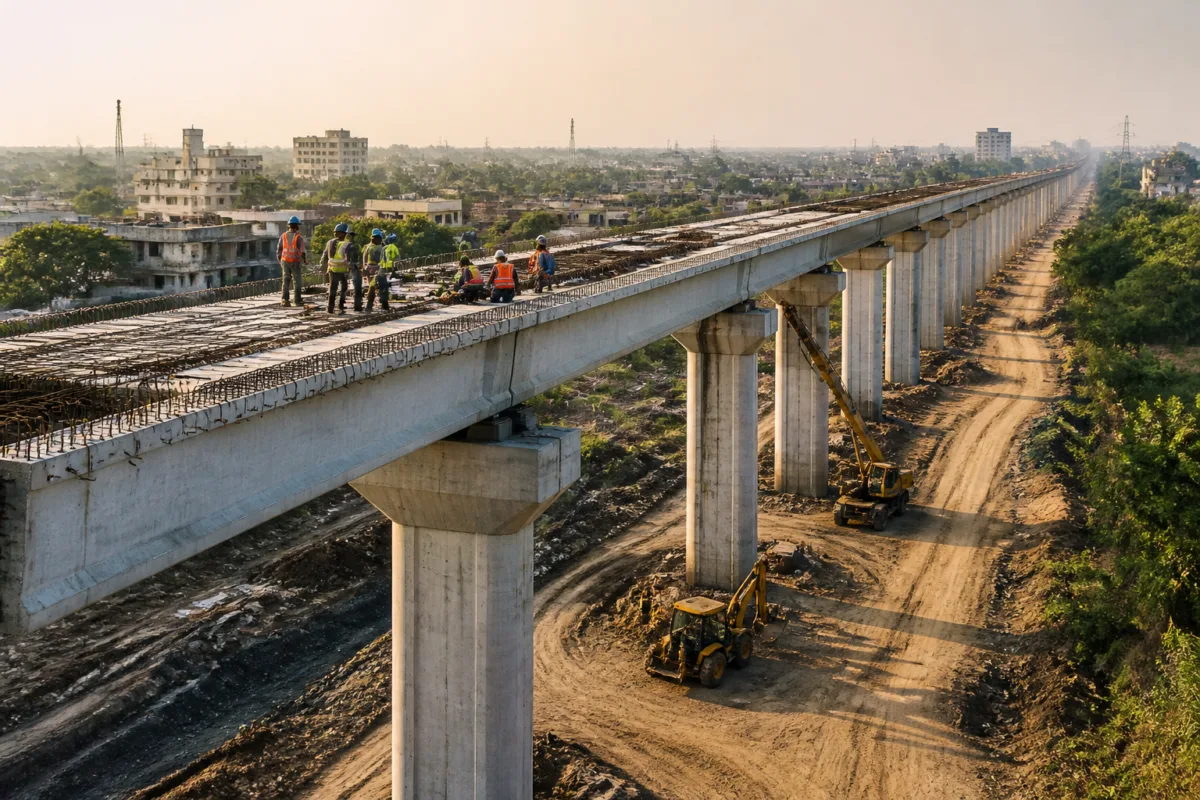
India’s first bullet train service is expected to begin in the last quarter of 2027, with the Surat–Vapi section of the Mumbai–Ahmedabad High-Speed Rail Corridor planned to open ahead of the rest of the route, according to Railway Minister Ashwini Vaishnaw as reported by MagicBricks.
The proposed first operational section lies entirely in Gujarat and is part of a phased approach to the corridor. Other sections towards Mumbai are expected to become operational progressively as construction is completed. The project will eventually connect Mumbai and Ahmedabad through a high-speed rail service designed to reduce the journey between the two cities to about two hours.
The update marks a shift from the project’s earlier focus on land acquisition, construction delays and work in densely developed areas to the prospect of partial operations. The Surat–Vapi section would give passengers the first operating segment of India’s high-speed passenger rail network, while construction continues elsewhere along the corridor.
According to the milestones cited in the report, the project had completed 456 km of pier work and 371 km of viaduct work by September 2026. Noise barriers had been installed along 299 km, with the report putting the number of barriers at six lakh. It also cited 9,300 overhead electrification masts across 206 km.
Civil construction was reported as complete at eight stations, with architectural finishing under way. Work was also continuing at train maintenance facilities in Sabarmati, Surat and Thane. These facilities will support train inspection, cleaning and preparation once services begin.
A major engineering challenge remains the underground section in Maharashtra. The corridor includes a 21-km tunnel, including approximately 7 km beneath Thane Creek. The report described this as India’s first undersea rail tunnel. Two tunnel-boring machines were deployed at Vikhroli and Savali in July 2026, while about 5 km of the larger tunnel had reportedly been excavated using the mountain tunnelling method.
The first Surat–Vapi operation could have consequences beyond travel time. Surat and Vapi are established industrial and employment centres, and improved rail access may strengthen their links with larger commercial markets. Station accessibility, local roads, public transport connections and the availability of employment near stations will determine how far those benefits extend into surrounding neighbourhoods.
The project may also influence housing and commercial property interest in areas around planned stations. Faster intercity travel can alter how businesses assess locations and how residents weigh access to major cities. However, the construction update does not establish that property prices will rise. Any such effect would depend on local infrastructure, station access, employment growth and actual passenger demand after services begin.
The phased opening also means that the first service will not represent completion of the entire Mumbai–Ahmedabad corridor. The remaining sections, including the difficult tunnel works in Maharashtra, will continue to determine when the full route becomes operational. Until those stages are finished, the Surat–Vapi section will provide an initial operating link rather than the complete high-speed connection promised by the project.
For Surat and Vapi, the immediate significance lies in moving the corridor from construction progress towards a defined first service. For the wider region, the more important test will be whether high-speed rail is integrated with local transport, station-area planning and employment centres. The longer-term urban impact will become clearer only after passengers begin using the line and additional sections open.

