


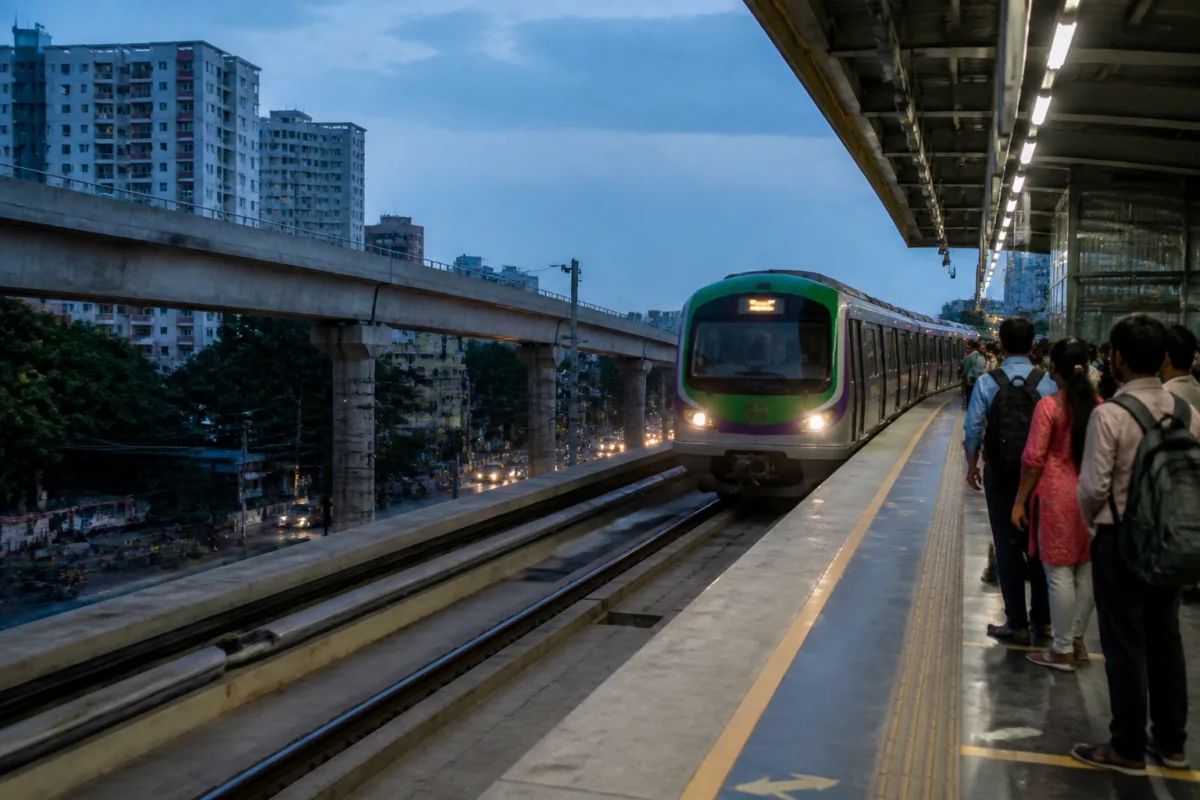
Bengaluru’s Namma Metro operator recorded finance costs of Rs 1,793.03 crore in 2025-26, exceeding its total revenue of Rs 1,624.62 crore, as a sharp rise in foreign-exchange variation increased the cost of servicing overseas loans, according to data reviewed by Deccan Herald.
Bangalore Metro Rail Corporation Limited’s (BMRCL) finance costs rose 219.66% from Rs 560.91 crore in 2024-25. Exchange-rate variation accounted for much of the increase, climbing from Rs 263.75 crore to Rs 1,444 crore during the same period.
The comparison is significant because BMRCL’s finance costs exceeded its combined fare, non-fare and other revenue for the first time since 2019-20, the report said. Finance costs include interest, loan fees and foreign-exchange losses, but do not include repayment of the principal amount.
The figures underline the financial exposure created when a capital-intensive public transport system borrows in foreign currencies while earning most of its operating revenue in rupees. The rupee’s movement against the euro and the dollar can increase the rupee value of liabilities and related expenses even when the underlying loan terms have not changed.
An informed source cited by Deccan Herald said the liability for foreign loans is booked according to the exchange rate on March 31 each year. This accounting treatment differs from the actual exchange rate used when payments are made. The source said the rupee’s decline meant the effective cost of foreign borrowing was higher than the domestic cost of borrowing during the year.
BMRCL relies substantially on foreign loans for metro construction. Although the Government of India releases these loans as Pass-Through Assistance, BMRCL remains responsible for repaying them in full, according to the report. If operating income is insufficient, the Karnataka government provides financial support.
The pressure could intensify as more metro sections become operational and interest costs move from Interest During Construction to the profit-and-loss statement. Deccan Herald reported that BMRCL’s outstanding loans are expected to reach Rs 56,087.49 crore by March 31, 2028.
The operator also faces rising operating expenses, including energy costs and pay increases. Sources cited in the report warned that BMRCL could face an operational loss if a 5% fare increase due in February 2027 is not implemented. The potential fare decision has therefore become linked to the wider question of how Bengaluru’s expanding metro network will be financed.
Karnataka has asked the Centre to share BMRCL’s exchange-rate variation and cash losses in a manner similar to the support provided to Delhi Metro. The state has also sought assistance with hedging, which involves locking in an exchange rate to reduce the risk of future currency movements. In Delhi, the Centre also pays the metro corporation’s security expenses, according to the report.
The division of project financing remains disputed. Karnataka has argued that it would bear Rs 65,291 crore, or 83.8%, of the approved project cost of Rs 77,891 crore up to Phase 3, while the Centre’s contribution would be Rs 12,600 crore, or 16.2%. BJP MP L S Tejasvi Surya has presented a different calculation, putting the Centre’s share at Rs 41,558 crore, or 53.35%, and the state’s at Rs 36,333 crore, or 46.65%.
Surya’s calculation includes Rs 28,958 crore in sovereign-backed foreign loans that are fully repayable by BMRCL. The competing figures show how the treatment of loans and repayment obligations shapes the political and fiscal debate over metro funding.
There has been some improvement in BMRCL’s non-fare earnings. Revenue from advertising, property-related activity and other non-ticket sources rose from Rs 54.97 crore in 2024-25 to Rs 88.51 crore in 2025-26, and is expected to cross Rs 100 crore in 2026-27.
That increase, however, remains small compared with the reported finance-cost burden. The central challenge for BMRCL is to balance affordable fares and continued network expansion with the cost of foreign borrowing, currency risk and day-to-day operations. The outcome will determine how much of Bengaluru’s metro expansion can be supported by passenger and commercial revenue, and how much will continue to depend on state and central assistance.

