


The CAQM report card on pollution-control targets shows sharply uneven progress across Delhi and neighbouring states, with gaps in air-quality monitoring, parking, public transport, waste treatment and crop-residue management still visible ahead of the final 2026 assessment.
According to the report card, which includes data up to October 31, the states and Delhi were assessed against targets set under their 2026 pollution-control action plans. The targets cover both direct air-quality measures and supporting urban systems, including construction and demolition waste processing, continuous monitoring stations, parking capacity, buses, municipal solid-waste treatment and environmentally friendly cremation facilities.
Crop-residue management remains a weak area in Punjab and Haryana. Haryana achieved 35% of its target for stubble disposal, while Punjab achieved 53%. On the deployment of crop-residue management machinery, Haryana, Rajasthan and Uttar Pradesh reported 100% achievement against their targets. Punjab reached 88%.
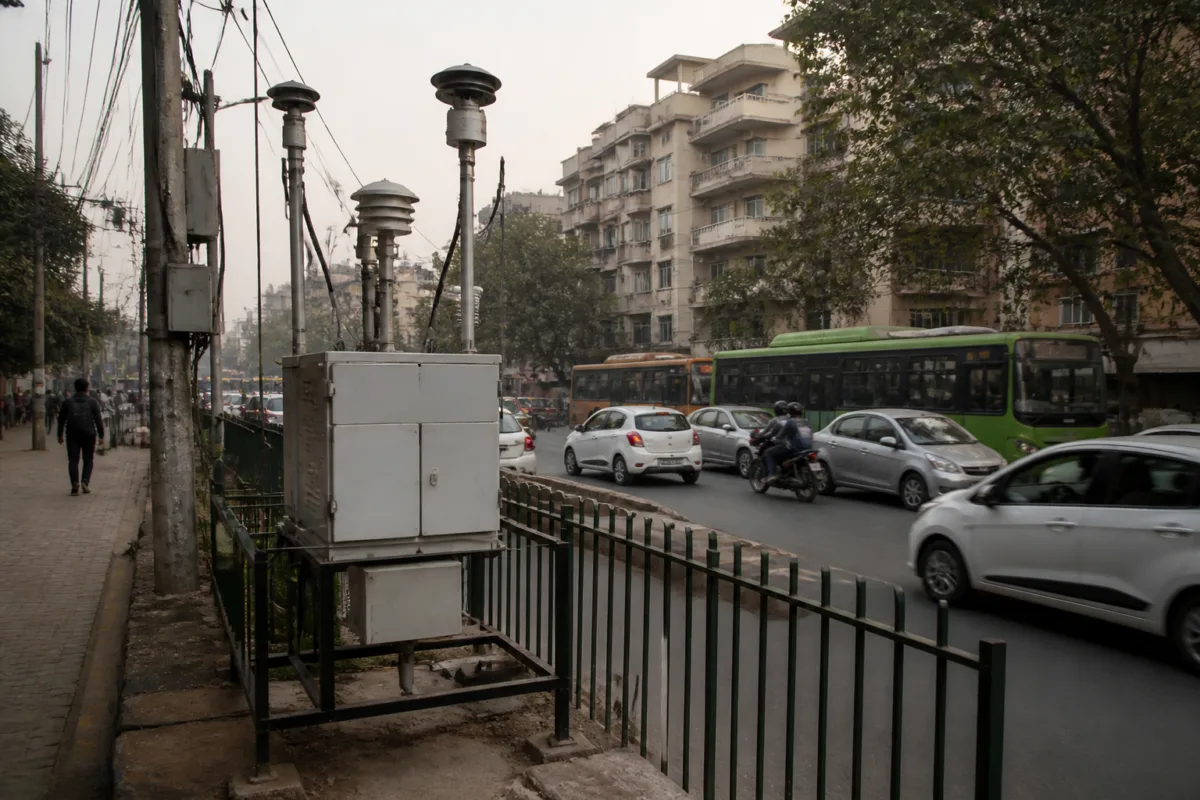
The performance on continuous ambient air-quality monitoring stations was also uneven. Delhi installed 19 CAAQMS units and met its stated target. Haryana, which had a target of 23 stations, had not installed any by October 31, according to the report card. These stations are important for tracking changes in pollution levels and supporting evidence-based responses, although the source report does not provide further details on station locations or the underlying monitoring methodology.
Parking infrastructure recorded one of the widest gaps between planned and completed capacity. Delhi had completed 15 of its target of 266 parking sites. Haryana had built nine of 79, while Rajasthan had completed four of 19. Uttar Pradesh was the strongest performer in this category, with 21 of its 24 targeted sites completed.
The report card also assessed progress in expanding bus fleets. Delhi achieved 71% of its target, followed by Uttar Pradesh at 44%. Haryana achieved 8%, while Rajasthan recorded no progress against its stated target. The figures indicate that progress in public transport capacity was not consistent across the assessed jurisdictions.
Municipal solid-waste treatment capacity was another area of concern. Delhi, Haryana, Uttar Pradesh and Rajasthan were all described as having unsatisfactory performance. Delhi was placed at the bottom of the list, with no increase in capacity against a target of adding treatment capacity for 650 tonnes of municipal solid waste per day.
All four jurisdictions also failed to build any green cremation facilities during the period covered by the assessment. The targets were 49 facilities for Delhi, 196 for Haryana, 53 for Rajasthan and 123 for Uttar Pradesh. Green cremation facilities are included in the action plans as an environmental measure, but the source report does not specify the technologies or standards used to classify a facility in this category.
The findings underline that pollution-control performance depends on more than emergency restrictions during severe pollution episodes. It also relies on routine urban infrastructure: functioning waste-treatment capacity, accessible parking, public transport expansion and a sufficiently distributed monitoring network. The report card shows that jurisdictions leading in one category may lag in another. Uttar Pradesh performed strongly on parking and crop-residue machinery, while Delhi led in monitoring stations, bus expansion and remained weak on waste-treatment capacity and parking delivery.
The assessment is not the final ranking for the year. The report states that Delhi and the neighbouring states have the remaining period of 2026 to accelerate implementation, with the final report card scheduled for January 2027. Until then, the reported figures provide an interim view of whether the pollution-action plans are translating into completed infrastructure and operational capacity.

