


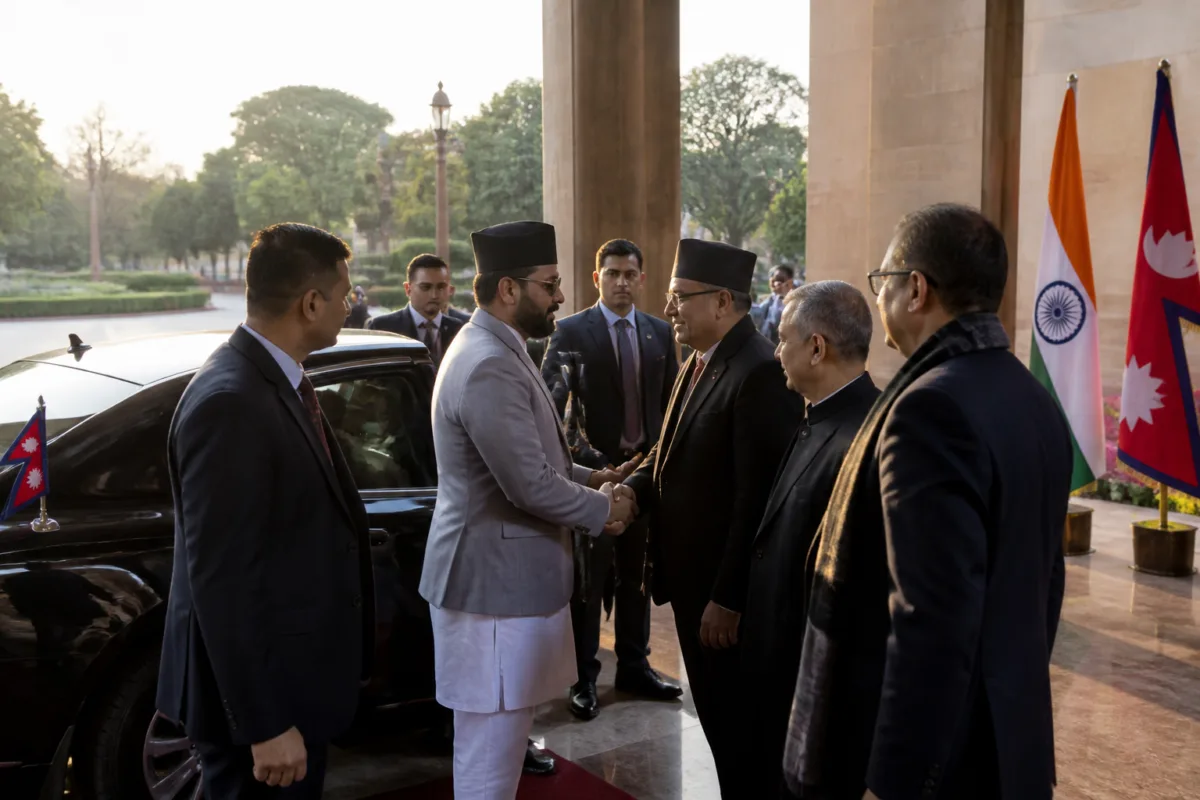
India-Nepal infrastructure cooperation is expected to feature prominently when Prime Minister Narendra Modi meets his Nepalese counterpart Balendra Shah in New Delhi on Monday, with energy, hydropower, railways and cross-border connectivity identified as key areas for discussion.
Shah arrived in the national capital on Sunday for his first state visit to India since taking office in March. He was received by Jitin Prasada, Minister of State for Commerce and Industry. The meeting is expected to provide political direction for bilateral cooperation in the coming years, PTI reported, citing people familiar with the matter.
The two prime ministers are also expected to virtually inaugurate several projects in Nepal after their talks. According to the report, the countries may conclude and exchange bilateral documents covering a range of sectors, although the specific projects and commitments were not detailed.
Transport connectivity is among the proposed areas of cooperation. India and Nepal are discussing possibilities including the Raxaul-Kathmandu railway link, which could support future passenger and freight movement between the two countries. A new passenger train service between Ayodhya and Janakpur Dham is also expected to commence, connecting two important religious and cultural centres.
Energy cooperation is another significant part of the relationship. Nepal generated approximately 1,800 crore Nepalese rupees in net electricity-export revenue from India in 2025-26, according to the report. The countries also have a long-term power-supply arrangement that supports Nepal’s energy requirements and forms part of their broader development partnership.
The proposed infrastructure agenda is linked to wider economic and logistical dependence. Nepal, a landlocked country, relies heavily on India for the movement of goods and services and accesses the sea through Indian routes. India is Nepal’s largest trade, transit and investment partner, while Nepal has duty-free access to the Indian market.
India receives about 80 per cent of Nepal’s goods exports and accounts for almost one-third of the foreign direct investment received by Nepal, PTI reported. Both sides are expected to explore ways to expand economic engagement alongside cooperation on infrastructure, technology adoption, natural-disaster response and climate-related challenges.
The visit follows tensions in May over Shah’s remarks that China and the United Kingdom should be involved in addressing the longstanding India-Nepal border dispute. New Delhi rejected third-party involvement and said the issue should be handled through the established bilateral mechanism. The border disagreement involves Lipulekh, Limpiyadhura and Kalapani.
The infrastructure-related announcements expected after Monday’s talks will indicate whether the visit produces new implementation commitments or mainly restates existing areas of cooperation.

