


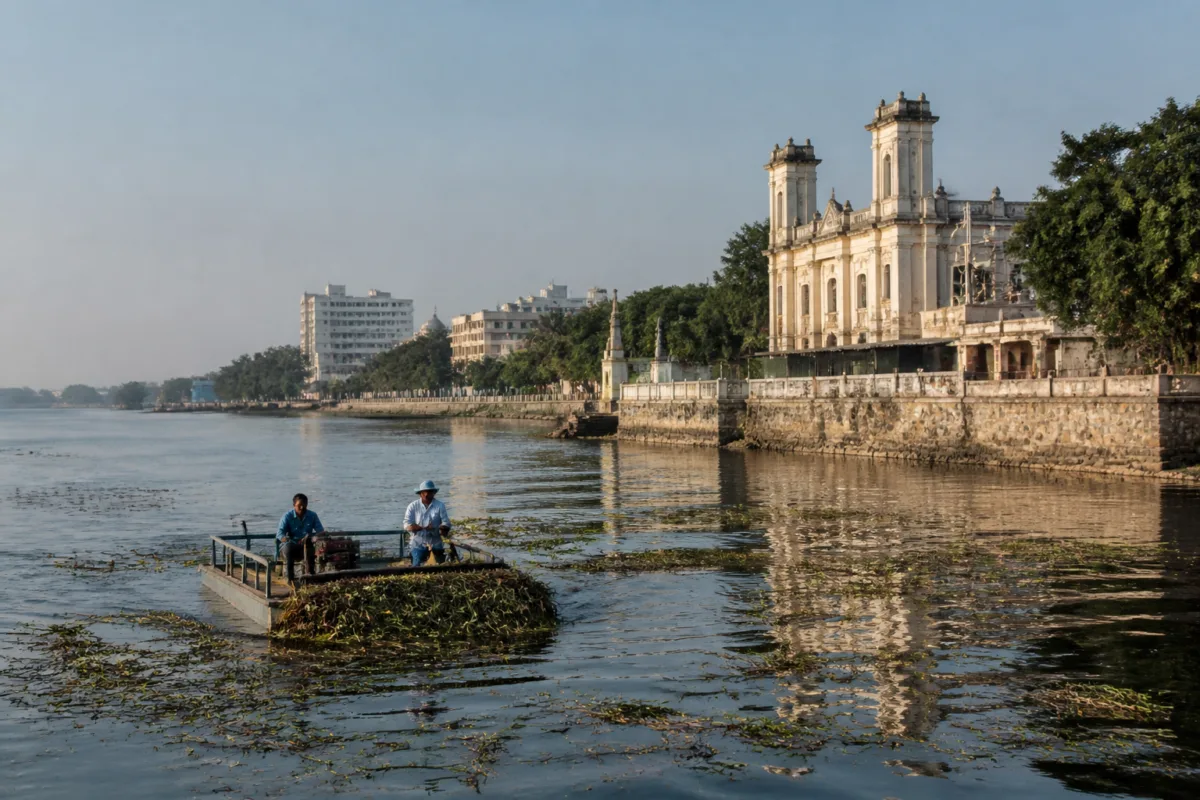
Hyderabad’s Hussain Sagar lake was already facing aquatic overgrowth and mosquito-breeding concerns in 1940, archival records show, prompting the Nizam government to combine mechanical lake maintenance with public-health measures.
A memo issued in April that year warned of rapidly spreading aquatic growth. After inspecting the lake near the power house, the Public Works Department identified creeping lotus moving from cooling ponds towards the Bulkapur channel inlet and the power house condenser inlet. The archival account is held by the Telangana State Archives and Research Institute.
The department found that manually removing the creepers was costly and provided relief for only about a fortnight. Armstead, a mint master who had earlier dealt with similar growth in the power house cooling ponds, suggested injecting super-heated steam into the plants’ roots. Officials considered the proposal expensive and questioned its effectiveness because some roots were embedded as deep as 20 feet underwater.
The task was then assigned to S.K. Iyer, the State Mechanical Engineer, who designed an underwater cutter. The machine was described as efficient and inexpensive, clearing nearly 60 per cent of the growth along the foreshore in less than two weeks.
Following the trial, the department proposed manufacturing eight rafts fitted with cutters, four shears and eight plain rafts, along with one punt. The estimated cost was Rs 2,650. A further Rs 1,260 was proposed for weeding and cutting maintenance over two years, including a monthly expenditure of Rs 50. The monthly provision covered wages for three workers, cutter and punt repairs, and miscellaneous and unforeseen work.
The records indicate that the intervention was not a one-time clearance exercise. It took nearly two years to cut fresh shoots that appeared periodically, underlining the recurring maintenance burden created by aquatic growth in an urban lake.
Public health was another concern. The Nizam government was dealing with a malaria menace, and the lake had become a breeding ground for malaria mosquitoes. The Director of Medical and Public Health sought 75 workers for three months to clear thick overgrowth along the lake edges. The director also requested 20 permanent workers to oil the edges and prevent mosquito breeding.
The 1940 episode places lake restoration within a broader urban-governance framework. Hussain Sagar’s problems were treated not only as a water-body issue but also as a matter involving power-house operations, maintenance budgets, labour deployment and disease prevention. The archival record also shows that mechanical solutions were assessed alongside their operating cost and the likelihood of regrowth.
The account does not by itself establish the present condition of Hussain Sagar or quantify current pollution. It does, however, show that managing the lake’s ecological and public-health risks has long required sustained maintenance rather than a single clearance operation.

