


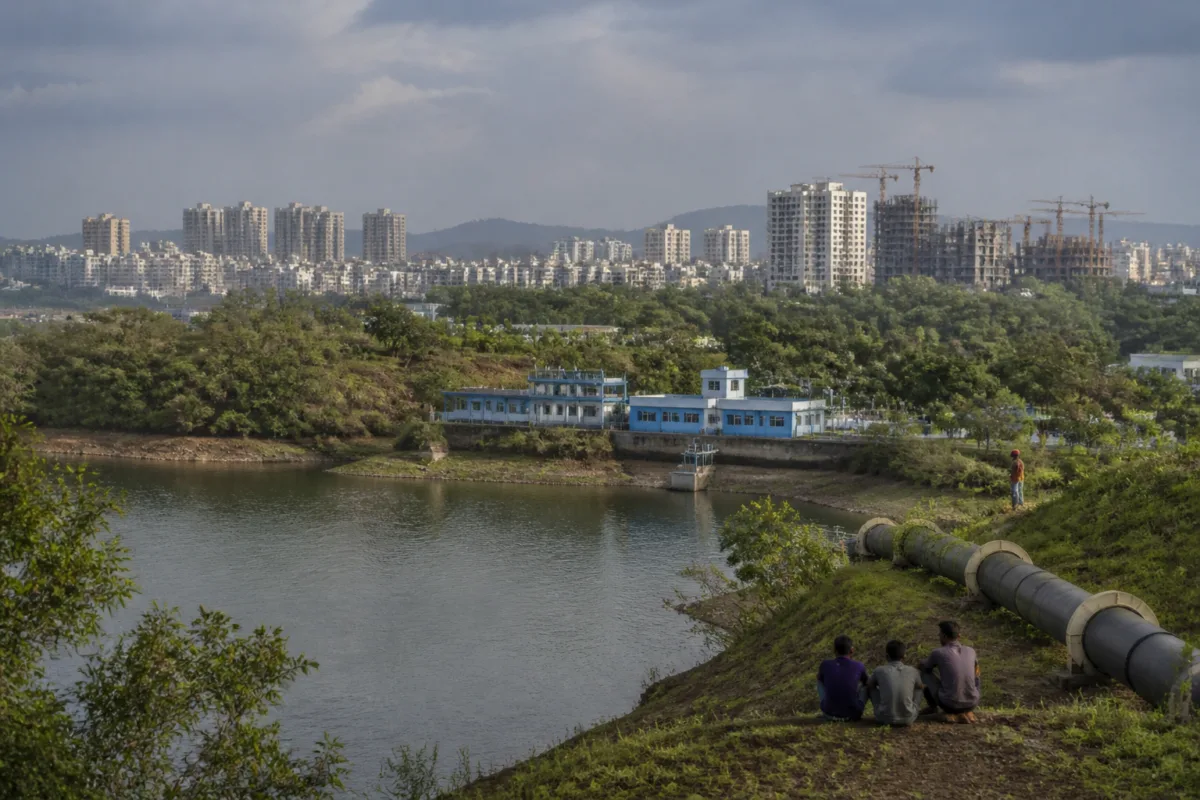
Maharashtra Chief Minister Devendra Fadnavis has directed officials to urgently study whether a separate dam can be developed to meet Pune city and the wider Pune Metropolitan Region’s long-term drinking-water needs, according to a report by Civic Mirror.
The direction was issued at a high-level meeting in Mumbai chaired by Fadnavis. The meeting reviewed water planning and management for the Mumbai and Pune metropolitan regions. It did not, according to the report, constitute final approval for construction of a new dam. Officials have been asked to examine feasibility and submit a proposal.
The proposal comes as the Pune region faces a reported gap between currently reserved water and demand. PMRDA Metropolitan Commissioner Abhijit Chaudhary presented planning figures stating that the region has a population of about 1.80 crore and could reach 4.12 crore by 2047. The presentation put current water reservations at 36.90 TMC against demand of 41.65 TMC. By 2047, total demand was projected at about 100 TMC, described in the report as equivalent to 7,816 million litres per day.
The figures and projections were presented by PMRDA at the meeting and should be read as planning estimates rather than independently verified demographic or hydrological assessments. The report does not identify the capacity, cost, environmental footprint or construction timeline of the proposed dam.
The district administration has reportedly identified a location in Velha taluka as a preliminary option after searching for a site for about six months. Following the chief minister’s directive, the administration is expected to begin a survey of the location. A site preference is not the same as a final site selection, and any project would still require technical studies, land acquisition, rehabilitation and forest and environmental clearances.
Fadnavis also directed agencies to prepare integrated, time-bound and financially viable water plans based on projected population, urbanisation and industrial growth. The instructions cover Pune’s needs through 2047 and call for measures beyond new storage projects, including treated wastewater reuse, leakage control, rainwater harvesting and alternative water sources.
The meeting discussed using tertiary-treated wastewater for large non-potable consumers such as industries, power plants and data centres. Water receiving secondary treatment could be used for irrigation, according to the report, reducing pressure on drinking-water sources. The state government also wants a proposal for a wholly owned Maharashtra Industrial Development Corporation subsidiary to manage water supply for industries and data centres, including the distribution of treated water from municipal sewage-treatment plants.
Municipalities and councils were directed to undertake water audits covering inflows, distribution and billed consumption. The chief minister also called for greater use of smart meters for commercial and industrial users and for a phased reduction in non-revenue water. The measures include repairing ageing pipelines and expanding 24-hour water-supply schemes. Fadnavis said these interventions could save about 350 million litres per day, although the report does not provide the methodology behind that estimate.
The meeting also considered a possible inter-basin transfer from the Savitri river basin in the Konkan region towards the Kukadi, Bhima, Indrayani, Mula-Mutha and Nira basins. Officials were instructed to prepare a preliminary project report for a Konkan-to-Bhima basin-linking option.
For Hinjewadi, Maan, Marunji and seven surrounding villages, the administration will examine the technical and financial feasibility of bringing about 8 TMC from the Mulshi, or Tata, dam to the Khadakwasla area through a pipeline. The report presents this as a water-security option for the fast-growing information-technology corridor and nearby settlements, not as an approved water transfer.
The range of options discussed shows that Pune’s water planning is moving on several tracks: additional storage, reuse of treated wastewater, reduction of distribution losses, industrial demand management, groundwater recharge and possible river-basin transfers. Each carries different institutional, financial, environmental and land-related requirements. For residents, the immediate outcome is therefore an expanded planning exercise rather than a confirmed new dam. The next concrete steps are the proposed site survey, feasibility assessments and submission of project proposals.

