


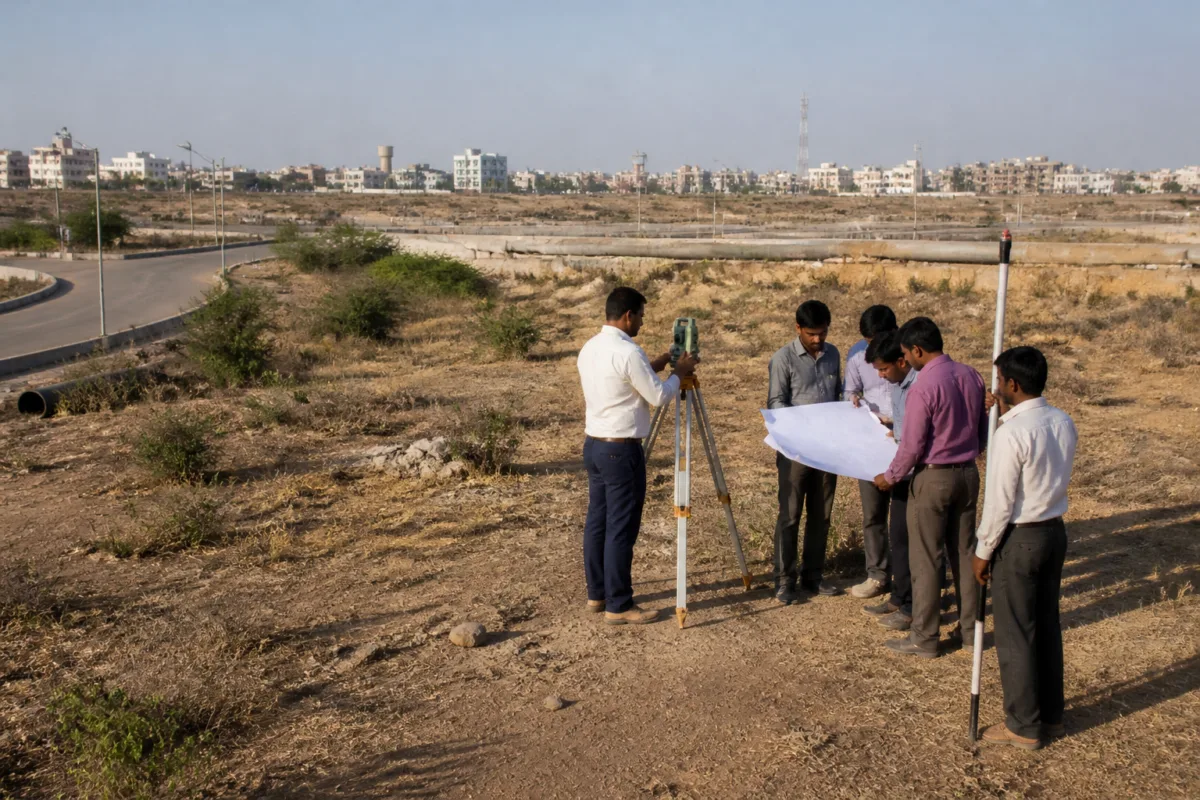
Gujarat municipal land allocation rules have been relaxed for nine newly formed municipal corporations that require land for essential civic infrastructure but face funding constraints, according to a report by Nav Gujarat Samay. The state government has decided to make government wasteland and gauchar land available under a concessional framework rather than requiring the corporations to bear the full cost of land acquisition.
The nine municipal corporations are Navsari, Vapi, Anand, Nadiad, Mehsana, Surendranagar, Morbi, Porbandar and Gandhidham. The report says the corporations cover large areas and serve sizeable populations, creating an immediate requirement for offices and public facilities. Their recent formation and limited funds, it adds, have affected the ability to undertake public-interest and development works within scheduled timelines.
Under the reported decision of the Revenue Department, land for mandatory municipal services can be allotted at 25% of its market value. Land for optional services can be allotted at 50% of market value. The relaxation has been provided for five years under the earlier revenue rules, according to the report. The framework also allows advance possession of the land.
The land will be transferred through a classification change under the applicable land-revenue rules and handed over to the Urban Development and Urban Housing Department. A district collector can transfer up to one hectare of government land for essential requirements. Requests for more than one hectare, or requests involving gauchar land, will require a proposal to be sent to the state government for approval.
The reported procedure places conditions on the use of gauchar land. Where such land is allotted, an equivalent area of other government wasteland must be identified under the gauchar head in accordance with the state’s gauchar policy before a proposal is made for allocation.
Municipal commissioners will have to apply to the concerned collector through the iORA portal for land for a specified purpose. The report does not identify individual parcels, project locations or the estimated value of the land that may be allotted to any of the nine corporations.
The permitted uses cover a wide range of municipal and public-service infrastructure. They include municipal corporation offices, fire stations, sewage treatment plants, water treatment plants, underground drainage systems, pumping stations, water-supply projects, solid- and liquid-waste management plants, storm-water drainage, anganwadis, town halls, community halls and convention centres.
The policy also retains government control over the land. If land transferred through classification change remains unused and the government later requires it for another public purpose, it can be taken back, the report says. Ownership will continue to remain with the government. The land will continue to be recorded as state property in Village Form 7, while the Urban Development Department’s name will be shown in the relevant additional-rights entry.
For the new corporations, the framework could reduce the initial land-cost burden associated with establishing basic administrative and civic facilities. It also links access to subsidised land with a defined public purpose, approval thresholds and a possible reversion if the land is not used. However, the reported decision does not provide project-wise implementation schedules, funding commitments for construction or details of how demand for land will be prioritised among competing municipal services.
The immediate administrative step is for municipal commissioners to submit purpose-specific applications to the respective collectors. Larger land requirements and proposals involving gauchar land will then follow the additional state-approval process described in the Revenue Department’s reported decision.

