


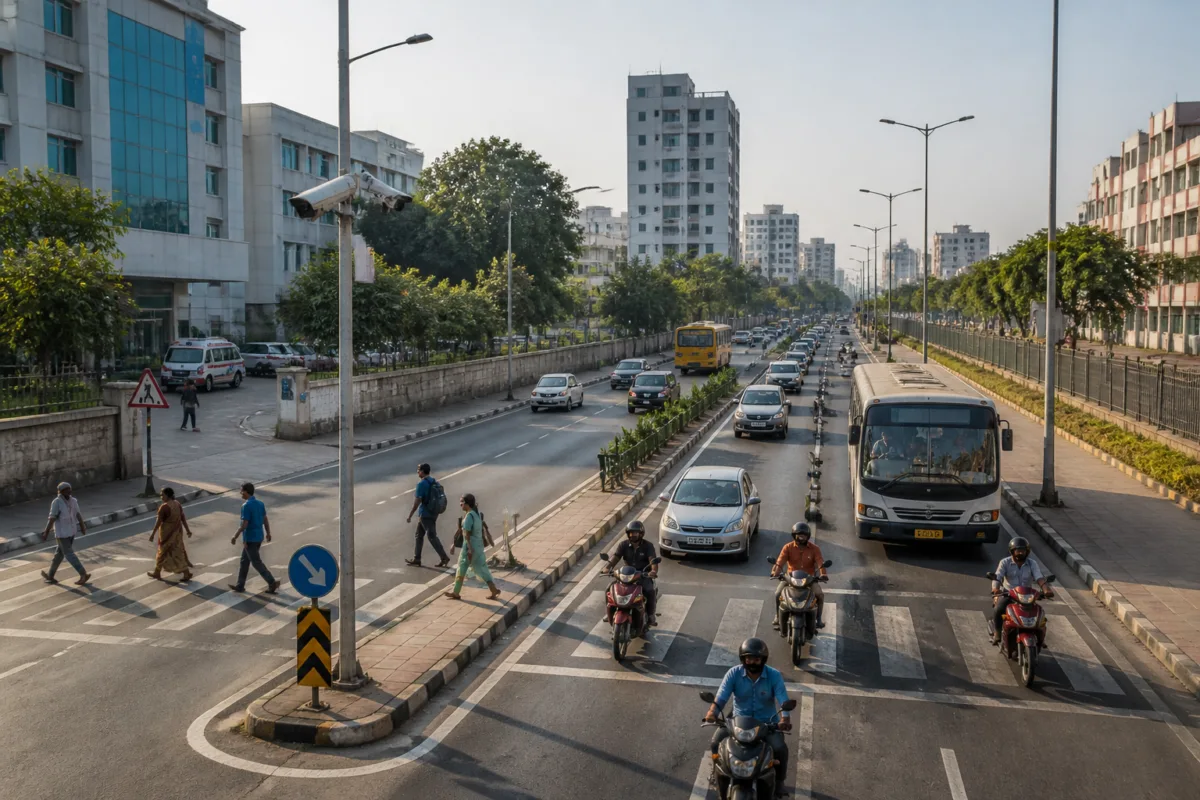
India’s ambition to move towards zero road accidents will depend on more than stricter penalties or public awareness, according to experts at the Indian Roads Congress (IRC). They said road design, vehicle safety, speed management, automated enforcement and post-crash care must be addressed together if the country is to reduce fatalities.
The discussion followed Union minister for road transport and highways Nitin Gadkari’s call for a national commitment to achieving zero road accidents. Experts said the objective would remain difficult to achieve unless safety is built into the planning and operation of roads, rather than treated as a separate enforcement issue after construction.
Bhargab Maitra, a professor in the civil engineering department at IIT-Kharagpur, identified road engineering as one of the main reasons India has not demonstrated a declining trend in crash fatalities. He said road projects often focus on the carriageway itself without adequately considering the surrounding context, including schools, hospitals and the needs of people crossing the road.
A six-lane highway, he noted, cannot be considered safe if pedestrians have no practical or protected way to cross it. This places road safety within the scope of street design and land-use planning, rather than limiting it to driver behaviour. Safe crossings, appropriate access arrangements and design responses around sensitive locations would need to be considered while planning and building roads.
Maitra also pointed to poor-quality vehicles with low safety ratings, unsafe road-user behaviour, limited awareness and inadequate post-crash critical care as additional factors. He argued that speed restrictions should be based on the conditions and risks along each road stretch. Until other safety measures improve, he said, lower speed limits may be the most immediate intervention available. He added that speed limits could be reviewed as road and vehicle safety conditions improve.
The experts also called for greater use of technology to identify violations, penalise repeat offenders and communicate a consistent safety message. Samrat Valani, an international infrastructure executive and strategic adviser, cited Pennsylvania’s use of automated work-zone speed cameras as an example. According to Valani, the system issues a warning for a first offence, followed by fines of $75 and $150 for subsequent offences. He said peak-season speeding in enforced zones had fallen by 43% since 2020, excessive speeding by 60%, while annual crashes declined from about 1,800 to 1,250.
Those figures were presented by Valani during the IRC discussion and are not independently substantiated in the report. Their broader relevance lies in the proposed enforcement model: technology can allow authorities to monitor high-risk zones continuously and apply penalties without relying solely on police presence.
Valani also referred to Vietnam’s national child helmet action plan, which he said increased helmet use among children from 36% to 69% within 13 months before settling at around 57%. The example illustrates the importance of sustained, focused communication, particularly when a single road-safety issue affects a clearly identified group.
Data could support a similar approach in Indian cities. Valani said Washington uses artificial intelligence to identify near-misses from existing traffic-camera footage and test possible safety interventions using the same recordings. Such systems could help authorities examine dangerous locations before a serious crash occurs, provided the data is collected responsibly and translated into practical changes on the ground.
The recommendations place responsibility across several institutions. Road agencies would need to incorporate safety into design and construction. Transport authorities would have to set and periodically review speed limits. Vehicle regulators and manufacturers would need to improve the availability of safer vehicles. Enforcement agencies would need reliable automated systems, while health authorities would remain responsible for rapid post-crash care.
The central message from the IRC discussion is that a zero-crash objective cannot be delivered through a single intervention. Safer roads require engineering that recognises pedestrians and surrounding land uses, vehicles with stronger crash protection, speed controls matched to local conditions, consistent enforcement and better use of safety data. Without that combination, the national target risks remaining an aspiration rather than an operational road-safety programme.

