


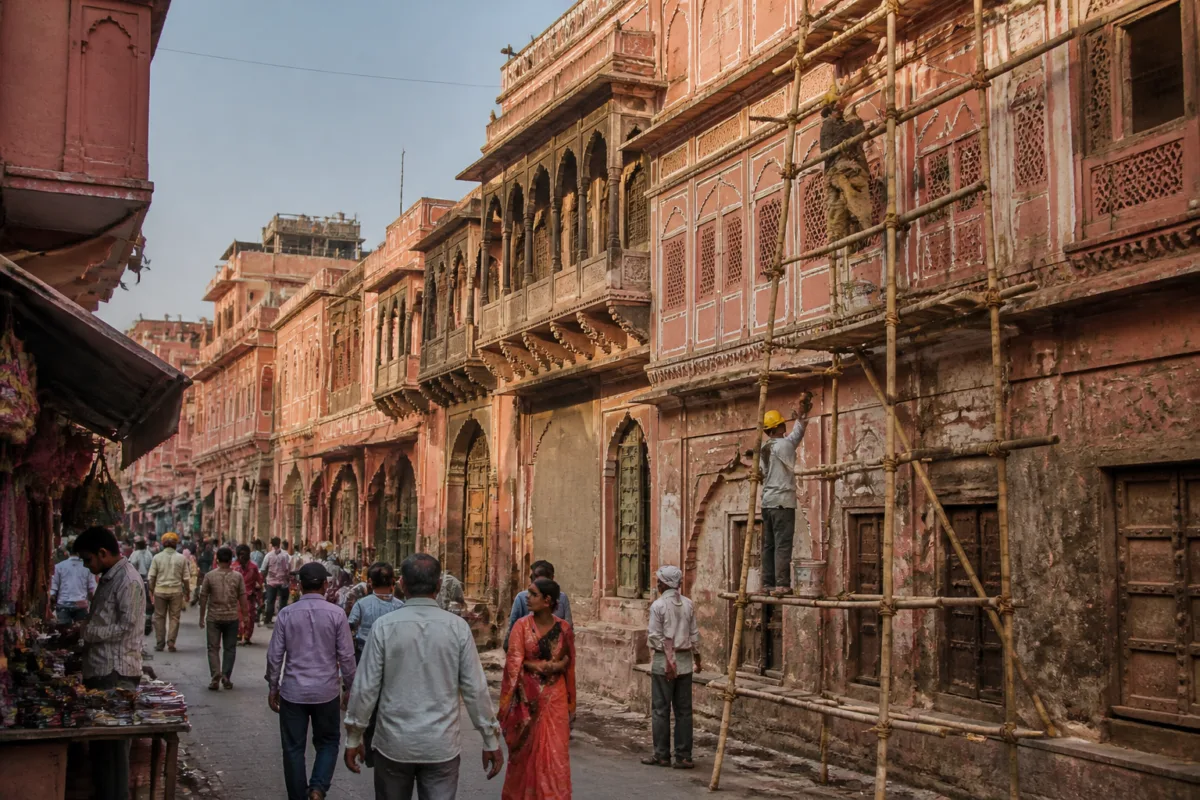
Jaipur’s state government has reconstituted its State Heritage Committee and Technical Heritage Committee ahead of a December 1 UNESCO review of conservation measures in the Walled City, a move prompted by concerns over deteriorating old houses, alterations to historic buildings and unauthorised construction.
Jaipur was inscribed as a UNESCO World Heritage City in 2019. According to the report, UNESCO has sought details of measures taken to safeguard the historic area. If it is not satisfied with the state’s response, it could send a Reactive Monitoring Mission to assess the condition of the site.
The restructuring follows the merger of Jaipur Greater and Jaipur Heritage municipal corporations. The state government said the revised committees would strengthen heritage conservation by separating policy and administrative oversight from technical supervision.
The State Heritage Committee, headed by Chief Secretary V. Srinivas, will deal with policy and administrative matters. Its membership will include the concerned MLA, the Jaipur Municipal Corporation mayor, the principal secretaries of local self-government, art and culture, and tourism, the police commissioner, and the Archaeological Survey of India’s joint director general for World Heritage.
Representatives of residents’ welfare associations and trade bodies from the Walled City, along with historians and heritage conservation experts, will also be included. Their participation is intended to bring local concerns and specialist inputs into conservation decisions.
The Technical Heritage Committee, headed by Local Self-Government Secretary Ravi Jain, will oversee technical aspects of conservation. It will include the tourism department director-commissioner, the municipal corporation commissioner, the director of local bodies, the chief town planner, the municipal corporation chief engineer and officials from the archaeology department.
Jain said the committees had been restructured after the municipal corporation merger. He identified the poor condition of old houses, changes to historic buildings and unauthorised construction as key challenges facing the Walled City.
The revised arrangement places municipal, state, police, archaeology and tourism representatives within a common conservation framework, while also creating a formal place for residents, traders and heritage specialists. The structure therefore addresses both administrative coordination and the technical review of changes within the historic urban area.
However, the report records the reconstitution of the committees rather than any completed conservation work or enforcement outcome. The immediate significance of the move is that the state has established a revised institutional mechanism to present its conservation measures before UNESCO’s review. The conditions identified by the government—ageing buildings, unauthorised construction and alterations to historic structures—remain the central challenges for the Walled City’s protection.

