


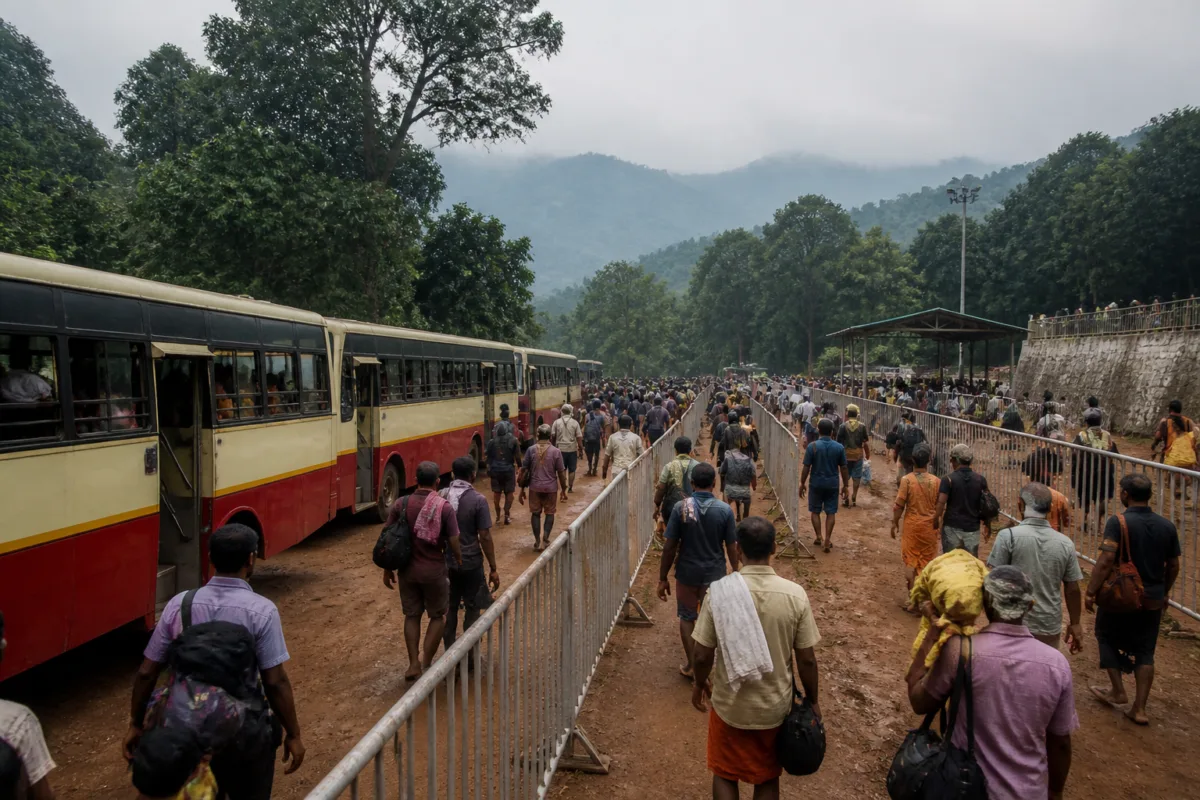
Sabarimala’s Mandalam season has opened with a sharp fall in pilgrim arrivals, highlighting how tighter virtual-queue and spot-booking rules are affecting access to the hill shrine and the public transport network serving it.
Official figures cited by the Times of India show that footfall at Sannidhanam during the first three days was about 1.5 lakh lower than in the corresponding period last year. On November 16, 26,131 pilgrims had darshan, followed by 35,073 on November 17 and 40,037 on November 18. The figures rose to 46,603 on November 19, while 46,513 pilgrims had arrived by 5pm on Friday.
In the corresponding first three days last year, the numbers were 53,278, 98,915 and 1,12,056 respectively. The lower arrivals have eased the immediate pressure on darshan and movement at Sannidhanam, but the figures have also raised questions about whether the booking system is preventing pilgrims from reaching the shrine.
The report said devotees may be postponing their journeys after securing virtual-queue slots or avoiding the pilgrimage because of stricter access restrictions. Pilgrims have also raised concerns about the absence of a spot-booking centre at Pamba. Those without bookings are reportedly not being allowed to travel from Nilackal to Pamba, and KSRTC staff have been directed to drop such passengers at Nilackal.
The directive was intended to ensure that pilgrims had advance bookings before proceeding towards the shrine. However, the report said some devotees had to return without obtaining a slot, creating an access problem for people who reach the transport interchange without a confirmed booking.
The operating limits have also changed from last year. Daily darshan permission was capped at 90,000 pilgrims last year, including 70,000 virtual-queue bookings and 20,000 spot bookings. This year, the daily cap is 80,000, with 66,000 virtual-queue slots. Spot-booking quotas were reduced as part of efforts to control crowds, a decision officials believe has contributed to the decline in arrivals.
The Travancore Devaswom Board has responded to the lower footfall by increasing virtual-queue bookings by 5,000. Spot-booking quotas are also to be raised on Saturday and Sunday, according to the report. The current virtual-queue allocation includes 60,000 slots through the Nilackal-Pamba Saranapatha and 6,000 through forest paths. The Erumeli-Azhutha and Vandiperiyar-Sathram routes have 3,000 slots each.
Spot booking currently includes 10,000 slots at Nilackal and 2,000 through the Erumeli and Sathram forest paths. A spot-booking centre has been permitted at Chengannur, although its quota had not been decided at the time of the report.
The numbers indicate that Sabarimala’s access system is not only a temple-management issue. It also determines how pilgrims use the transport chain from arrival points such as Chengannur, Nilackal, Pamba and Erumeli. When passengers without confirmed bookings are stopped at Nilackal, the booking rule directly affects bus operations, onward movement and the ability of visitors to complete their journeys.
The Sabarimala Karma Samithi has demanded an investigation into alleged discrepancies in the virtual-queue system. It said the portal shows daily slots as fully booked even though the number of devotees reaching Sannidhanam is substantially lower. The organisation claimed that between 20,000 and 35,000 booked pilgrims fail to arrive each day, and cited one day when more than 58,000 bookings were recorded but fewer than 40,000 devotees reached the shrine.
Those claims have not been independently established in the report. The organisation has asked the police, the Devaswom Board and technical authorities to examine whether tour operators or agencies are block-booking slots, whether the system is being misused, and why genuine devotees are unable to obtain access.
The immediate administrative response has been to increase available bookings and expand spot access at selected locations. The unresolved issue is whether the lower arrivals mainly reflect reduced demand, pilgrims postponing travel, unused bookings or difficulties within the booking system. A clearer reconciliation of bookings, cancellations, no-shows and actual arrivals would help determine whether the revised quotas are improving access while maintaining crowd control.

