


Bengaluru’s latest technology summit ended with venture capital firms pledging about Rs 1,050 crore for deeptech startups, alongside state-backed initiatives covering drone testing, artificial intelligence skills, digital inclusion and technology applications relevant to urban planning.
The commitments were announced during the 29th Bengaluru Tech Summit, held from November 17 to 19 at the Bengaluru International Exhibition Centre. According to officials cited by PTI, 24 venture capital firms made the investment pledges at the Future Makers Conclave. The figure is higher than the Rs 400 crore announced for AI and deeptech startups at the same platform last year.
The announcements are pledges, not evidence that the full amount has already been invested. Their significance for Bengaluru’s urban economy will depend on whether the proposed partnerships and facilities move from agreements to operating programmes, jobs, research output and deployable products.
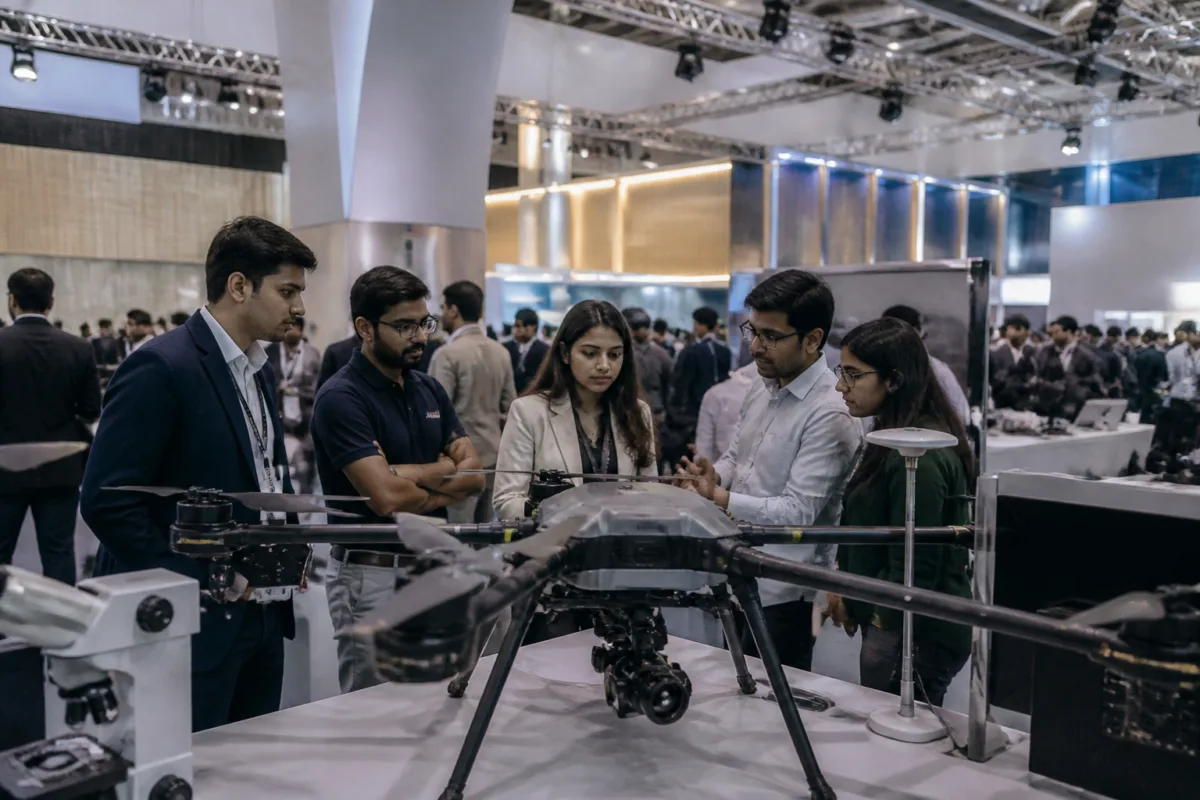
One of the clearest links to the built environment is a drone testing and certification facility being developed at Jeedarahalli village in Chikkaballapur district. The facility is intended to support testing and evaluation of drones used in agriculture, defence, logistics, maritime technology and urban planning. The source report did not provide an operational date, investment amount or details of the agency responsible for running the facility.
Drone systems can be relevant to planning and infrastructure when they are used for surveying, mapping, inspection and logistics. However, the summit announcement alone does not establish how the proposed facility will be integrated with city agencies, planning approvals or public infrastructure programmes.
The Karnataka Innovation and Technology Society also signed an agreement with SolAres to promote digital inclusion and the reuse of electronic equipment. Under the arrangement, unused corporate laptops are to be refurbished and distributed to government schools, gram panchayats and government offices. If implemented, the programme would extend access to computing equipment across urban and rural public institutions, although the report did not specify the number of devices or the distribution schedule.
The summit also announced an AI skills initiative for 63,200 students and engineers. This expands the state’s stated focus on building an AI talent pool, while a report released at the event said Karnataka hosts 1,088 global capability centres, representing 51 per cent of India’s 2,117 such centres. The report further said these centres employ 1.11 lakh AI and machine learning professionals.
Those figures describe Karnataka’s existing technology ecosystem rather than guaranteed outcomes from the new announcements. The report recommended prioritising global AI leadership, skills development and commercialisation of research by 2030. It also said 66 per cent of surveyed global capability centres had reached advanced stages of AI adoption.
Other agreements covered biotechnology, cybersecurity, startup market access and international technology cooperation. A Letter of Intent with Amagi proposed a government-backed Centre of Excellence in Sports Technology in Bengaluru, with a focus on sports analytics, biomechanics, athlete performance, injury prevention and rehabilitation. Its governance and operating framework are to be finalised through later agreements.
The summit brought together representatives from 64 countries and featured 162 sessions, 24 roundtable discussions and 704 speakers. It recorded 11,257 conference delegates and 58,872 registered industry visitors, with total attendance reported at 70,129 when other participants were included but students were excluded.
For Bengaluru and Karnataka, the central implementation question is whether these announcements create durable public value beyond the summit. That will require clear timelines, responsible institutions, disclosed funding arrangements and measurable results for research, skills, digital access and urban technology deployment.

