


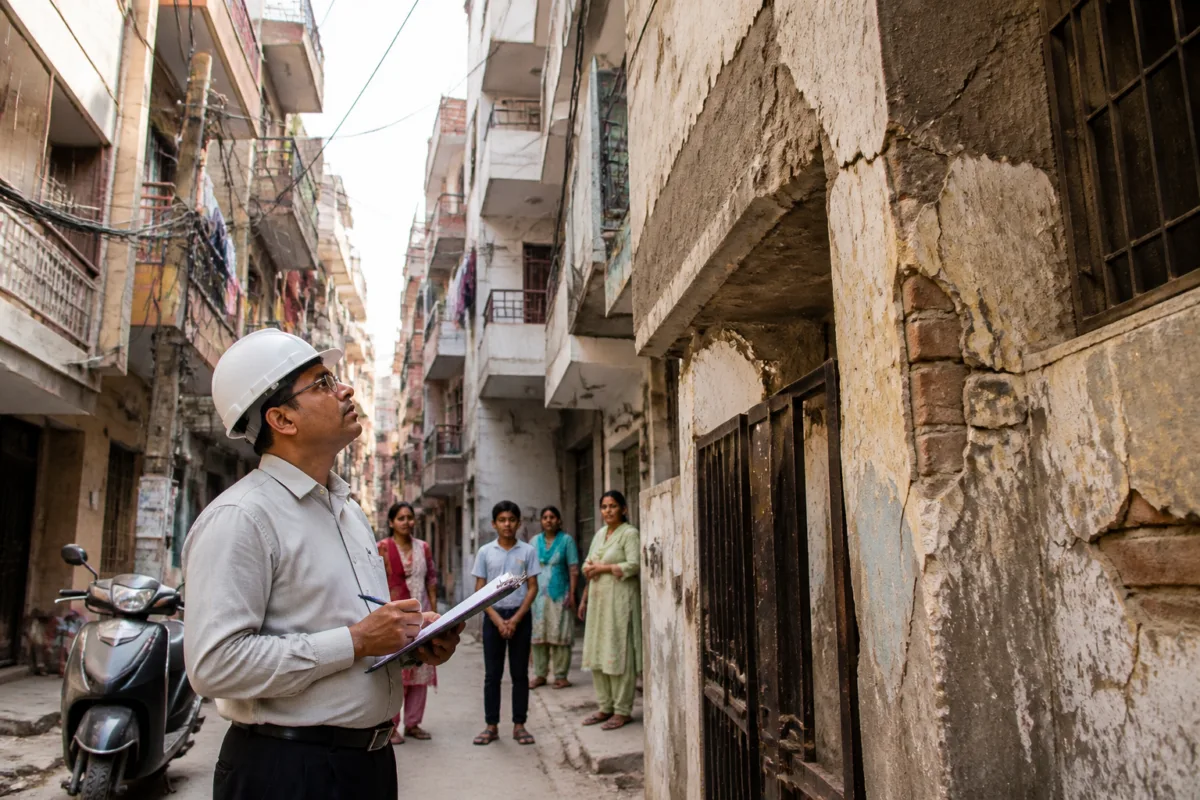
The Centre is preparing amendments to Delhi’s Unified Building Bye-Laws (UBBL) that could require owners of older buildings to submit structural-safety certificates, after repeated collapses exposed gaps in the city’s system for identifying dangerous structures.
The proposal was discussed at a recent meeting convened by the Union Ministry of Housing and Urban Affairs (MoHUA), attended by officials from the Municipal Corporation of Delhi (MCD) and the Delhi Development Authority (DDA). Officials said a new chapter or provision could be added to the UBBL, with requirements varying according to a building’s age and condition.
MCD commissioner Sanjeev Khirwar told a Standing Committee meeting that owners of buildings around 15 years old and those above 50 may have to furnish separate details. Officials are also examining parameters other than age that could trigger mandatory certification. The provisions are expected to be framed using practices from India, with their introduction discussed within two months, according to the report.
The proposed framework would shift part of the responsibility for demonstrating structural safety to building owners. Khirwar said authorities, particularly the MCD, are held responsible after every collapse and that placing obligations on owners could help address the problem. He also said structural safety could not be treated as a one-time exercise and that a mechanism involving owners and structural engineers would be needed for regular assessments.
The proposal comes as the MCD acknowledges that it does not have enough manpower and technical expertise to conduct comprehensive safety surveys. Delhi has nearly 40 lakh houses, according to the commissioner, making a property-by-property assessment difficult with the existing workforce. The MCD currently has 660 empanelled structural engineers.
Officials discussed Maharashtra’s model, under which buildings aged 30 years or more must undergo structural audits. Delhi’s proposed system may use a different combination of age, condition and other risk indicators, although the final criteria have not been announced.
Implementation would also have to address construction quality and the city’s varied approval conditions. Khirwar raised concerns about construction on plots smaller than 105 square yards, where building plans receive automatic approval with limited paperwork. He said responsibility would need to be established, including whether the quality of construction material had been compromised.
Ownership documentation is another reported obstacle. At the meeting, DDA officials said new UBBL provisions were under preparation following notification of the Master Plan of Delhi 2047. BJP councillor Hemchand Goel said several dilapidated houses in 1,511 PM-UDAY colonies could not be repaired or reconstructed because residents lacked ownership documents.
MCD officials said the Delhi government was working to simplify the ownership process. Without ownership papers, they said, the civic body could not sanction building plans. That means a safety-certification regime could face practical limits in areas where residents cannot legally proceed with repair or reconstruction, even when structures are in poor condition.
The scale of the safety challenge is reflected in fire-department figures cited in the report. Till October 26 this year, the department had received 395 calls related to house collapses, in which 36 people died and 139 were rescued. In 2025, it received more than 500 such calls, resulting in more than 50 deaths and 170 rescues.
The MCD has also begun reporting building owners to the police and taking action against empanelled structural engineers after collapses. Officials said an engineer was debarred after the Rohini incident on July 8, while action was under way against another engineer after a building collapse in Karol Bagh. They said these cases involved buildings with sanctioned plans, while buildings outside the formal approval system required a more concrete solution.
The proposed UBBL amendment therefore faces two linked tests: whether Delhi can create a credible, recurring inspection system, and whether residents can obtain the ownership and approval documents needed to act on safety findings. The report does not provide the final draft, enforcement mechanism, certification cost or timeline for notification, leaving those details unresolved.

