


Maharashtra’s drought-affected talukas have increased to 310 after Hatkanangale and Gadhinglaj in Kolhapur district were added to the list, according to Revenue Minister Chandrashekhar Bawankule. The state government has also proposed a three-year water conservation programme worth around ₹5,000 crore covering 15,000 villages.
The package combines immediate drinking-water measures with longer-term efforts to revive groundwater and local storage. Bawankule, who heads the drought mitigation subcommittee, said surveys had been ordered to examine recommendations for adding another 13 talukas. Vikramgad, Wada, Dindori and Chiplun were also recently added to the drought list, the report said.
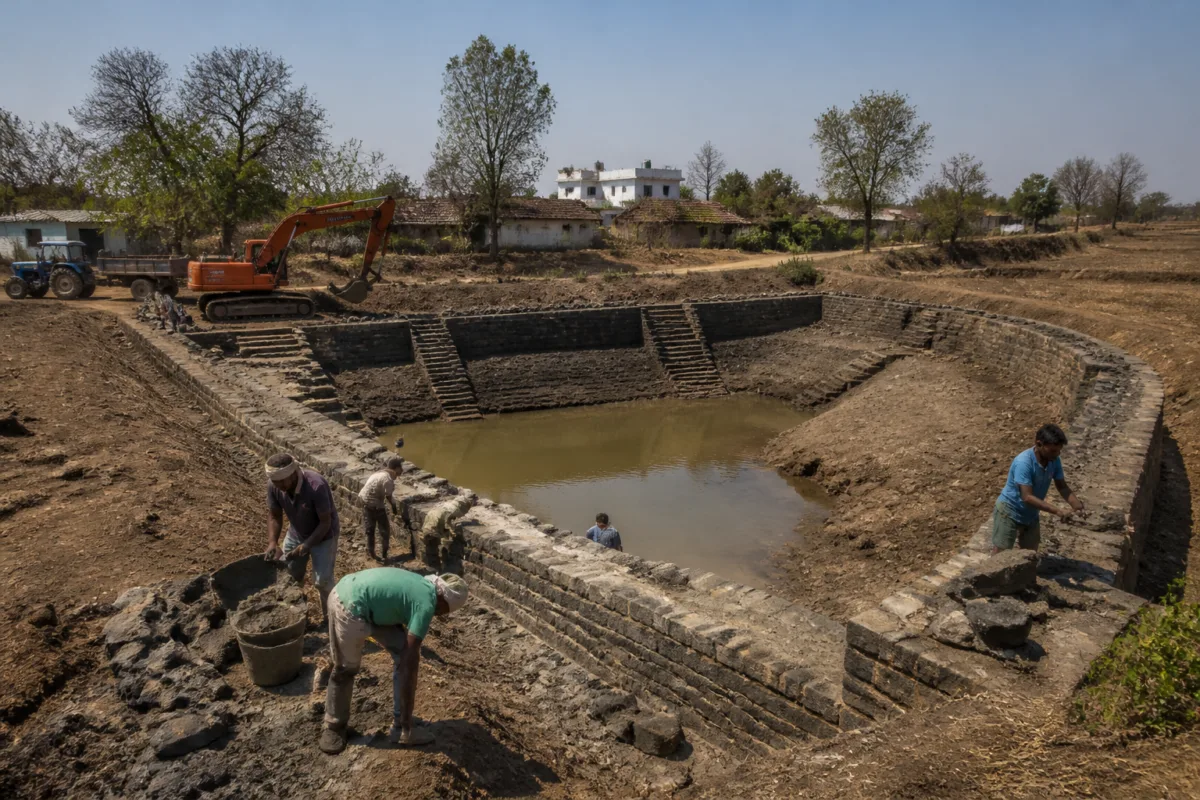
The proposed programme would focus on repairing and reviving defunct check dams, village ponds, storage tanks, irrigation reservoirs and traditional water bodies. A committee of five secretaries is expected to prepare a standard operating procedure and detailed action plan. Chief Minister Devendra Fadnavis has approved a proposal to make a provision of around ₹5,000 crore in the December budget, according to the minister.
The immediate infrastructure component involves ₹488 crore for pending rural drinking-water supply schemes. Of this amount, ₹400 crore is earmarked for schemes that are at least 75% complete but remain unfinished, while ₹88 crore is intended for projects with between 5% and 20% of work pending.
The schemes will be completed through Zilla Parishads and the Maharashtra Jeevan Pradhikaran using already approved tenders and work orders. District collectors and Zilla Parishad chief executive officers have been instructed to expedite construction and reduce dependence on water tankers.
The government also plans to address utility bottlenecks. Around 400 to 500 water-supply schemes awaiting electricity connections are to receive power through District Planning Committee funds. For schemes where electricity has been disconnected because of unpaid bills, officials have been instructed to restore supply after collecting current bills without requiring immediate payment of previous arrears.
To speed up emergency responses, Maharashtra has increased the financial powers available to district collectors and divisional commissioners. District collectors can approve temporary supplementary water-supply schemes costing up to ₹40 lakh, while divisional commissioners can approve projects costing up to ₹1 crore. For special repairs to drinking-water schemes, the corresponding limits are ₹60 lakh and ₹1 crore.
The expenditure limits for temporary arrangements to fill water tankers have also been increased to ₹1 lakh for district collectors and ₹2 lakh for divisional commissioners. Water supplied through bullock carts will be reimbursed at ₹3,000 per cart per day.
The drought response extends to construction and municipal water management. The government has decided to discourage the use of drinking water for cement road construction in drought-prone areas. Where appropriate, roads should instead be built using metal or asphalt. If treated tertiary water from sewage treatment plants is available, district collectors may decide whether it can be used for cement road construction.
Bawankule said drinking water should not be used for large cement road projects, industries in Maharashtra Industrial Development Corporation areas, power plants and gardens. Municipal corporations and councils will be asked to implement a ‘Zero Discharge’ policy, under which treated wastewater is recycled instead of being released into rivers and drains. The report cited the Koradi power project in Nagpur as an example.
A joint meeting of municipal commissioners, chief officers, mayors and elected representatives is expected to be convened with Deputy Chief Minister Eknath Shinde to discuss implementation. The effectiveness of the package will depend on whether funding, electricity connections, inter-agency coordination and wastewater reuse systems are delivered alongside the announced administrative measures.
The government has attributed the water shortage partly to the El Niño effect. Its stated approach is to achieve maximum water conservation at minimum cost by identifying neglected water bodies and restoring them across districts. For cities and expanding peri-urban areas, the proposed restrictions on potable water use in construction and the push for treated wastewater reuse could become important components of managing competing demands during periods of scarcity.

