


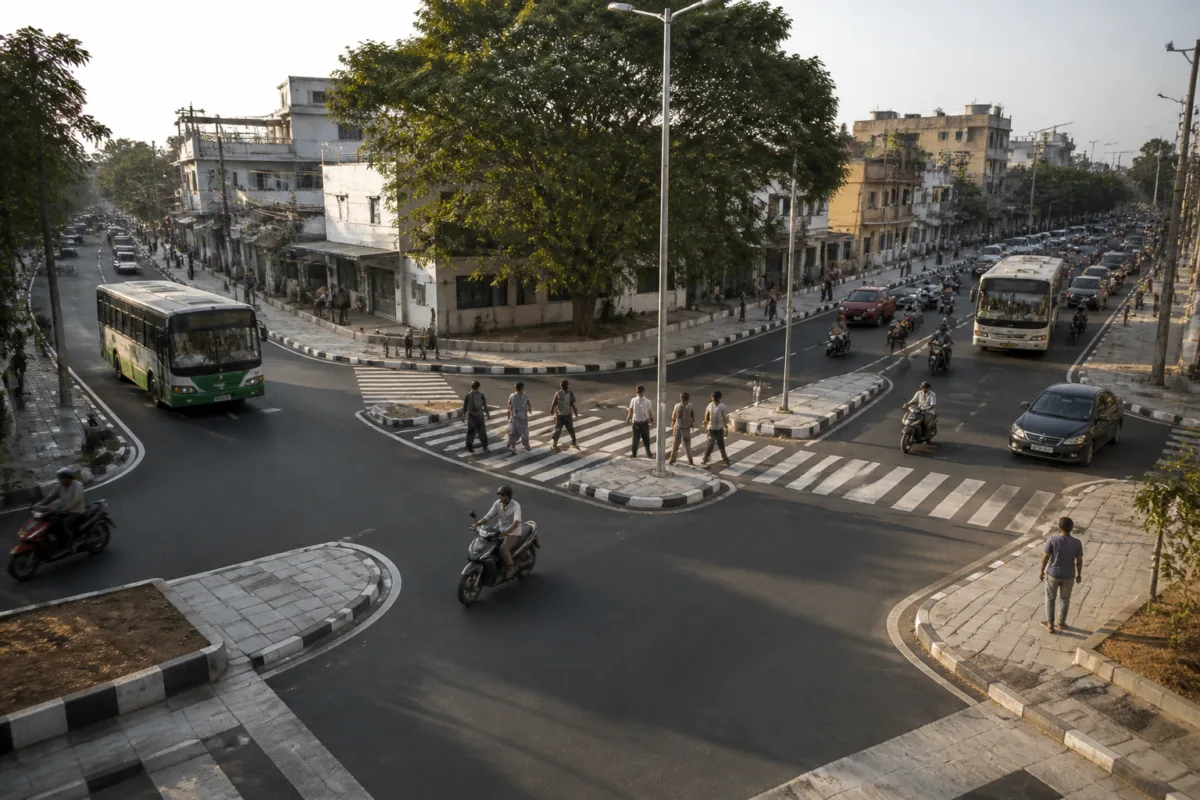
Redesigning busy road junctions can reduce vehicle conflicts, improve pedestrian safety and lower the need for traffic police deployment, according to WRI India.
Presenting a study of safer junction designs in Delhi, Mumbai and Bengaluru at the Indian Roads Congress, WRI India programme lead Chetan Sodaye cited Delhi Gate junction as an example. He said engineering improvements there reduced the requirement for traffic personnel from more than 10 to two.
The redesign also reduced the area of conflicting vehicle movements by 70 per cent and reclaimed around 4,500 square metres of road space, Sodaye said. The findings indicate how changes to junction geometry and pedestrian facilities can address safety and operational problems without relying only on enforcement personnel.
WRI India identified five principles for safer junctions: designing for human error and appropriate speeds, prioritising vulnerable road users, keeping intersections compact, using low-cost interventions with maximum impact, and accommodating all road users.
The measures highlighted in the presentation include pedestrian refuge islands, raised crossings, kerb extensions and speed humps. WRI India said these interventions could improve safety without requiring major infrastructure spending.
The organisation has proposed simplifying more than 150 urban road guidelines into 20 priority recommendations for adoption across more than 450 Indian cities with populations exceeding one lakh. Workshops involving state governments, municipal bodies, engineers and civil society organisations are planned, with the first tentatively scheduled for January 2027.
The findings are relevant to Hyderabad ahead of Cyberabad Moves 2026, a three-day mobility symposium scheduled at T-Hub from November 26 to 28. The event is being organised by the Cyberabad Municipal Corporation, Cyberabad Police and the Society for Cyberabad Security Council.
The symposium will focus on pedestrian-friendly roads, public transport connectivity, safer commuting and sustainable urban mobility. Its programme is expected to include exhibitions, technical sessions, discussions and a mobility innovation challenge.
For cities, the junction-design approach shifts part of the safety response from regular police deployment to the physical design of streets. However, the proposed recommendations and planned workshops remain at the guidance and engagement stage in the information available, rather than representing a confirmed nationwide implementation programme.

