


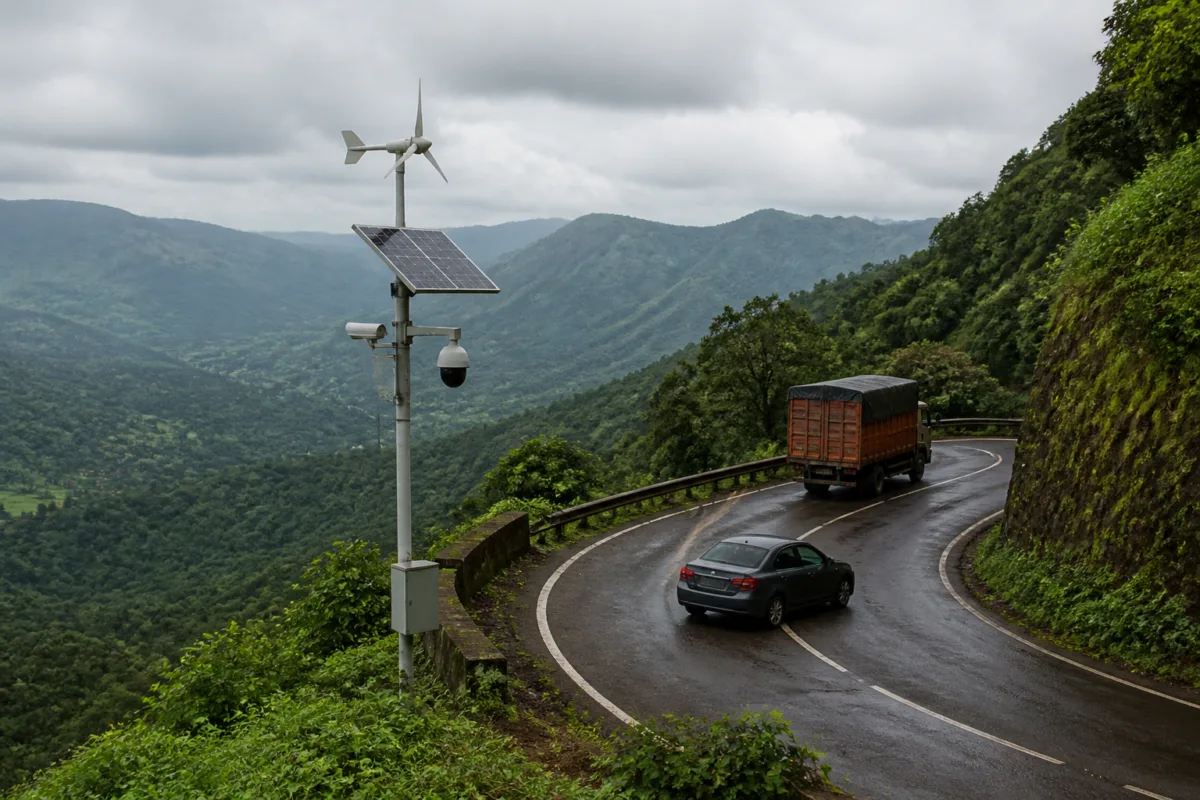
Researchers from Pune have proposed solar- and wind-powered smart poles to detect vehicles that fail to reach the next monitoring point on remote ghat roads and alert rescue teams, particularly in stretches without mobile connectivity.
The proposal was presented at the Indian Roads Congress by Dr Sudarshan Sampatrao Bobade and Dr Harish Umashankar Tiwari of PCET’s Pimpri Chinchwad College of Engineering and Research. It is intended to reduce delays in locating vehicles that may plunge into valleys after accidents.
Under the proposed system, cameras mounted on smart poles would monitor vehicles travelling in both directions. An algorithm would calculate the expected travel time between successive monitoring points. If a vehicle did not reach the next point within that period, the system would generate an alert so authorities could begin a search.
The researchers said accidents on remote ghat stretches often go undetected for hours, delaying rescue operations and emergency medical care. Solar panels and wind turbines would be used to keep the poles operating in areas with limited infrastructure.
The researchers have proposed a pilot project at Amboli Ghat in Maharashtra to test the system under actual road conditions. The report does not indicate that the pilot has been approved or provide a deployment timeline.
The researchers also suggested dedicated turning lanes for different vehicle categories at busy junctions to reduce congestion caused by heavy vehicles making U-turns. Another proposal was a three-tier bridge system separating light vehicles, heavy vehicles and mixed traffic on service roads.

