


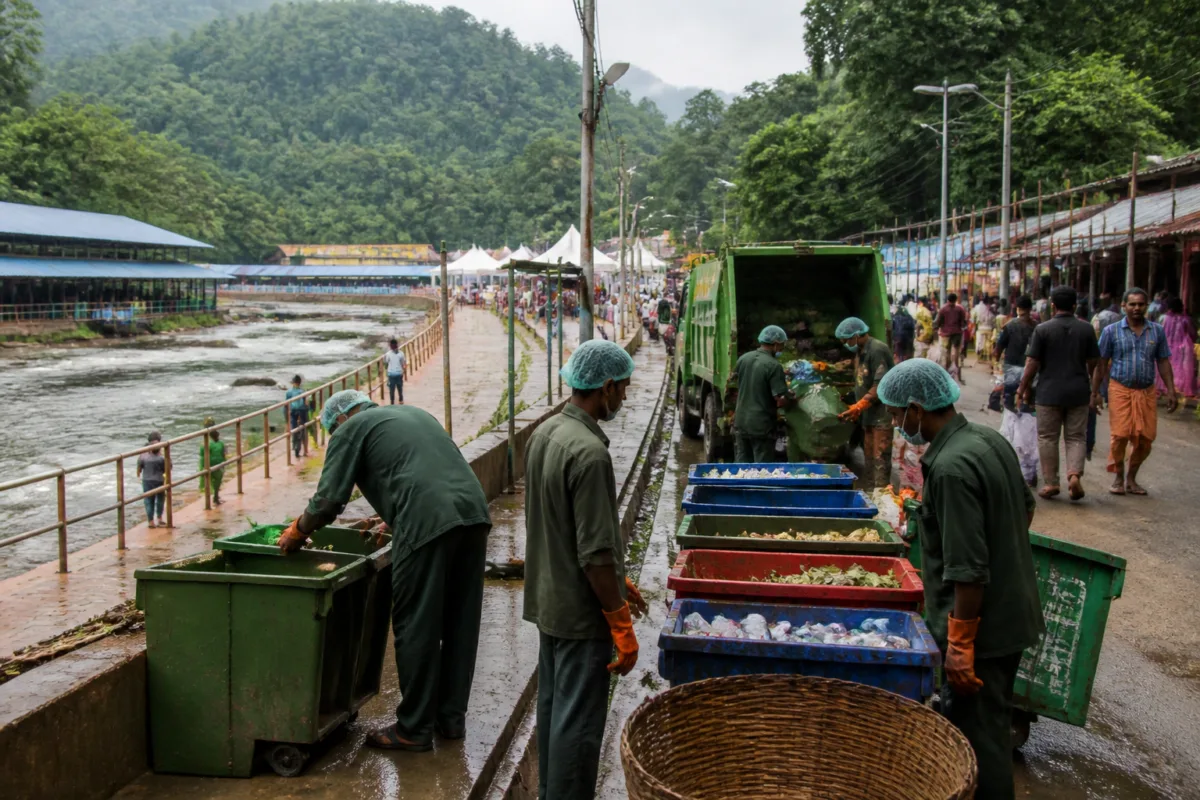
Sabarimala waste management has come under renewed scrutiny after the Kerala Assembly’s environment committee called for an integrated plan covering Erumely, Pamba, Nilakkal and Sannidhanam, four locations it said must be treated as connected parts of the pilgrimage system.
At a review meeting in Pamba on Thursday, the committee directed authorities to strengthen sanitation at Pamba and Sannidhanam, improve basic facilities along the pilgrimage route and prepare a comprehensive plan for the four locations. The report will be jointly prepared by the Pathanamthitta district collector and district police chief, with inputs from departments involved in the pilgrimage.
The committee’s chairperson, Sajeev Joseph, MLA, said the government needed a sustainable response to pollution and waste problems associated with the pilgrimage. He acknowledged the work of the police, government departments, the Kerala State Pollution Control Board, Suchitwa Mission, volunteers and community organisations, but said the dumping of clothes and other waste in rivers remained a serious concern.
The panel said it would incorporate proposed solutions into a report to the government and seek urgent attention to shortcomings identified during the review. It also plans another visit during the current pilgrimage season to assess implementation.
Water quality and sewage treatment were central concerns raised at the meeting. Chandy Oommen, MLA, said drinking water and emergency treatment centres were available to a good standard, but pollution needed to be addressed more seriously. He flagged high levels of coliform bacteria in water and called for greater efficiency at sewage treatment plants.
M J Sebastian, MLA, said pollution in Valiyathodu at Erumely had reached a level at which people could not bathe. He sought strict enforcement of restrictions on soap use, action against the dumping of plastic covers and coordination between departments for scientific waste segregation and processing.
The committee also heard that segregated waste was being transported together in the same vehicle during collection. Faisal Babu, MLA, said the practice should stop. The panel called for more effective intervention to prevent pilgrims from discarding clothes at Pamba and directed that oil be removed from polluted water.
Improving the treatment plant, training and health facilities for sanitation workers were also included among the directions. The committee said a study report on conserving microorganisms in the forest region had been received and that further action would follow.
The review extended beyond waste and water. Oommen flagged narrow roads and encroachments in Erumely, while Babu called for steps to stop tractors from travelling up to Sannidhanam and for alternatives to be provided. The committee also sought basic facilities for police and other personnel working in the sun.
The panel assessed that various departments had taken timely measures for an eco-friendly pilgrimage, including cleaning arrangements along approach roads, at eateries and around toilets. However, the issues recorded at the meeting show the difficulty of managing a high-volume seasonal destination spread across river edges, forest areas, roads and settlement spaces.
The district collector, A Nizamudeen; Pamba special police officer P Niyas; Ranni divisional forest officer Arul Selvam; Periyar Tiger Reserve (West) deputy director Suresh Babu; heads of local bodies; and officials from several departments attended the meeting. The proposed integrated report will bring their inputs together, while the committee’s planned follow-up visit is expected to examine whether the recommendations have translated into changes on the ground.

