


Karnataka’s technology growth strategy is moving beyond Bengaluru’s established services economy, with 24 venture capital firms announcing plans to invest about ₹1,050 crore in deep-tech startups at the 29th Bengaluru Tech Summit.
The announcement, made during the three-day summit held from November 17 to 19 at the Bengaluru International Exhibition Centre (BIEC), highlights the state’s effort to build a wider innovation ecosystem spanning artificial intelligence, biotechnology, robotics, drones, cyber security and semiconductors.
The investment was announced at the summit’s Future Makers Conclave. Last year, the same platform had announced ₹400 crore for artificial intelligence and deep-tech startups, according to Vijay Karnataka. The latest announcement represents a significant increase in the stated investment intent, although the report does not provide details on disbursement schedules, individual investors or the startups expected to receive funding.
The summit also presented Karnataka as a major base for global capability centres (GCCs), which are units established by multinational companies to undertake technology, research, engineering and business functions. A report released at the event, titled ‘Global Capability Centres in Karnataka: Shaping the AI Future of Enterprises’, said the state has 1,088 GCCs—51% of the 2,117 centres in India.
According to the report’s findings cited by Vijay Karnataka, 1.11 lakh artificial intelligence and machine-learning professionals work in Karnataka, representing 43% of India’s GCC AI and machine-learning talent. The report also said the AI maturity of the surveyed GCCs in the state was 1.12 times the national average, while 66% of the centres had reached an advanced stage in AI adoption.
Bengaluru accounted for 44% of senior AI leadership job postings among GCCs in India, the report said. It recommended prioritising global AI leadership, skills development and the commercialisation of research by 2030.
These figures reinforce Bengaluru’s position as the country’s principal concentration of advanced technology employment. They also point to a continuing challenge for Karnataka: converting the state’s technology strengths into a more geographically distributed growth model. The summit report said efforts were under way to extend AI skills, startup activity and technology infrastructure beyond Bengaluru, supporting more balanced regional development.
The event featured four startups supported through Karnataka’s Elevate programme. Their work covered medical technology, biotechnology, defence technology and industrial automation. Selected deep-tech startups were also given an opportunity to present their innovations nationally through IdeaBaaz Season 2.
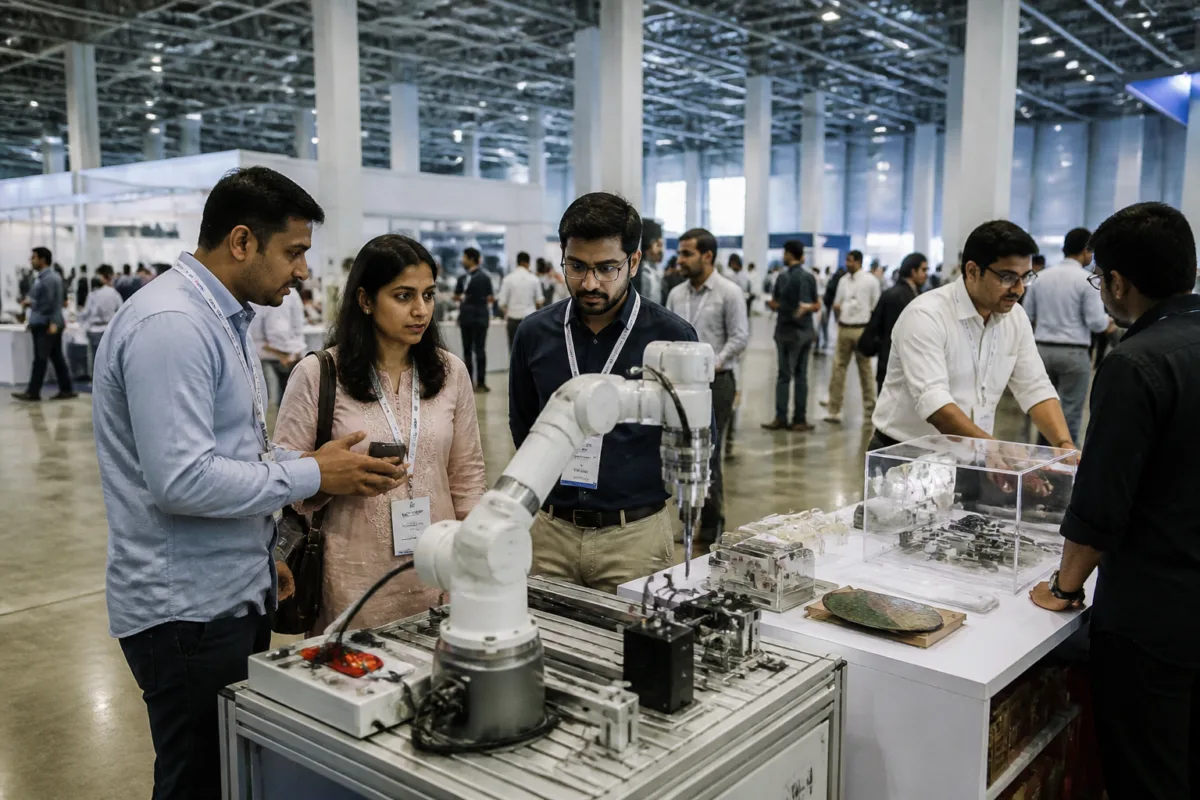
The summit’s scale reflected the breadth of the state’s technology ecosystem. It recorded 162 sessions, 24 roundtables and 704 speakers, with 11,257 conference delegates and 58,872 registered industry visitors. Including students, total attendance was reported at 70,129 people. A total of 1,518 exhibitors, including 923 startups from 104 cities, displayed their products and technologies. The event also recorded 938 direct business-to-business meetings and 11,289 industry connections through WhatsApp Connect.
Information on how the newly announced investment will be allocated, or which districts outside Bengaluru will receive new facilities, was not provided in the report. The source nevertheless links the summit’s investment, research and skills announcements to a broader policy ambition: positioning Karnataka not only as a technology-services centre, but also as a place where emerging technologies are developed, researched and commercialised.
For cities, that shift would have consequences beyond office demand. A larger deep-tech and GCC footprint can increase the need for specialised research facilities, high-quality commercial space, reliable power and digital networks, advanced manufacturing support, housing and transport connectivity. The available report does not quantify these requirements or confirm project locations, but its emphasis on expanding technology infrastructure beyond Bengaluru places regional capacity-building at the centre of Karnataka’s next phase of technology growth.

