


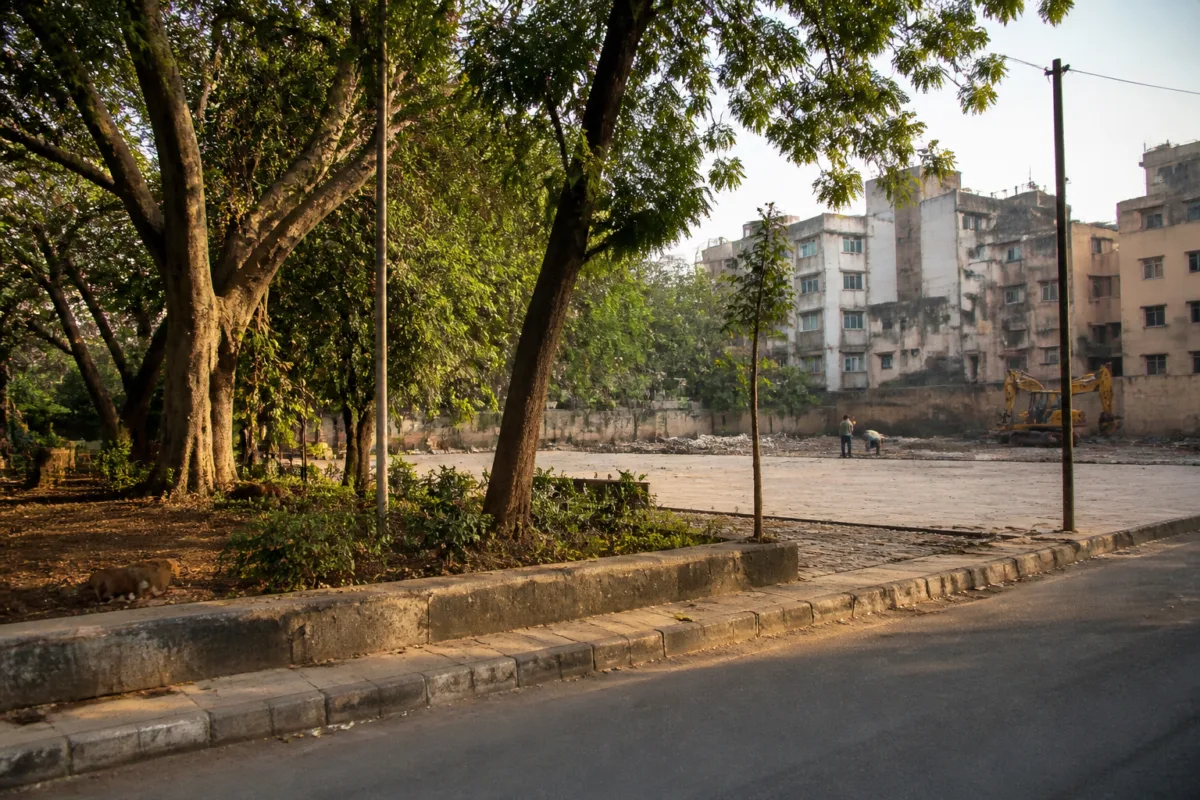
The Ahmedabad Municipal Corporation’s plan to build a community hall on a Panjrapole plot highlights how land reserved for public purposes can change use repeatedly, often at the expense of urban greenery. The plot in the Gulbai Tekra town planning scheme was originally designated for a school and playground, later developed as a garden and then converted into a parking area.
The site is now proposed for a community hall. The report said the town planning scheme refers to the revised use as “social infrastructure”, while the earlier references to a school and playground have been removed. The change follows around three decades of shifting uses on the plot.
The garden, named Rafiuddin Sheikh Vanikaran Udyan, was replaced by parking around five years ago, according to the report. The proposed community hall would therefore represent another change on land that was intended to serve a public function, but would reduce the space available for open and green use.
The Panjrapole case is part of a wider concern raised in the report about the Ahmedabad civic body’s ability to protect gardens. The Ahmedabad Municipal Corporation has planted more than 1.5 crore trees over the past seven years under its Mission Million Trees initiative. However, the report said gardens have also been cleared over the past decade for development works, including water infrastructure.
A source in the corporation said five plots in western Ahmedabad had been developed as gardens or afforestation parks in 2004 with support from various organisations. Some of those sites later faced competing demands for essential civic infrastructure.
In Memnagar, the Ahmedabad Urban Development Authority built Bhairavi Garden on 10,178 sq m of land next to Vishram Park on Gurukul Road in 2002. The report said the garden was cleared in 2021 for a large drinking-water tank and pumping station after rising population increased demand for water. Seven smaller tanks had earlier been built in the area, but the report cited a government source saying additional infrastructure was needed to address supply requirements.
The report also said Gajanan Garden in Chandlodia was demolished in 2022 for a water distribution station. These examples illustrate the planning challenge faced by cities where land reserved or developed for open space is later considered for utilities, transport, parking or public buildings.
A separate proposal in Memnagar shows that such changes can also face public opposition. In 2024, the AMC planned to close Saurabh Nursery, an 8,806 sq m site opposite Sharad Mehta Garden and Party Plot, to build an auditorium hall. The proposal involved cutting down more than 200 trees, but local protests led authorities to cancel the plan, according to the report.
The nursery plot had originally been reserved for a school and playground before becoming part of a state government afforestation scheme in 1995. Its history, like that of the Panjrapole site, shows how the designation of public land can evolve without necessarily preserving the original environmental or recreational purpose.
For Ahmedabad, the central planning question is not only whether community halls, water facilities and other civic assets are necessary. It is also whether the city has a transparent process for recording the loss of gardens, assessing alternatives and protecting the public functions that green spaces provide. The Panjrapole proposal brings that unresolved tension into focus.

