


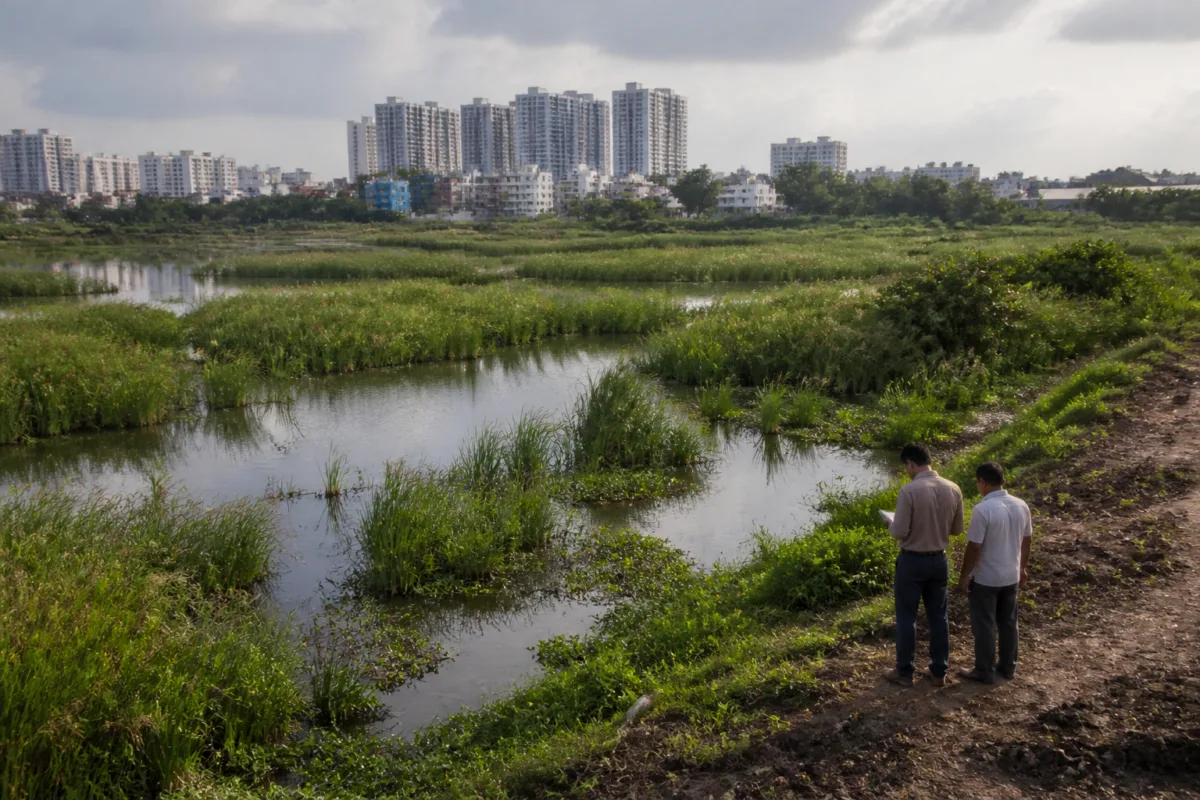
The Madras High Court has declined to quash a ban on development activities within a 1km zone of influence around Chennai’s Pallikaranai marsh, leaving the protective freeze in place while the wetland’s boundaries are verified and demarcated under the supervision of the Supreme Court.
A first bench comprising Chief Justice Sushrut Arvind Dharmadhikari and Justice G Arul Murugan disposed of a batch of petitions filed by the Confederation of Real Estate Developers Association of India (CREDAI) and others. The petitions challenged a September 24, 2025, order of the Southern Bench of the National Green Tribunal (NGT), which directed authorities not to grant approvals or permissions for development within the 1km area around the Ramsar Site boundary in Pallikaranai, within the limits of the Greater Chennai Corporation.
The High Court gave CREDAI and the other petitioners liberty to seek relief from the Supreme Court, where the issue is already pending adjudication. The court said it could not alter the protective perimeter while the apex court was monitoring the ground verification and boundary demarcation of the wetland.
“The delineation of a zone of influence cannot exist in a vacuum,” the bench said, according to the Times of India report. It added that, under the Wetlands (Conservation and Management) Rules, the zone of influence is measured outward from the notified boundary of the wetland itself.
The court said the core boundary of the Pallikaranai Ramsar Site must first be verified on the ground and finalised under the Supreme Court’s supervision. Until then, it declined to fix an interim buffer, exclude particular survey numbers or dilute the existing protection.
The order places responsibility on the Tamil Nadu State Wetland Authority, the Directorate of Survey and Settlement and the National Centre for Sustainable Coastal Management to complete ground-truthing, boundary demarcation and the statutory notification process in compliance with the regulations and the Supreme Court’s directions.
For landowners and developers, the decision means that approvals within the disputed 1km zone remain subject to the NGT’s restriction while the boundary exercise continues. For Chennai, the case concerns how development controls are applied around Pallikaranai, a major urban wetland whose protection has implications for flood management, drainage and the future conversion of surrounding land.
The High Court’s decision does not settle the final boundary of the Ramsar Site or determine the Supreme Court’s eventual outcome. It instead keeps the existing restriction in place and defers any change to the protected perimeter until the ongoing verification and demarcation process is completed.

