


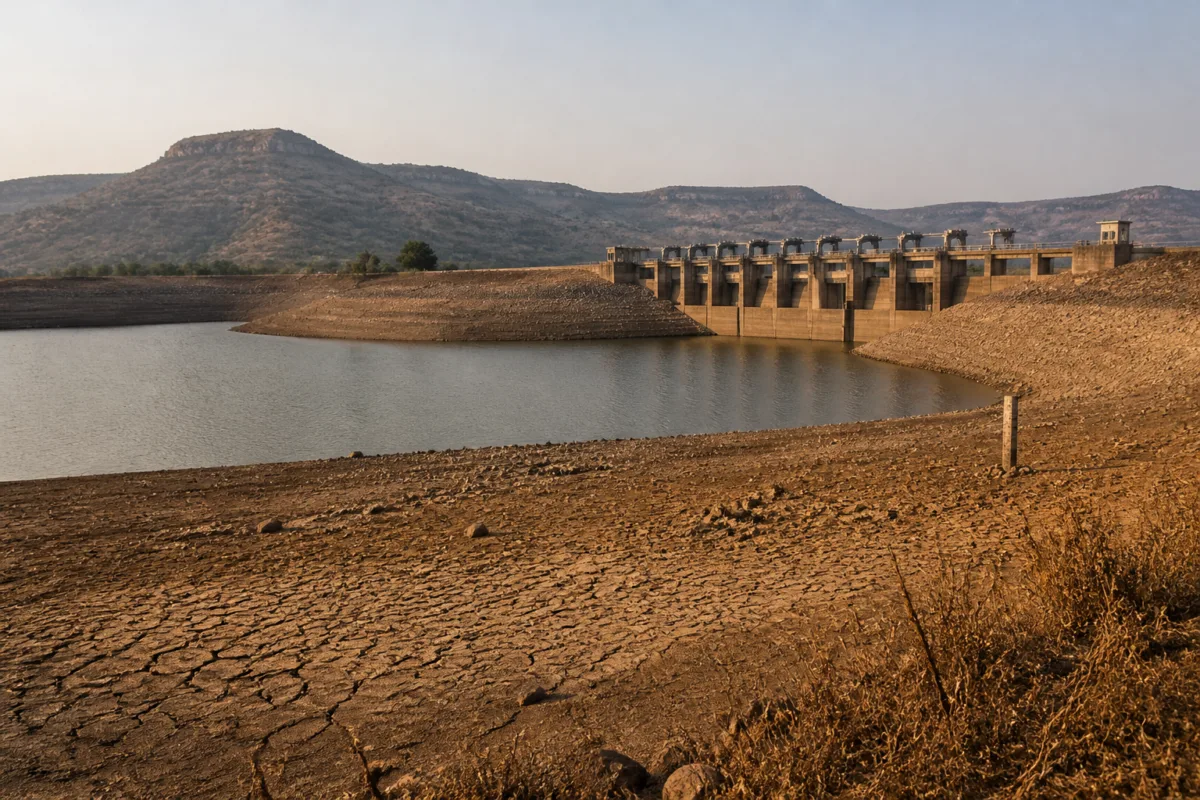
Maharashtra’s live water storage has fallen to 64 per cent of reservoir capacity as of November 17, down from 90 per cent during the corresponding period last year, according to a presentation by the state Water Resources Department before the Cabinet. The decline is increasing pressure on water planning for the rabi season and the summer months.
Live storage refers to the usable water held above a reservoir’s outlet level and excludes dead storage, the department clarified. The state’s reported live storage stood at 92,360 TMC, compared with 130,993 TMC during the corresponding period last year, as reported by Mid-Day.
The sharpest fall was recorded in the Chhatrapati Sambhajinagar division, which covers the Marathwada region. Storage there dropped to 36 per cent from 90 per cent a year earlier. Amravati and Nagpur divisions were also under pressure, with storage at 52 per cent and 56 per cent respectively.
Storage was comparatively higher in Konkan, Pune and Nashik divisions, at 81 per cent, 75 per cent and 74 per cent. However, all six revenue divisions recorded lower levels than during the same period last year, indicating that the decline is not confined to a single drought-affected region.
The department’s presentation identified particularly low levels in small and medium dams in Beed, Dharashiv, Jalna, Latur, Parbhani and Solapur districts. These reservoirs were reported to have reached single-digit storage levels. Minor irrigation projects, which support local water needs, had average storage of about 38 per cent.
The position of the Mumbai and Thane municipal water systems remained comparatively stronger, with storage at 84 per cent against 95 per cent last year. Among the reservoirs serving the region, Modak Sagar was identified as a concern, with storage at 46 per cent, 35 percentage points lower than a year earlier. Upper Vaitarna had 94 per cent storage.
The figures matter for cities as well as rural areas because municipal supply systems depend on coordinated reservoir operations, while declining reserves can intensify competition between drinking-water, irrigation and other requirements. The report does not state that any municipal rationing has been announced, but the lower reserves leave less room for managing demand if inflows remain weak.
The state government has declared drought in 308 of Maharashtra’s 358 talukas. Four talukas were added to the list on November 17: Chiplun in Ratnagiri district, Dindori in Nashik, and Wada and Vikramgad in Palghar. The government had previously declared drought in 304 talukas in two phases following deficient rainfall.
Reported measures include decentralising administrative powers, accelerating water and soil conservation works and prioritising fodder availability for livestock. Administrative deadlines for works under the District Annual Plan (General) for 2026–27 have been extended, with approvals allowed until November 30, 2026.
Under directions issued by the Chief Secretary, district officials and collectors have been empowered to expedite technical approvals for water-conservation and infrastructure projects. Collectors may approve drought-relief and water-scarcity projects costing up to Rs 25 lakh each under the MLA Local Area Development programme in rural and urban areas. Members of Parliament have also been asked to recommend priority works under the MP Local Area Development programme.
Soil and water conservation works are being undertaken in the 304 talukas initially identified under Trigger 1 and Trigger 2 drought conditions, through non-governmental organisations and the VBG-RAM-G scheme, according to the report. The immediate planning challenge will be to direct these measures towards the districts and reservoirs facing the greatest storage deficits while protecting essential water supply through the coming summer.

