


India’s rice surplus has become a public-policy and storage challenge as production, procurement incentives and exports grow faster than domestic consumption, according to a Reuters review of government communications, interviews with officials and discussions with scientists.
National rice output is forecast to reach a record 154 million tonnes in 2025/26, up 50% in a decade, while domestic consumption is estimated at 107 million tonnes. Exports have doubled over the same period to 22.3 million tonnes in 2025, giving India about 40% of the global rice trade, the report said.
The expansion has also increased pressure on the food subsidy system. Rice subsidies account for more than two-thirds of India’s federal food subsidy bill, which has more than doubled in a decade to 2.28 trillion rupees in 2025/26, according to the report.
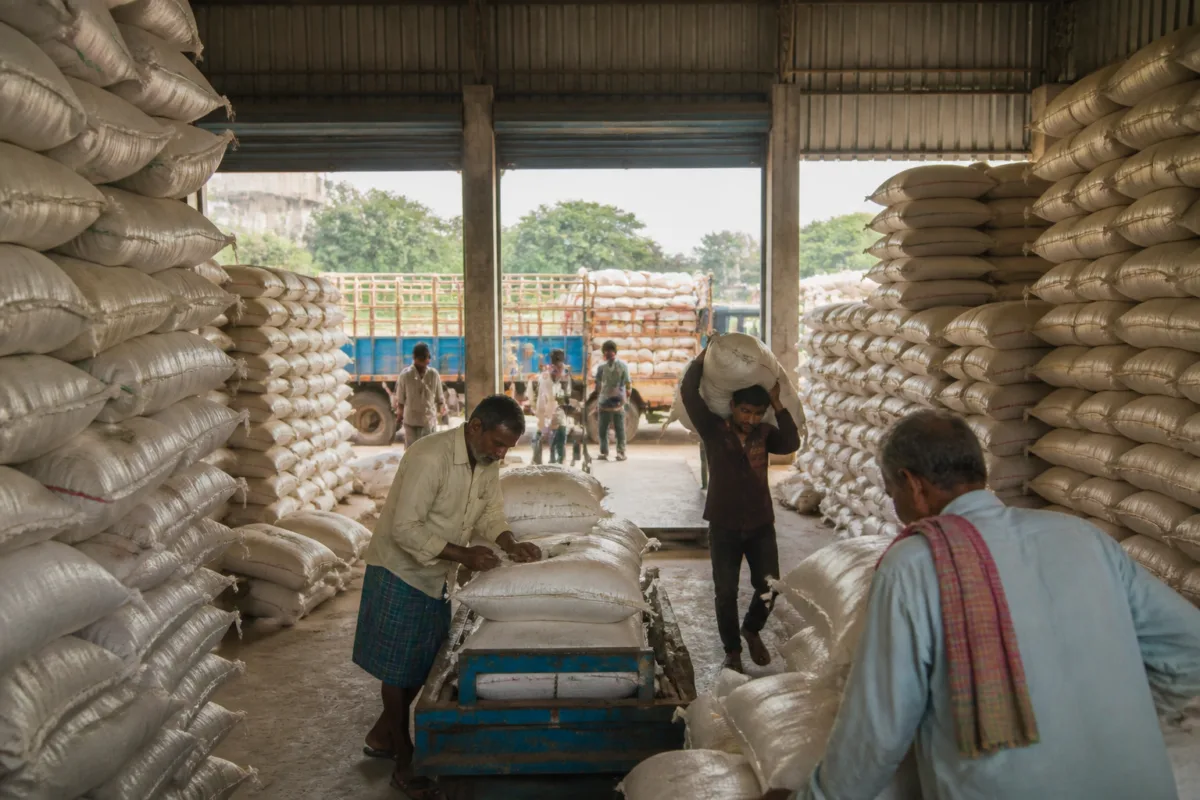
The immediate physical constraint is storage. Navin Aggarwal, a private miller in Cuttack, Odisha, told Reuters that facilities had run out of space and that government agencies had yet to lift rice already purchased from millers. The account points to a logistics problem beyond farm production: procurement, milling, warehousing and onward movement must keep pace with the volumes entering the public system.
India’s rice expansion was built through a policy framework created when the country faced food shortages. The federal government sets a minimum support price for rice, taking account of costs including labour and fertiliser, while rice-producing states can offer additional bonuses. These incentives make rice comparatively attractive to farmers and encourage continued cultivation.
The policy has also changed the geography of production. Rice-growing areas were historically concentrated in northern and north-western states such as Punjab and Haryana. The flood-tolerant Swarna-SUB1 variety, released commercially in 2009 by Indian researchers, helped extend more reliable cultivation into flood-prone parts of eastern India. The variety combined the flood-tolerant FR13A strain with Swarna, a high-yielding variety.
In Bihar, the Reuters report described how the variety has affected farming near the Kosi River, where recurrent floods had previously made harvests less dependable. The expansion of cultivation in eastern states has improved production reliability for some farmers, but it has also added to the national procurement and storage burden.
The surplus is creating tension between the federal government and state administrations. A senior federal food ministry official told Reuters that rice-producing states continued to press the ministry to purchase more rice, describing the situation as exasperating. The central concern is that state bonuses can increase production even when government stocks and export markets are already under pressure.
That incentive structure has consequences for land use and food security. The Reuters report said rice expansion is squeezing crops such as oilseeds and pulses, which India imports. A system designed to ensure an adequate rice supply can therefore make other parts of the food system more dependent on imports.
The costs also extend beyond domestic storage and procurement. Ashok Gulati, an agricultural economist and former government adviser on crop prices, said taxpayers were effectively subsidising foreign consumers when surplus rice was exported. The report said Indian rice was selling at a discount of about $110 a tonne to benchmark Thai rice, which traded at around $497 a tonne in mid-November.
The pricing has triggered complaints from competing producers. The United States has raised concerns about India’s rice subsidy, while representatives in Thailand and Vietnam have also linked India’s large stocks to pressure on export prices. India rejected a claim by US President Donald Trump that it was dumping rice, saying its US exports consisted of premium basmati rice, according to the report.
The challenge is complicated by the possibility of a weaker harvest in 2026/27 because of poor rains associated with El Nino. Even so, the US Department of Agriculture expects Indian exports to rise over the next two years because existing stocks remain ample.
For India’s food system, the central issue is no longer only whether enough rice can be produced. It is whether procurement policy, state-level incentives, warehouse capacity and crop planning are aligned with actual consumption and trade conditions. The Reuters findings show how a programme created to prevent scarcity can generate new fiscal, infrastructure and agricultural pressures when production consistently exceeds domestic demand.

