


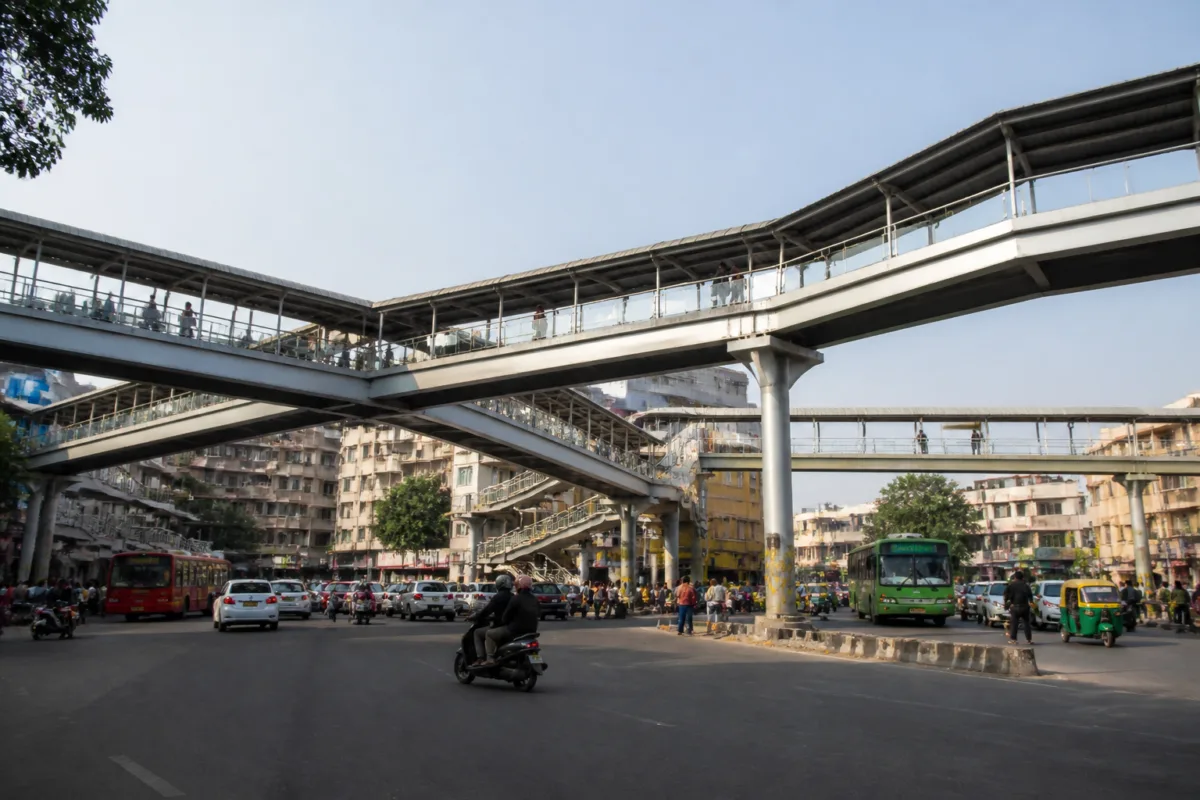
A 240-metre skywalk will be built near Nirman Vihar Metro station on Vikas Marg to connect the station with Laxmi Nagar Market, nearby malls and the commercial area of Preet Vihar, easing pedestrian movement across a busy East Delhi junction. The four-arm facility is expected to reduce conflicts between pedestrians and vehicles at the Vikas Marg-Patparganj Road intersection.
According to Public Works Department officials cited by Navbharat Times, the skywalk’s design has been finalised and construction is expected to begin within the next month to month and a half. The project will be East Delhi’s first skywalk.
The proposed structure will have four arms, each approximately 60 metres long. It will stand around 5.5 to 6 metres above ground, with each pedestrian corridor designed to be 3 metres wide. The stairs on all four arms will be 2 metres wide, while lifts will extend up to a height of 12 metres.
The project is planned around the junction near Nirman Vihar Metro station, where a mall and Laxmi Nagar Market are located on opposite sides of the surrounding roads. The commercial area of Preet Vihar is also nearby. Pedestrians currently have to cross the junction after exiting the metro station, a movement that becomes difficult during peak hours because of heavy traffic.
The PWD officials said pedestrian crossings at the junction contribute to slowing traffic on Vikas Marg and can lead to long queues during busy periods. By connecting the metro station and the junction through an elevated route, the proposed skywalk is intended to separate pedestrian movement from vehicles at the intersection.
The project follows earlier skywalks constructed at ITO and Benito Juarez Marg. The main skywalk at ITO’s W Point is 485 metres long and 5 metres wide. Including its ramps and loops, its total length is 615 metres, and it was designed to serve 30,000 pedestrians. The Benito Juarez Marg skywalk is approximately 600 metres long.
Unlike those longer structures, the Nirman Vihar facility has been designed as a four-arm connection around a specific metro station and road junction. Its layout is intended to link the station directly with the surrounding commercial destinations rather than function only as a crossing over a single road.
The next stated milestone is the start of construction, which PWD officials expect within one to one and a half months. The report does not specify the project cost, construction agency or completion deadline.

