


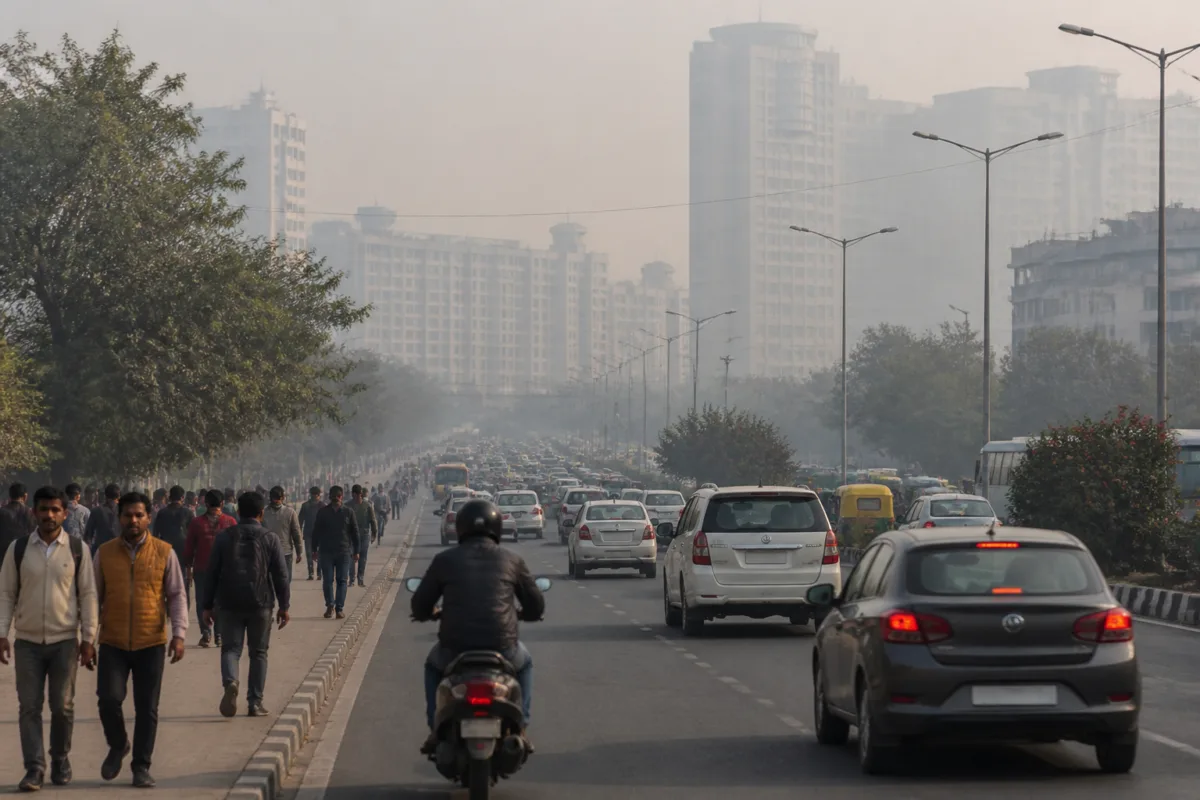
Delhi’s air quality is expected to deteriorate between November 19 and 22 as a change in low-level winds reduces the dispersion of pollutants across the capital region, according to a forecast by Skymet Weather. The weather service said temperatures may rise temporarily before cooler northwesterly winds return from November 23.
The forecast follows Delhi’s coldest minimum temperature of November so far. Safdarjung, the city’s base weather station, recorded a minimum of 11°C on November 18, after temperatures fell by more than 3°C the previous day. The reading was more than 1°C below normal for this time of year.
Skymet said the fall in temperature may now pause temporarily as wind patterns change over the northern plains. Fair weather conditions are expected over Delhi and the National Capital Region, but the shift is also expected to make atmospheric conditions less favourable for pollutant dispersion.
The current weather pattern developed after a western disturbance moved away from the northern mountains. Low-level winds then travelled down the slopes and across Punjab, Haryana, north Rajasthan and Delhi, contributing to the recent decline in mercury levels. Several locations in Punjab and Haryana recorded minimum temperatures of about 8°C to 9°C, while Sikar in Rajasthan recorded 8°C for two consecutive days.
Delhi has not yet recorded a single-digit minimum temperature this November. Skymet said the wait could extend into the fourth week of the month, with a single-digit reading possible only towards the end of November if conditions remain favourable.
The expected air quality deterioration is linked to a developing cyclonic system in the Bay of Bengal. As the system moves closer to the eastern coast, wind patterns across the Indo-Gangetic plains, including Delhi, are expected to change. Skymet said the shift could reduce the speed of easterly winds and lower the ventilation index, which combines mixing height and wind speed to indicate how effectively the atmosphere can disperse pollutants.
A lower ventilation index generally indicates more difficult pollutant dispersion. In Delhi, this means emissions can remain concentrated closer to the surface when wind speeds and vertical mixing weaken. The forecast therefore points to a weather-driven deterioration in air quality even as the city experiences a temporary rise in temperature.
Skymet expects the seasonal flow of cooler northwesterly winds to resume from November 23, after the cyclonic storm moves inland and weakens. Temperatures are then expected to fall again, although the timing and extent of any single-digit minimum in Delhi remain dependent on the subsequent wind pattern.

