


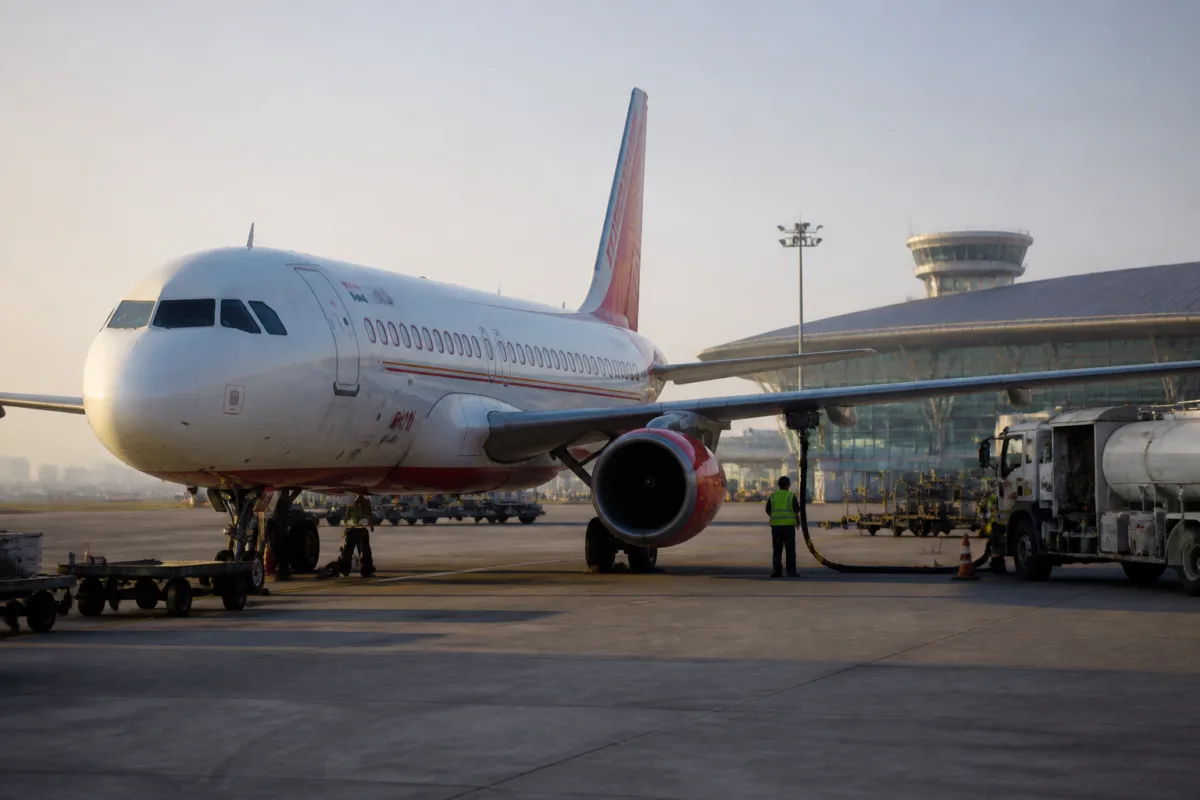
Air India and Airbus will develop a voluntary corporate sustainable aviation fuel programme in India, beginning with a feasibility study on how companies can support SAF procurement for Air India’s commercial operations and claim verified lifecycle emissions reductions against their business travel.
Under the proposed arrangement, Airbus would directly invest in the procurement of SAF used by Air India. The feasibility study will assess the structure of a programme open to businesses seeking to reduce the lifecycle emissions associated with air travel, according to a release issued after the agreement was signed in New Delhi.
The programme will evaluate how emissions reductions can be calculated by comparing the lifecycle carbon footprint of SAF with that of conventional jet fuel. The calculations would use globally recognised standard frameworks, allowing participating organisations to track and report verified reductions linked to their air travel.
Air India CEO and Managing Director Tewolde Gebremariam said the collaboration was intended to explore a credible mechanism for corporates to support SAF adoption and reduce emissions associated with business travel. Airbus India and South Asia President and Managing Director Jurgen Westermeier said decarbonising aviation required collective industry action and invited other companies to join the programme.
The agreement for the study was signed by Westermeier and P Balaji, Group Head – GRC and Corporate Affairs at Air India, at the India SAF Summit organised by industry body FICCI and the civil aviation ministry. Westermeier said Airbus would invest directly in SAF procurement by Air India and use the verified lifecycle carbon reductions against its own Scope 3 emissions.
Scope 3 emissions include indirect emissions connected to an organisation’s activities, including business travel. The proposed framework would therefore link corporate travel demand with SAF procurement rather than treating fuel decarbonisation solely as an airline or government responsibility.
The initiative comes as the government works on India’s SAF policy. The proposed policy would mandate a 1 per cent SAF blend in jet fuel from 2027 and raise the requirement to 5 per cent by 2030. The policy is still being finalised, and the announcement does not establish that the proposed corporate programme will replace or alter those blending requirements.
India could produce about 10 million tonnes of SAF annually by 2040, according to the information released at the summit. Reaching that potential would require estimated investments of USD 70-85 billion. The figures underline the scale of financing and production capacity needed if SAF is to move from pilot and voluntary procurement arrangements into a wider aviation fuel system.
SAF is considered a key element of the airline industry’s decarbonisation roadmap, but production capacity, availability and pricing remain significant barriers. The feasibility study will examine how a scalable framework could encourage participation from businesses across sectors and help develop a domestic SAF ecosystem.
Westermeier also reiterated a proposal to recognise eligible voluntary corporate SAF contributions under the Corporate Social Responsibility framework. Such recognition, he said, could help unlock an additional pool of private capital for aviation decarbonisation. Under the Companies Act, certain profitable companies are required to spend at least 2 per cent of their three-year average annual net profit on CSR activities.
The study will next focus on establishing the framework, verification method and participation model for the proposed programme. The announcement does not specify a launch date, the volume of SAF to be procured or the participating companies beyond Airbus and Air India.

