


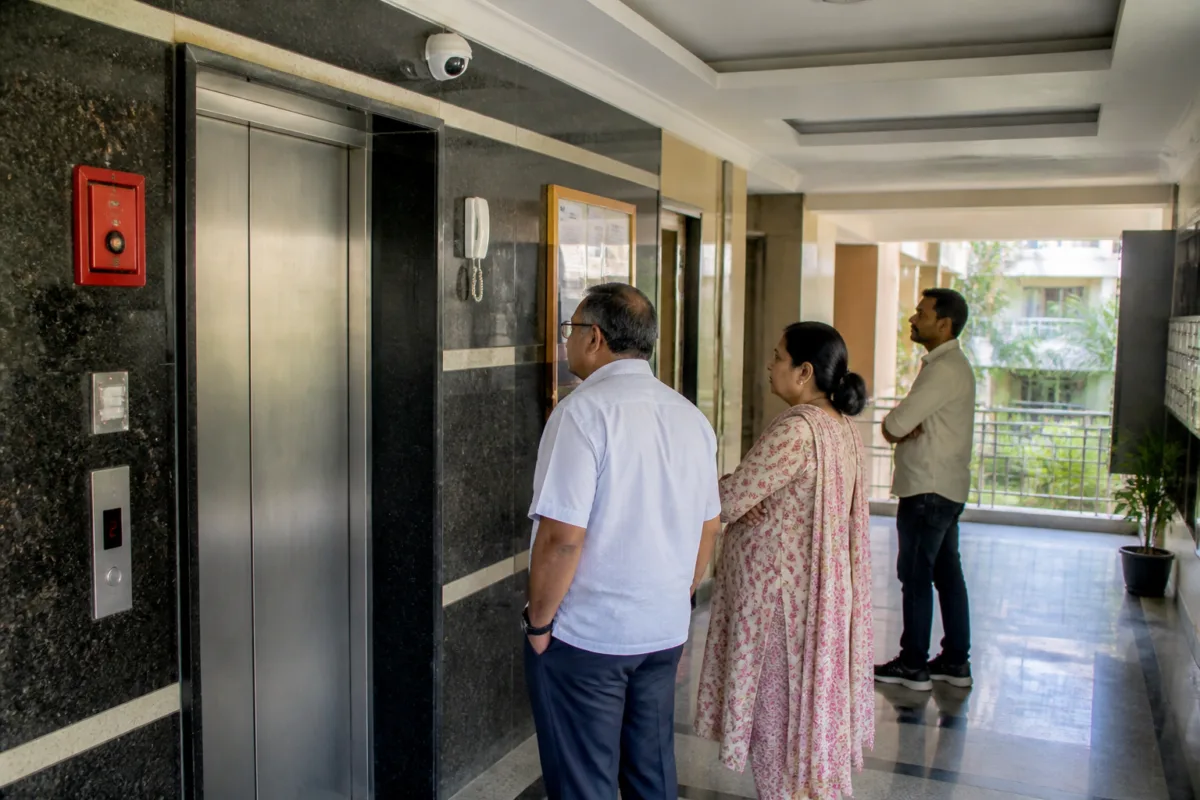
Maharashtra’s new lift safety rules do more than prescribe technical equipment. They shift everyday responsibility for vertical mobility towards housing societies, authorised contractors, lift operators and building occupants, creating a clearer legal framework for a system that has become essential to life in the state’s multi-storey buildings.
The Maharashtra Lifts, Escalators and Moving Walks Rules, 2026 were notified on October 28 and came into force on November 1, according to a report by Loksatta – Nagpur. The rules apply to lifts, escalators and moving walkways, and establish requirements covering installation, maintenance, safety audits, accident reporting and the restarting of equipment that has remained closed for an extended period.
The immediate significance is administrative as much as technical. The framework places regular maintenance on an authorised contractor, requires records of work, and introduces an annual safety audit whose report must be submitted to electrical inspectors. This converts lift maintenance from an occasional response to a breakdown into a recurring compliance responsibility.
That distinction matters in housing societies, where lifts are commonly treated as part of routine building maintenance rather than as regulated safety infrastructure. A lift may be used hundreds of times a day by residents, domestic workers, delivery personnel, visitors and service staff, but responsibility for its condition can be divided between the society, its managing committee, a facility manager and an external maintenance company. The new rules establish more specific obligations within that chain.
Under the rules, every lift must be inspected and maintained at least once a month by an authorised contractor. Any defect found during an inspection must be repaired, and details of the work carried out must be recorded. Each lift must also undergo a safety audit at least once a year. The audit report is required to be submitted to the electrical inspector.
The record-keeping requirement is particularly important because it creates an administrative trail. The supplied report does not specify the format, retention period or inspection mechanism for these records, but the obligation itself means that maintenance can no longer be documented only through informal complaints or verbal assurances. For residents, the effectiveness of this provision will depend on whether societies maintain accessible and accurate records and whether the responsible authorities review them consistently.
The rules also make third-party insurance compulsory for lifts. The report does not provide the required coverage amount, policy conditions or the party responsible for purchasing the policy. It does, however, place insurance within the safety framework, alongside maintenance and auditing. That links operational negligence with a formal financial protection mechanism, although the practical consequences for residents and housing societies will depend on the detailed implementation of the insurance requirement.
Emergency equipment is another central element. Newly installed lifts must have closed-circuit television cameras and required safety systems. Existing lifts without CCTV, an automatic rescue device or an overload protection device must be fitted with them. Housing societies operating older buildings have until October 28, 2027, to install these systems.
The automatic rescue device is intended to bring a lift to the nearest floor and open its doors when the electricity supply fails. The overload protection device prevents the lift from operating when the weight exceeds its capacity. These systems address different risks: one concerns passenger entrapment during a power interruption, while the other concerns operation beyond the lift’s designed load. The rules therefore distinguish between a building’s need for continuity during an outage and the need to prevent unsafe loading.
The deadline for older lifts is significant because it recognises that safety compliance cannot be achieved only through standards for new construction. A large part of the state’s vertical housing stock already exists, and its equipment may have been installed under earlier requirements. By setting a date for retrofitting CCTV, automatic rescue devices and overload protection devices, the rules bring existing buildings into the new safety regime rather than limiting the framework to future projects.
The source report identifies the earlier legal position as the 2017 law, which now has a detailed set of rules. In practical terms, this means that the legal framework has moved from a broad statutory foundation to more specific operational requirements. The supplied material does not describe the provisions of the 2017 law or explain how enforcement will be organised, so it is not possible to assess from the available evidence how many lifts will require upgrades or how inspections will be monitored across the state.
The rules also regulate who may use the equipment and how accidents must be handled. Children below the age of 12 cannot use a lift or escalator without adult supervision. A lift operator must be at least 18 years old. If an accident occurs involving a lift, escalator or moving walkway, information must be provided to the electrical inspector and local police within 24 hours.
These provisions extend the framework beyond machinery. They introduce behavioural and reporting duties into the management of shared residential infrastructure. The age restriction places a direct responsibility on accompanying adults, while the operator-age requirement sets a minimum standard for a role that may otherwise be assigned informally. The 24-hour reporting rule also creates a clear post-incident timeline, although the report does not state the penalties for delayed or non-reporting.
The restarting of long-closed lifts is subject to a separate safeguard. Any lift that has remained shut for six months or more must undergo prescribed safety tests by an authorised contractor before it is put back into service. This is relevant to buildings where equipment is left unused because of repairs, disputes, financial constraints or changes in occupancy. The rule treats prolonged inactivity as a safety condition requiring verification, rather than assuming that an old lift can be restarted simply because its mechanical system appears functional.
The available facts reveal three layers of responsibility. The first is preventive: authorised contractors must inspect and maintain lifts every month, defects must be repaired and records must be kept. The second is technical: new and existing lifts must have specified safety systems, with a retrofit deadline for older installations. The third is institutional: annual audits, accident reporting, insurance and approval before restarting long-closed equipment create a compliance relationship between societies, contractors and public authorities.
What remains unclear from the supplied material is how this responsibility will be enforced. The report does not state the number of lifts covered, the staffing or powers of electrical inspectors, the penalties for non-compliance, the cost of retrofitting, or whether residents will have a formal mechanism to inspect audit reports. It also does not specify whether responsibility will differ between individual apartment buildings, commercial premises and public facilities. These are important implementation questions, but they cannot be answered from the announcement as reported.
For housing societies, the rules make lift safety a continuing governance function. A managing committee will need to coordinate authorised contractors, track monthly inspections, address defects, arrange annual audits, retain records and ensure that older equipment is upgraded before the October 28, 2027 deadline. The cost and procurement implications are not provided in the source, but the compliance duties are now defined more clearly than before.
For residents, the most visible changes may be the presence of safety devices, restrictions on unsupervised use by children under 12 and a more formal response after accidents. Yet equipment alone cannot establish safety. The rules depend on maintenance records being genuine, defects being repaired promptly, audits being meaningful and reports reaching the responsible authorities within the required time.
The larger urban question is how cities manage the safety of systems that are privately operated but collectively essential. In multi-storey housing, lifts are not an optional convenience for many residents; they are the basic connection between homes, entrances and public space. A regulatory framework that covers installation, maintenance, retrofitting and incident reporting acknowledges that vertical mobility is part of the built environment’s essential infrastructure.
Maharashtra’s rules therefore provide a more defined compliance structure, but their impact will ultimately be measured through implementation. The immediate milestones are the monthly inspections, annual safety audits, 24-hour accident reporting requirement and the October 28, 2027 deadline for specified upgrades in older lifts. The effectiveness of the framework will depend on how these obligations are recorded, checked and enforced across housing societies and other buildings.

