


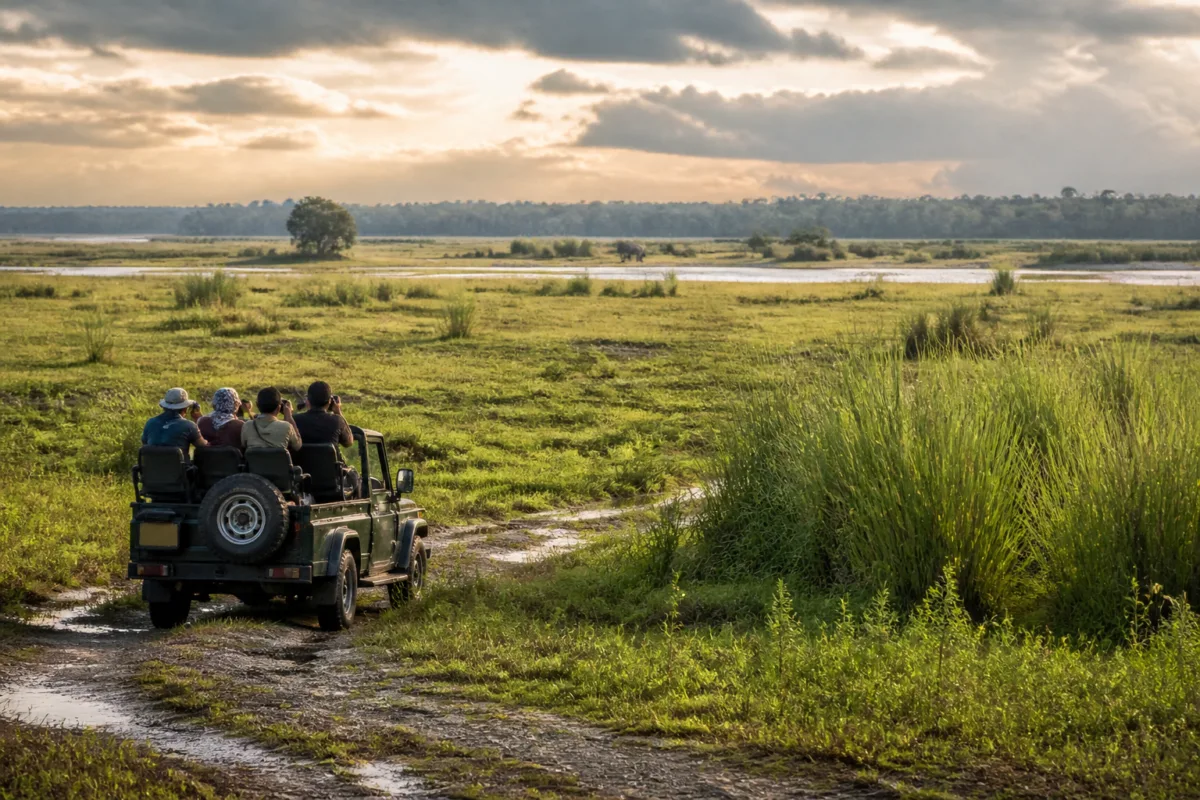
Jaldapara tourism has rebounded sharply after a devastating flood damaged the national park’s grasslands and displaced 13 rhinoceroses, but the visitor numbers also reveal how closely wildlife conservation, disaster recovery and local livelihoods are tied together. Between October 15 and November 15 this year, 14,625 tourists visited Jaldapara for safaris, including 201 international visitors from Europe and the United States, according to forest sources cited by The Telegraph India.
The numbers offer a clear sign that the park has regained enough operational stability and visitor confidence to attract tourists during the festive season. They also show that recovery is not limited to the forest boundary. In Madarihat and surrounding areas, the economic effects of tourism extend to resort owners, jeep operators, guides, shopkeepers and others whose incomes depend on visitors moving through the wildlife destination.
That recovery followed an unusually demanding rescue operation. On October 5, 2025, a massive flood swept 13 rhinoceroses out of Jaldapara National Park, while extensive grassland along the Torsa river suffered severe damage. The flood disrupted both the park’s ecological landscape and the tourism economy that depends on access to its habitats, safari routes and surrounding accommodation.
The displaced rhinoceroses were subsequently rescued from different locations across Alipurduar and Cooch Behar and brought back to Jaldapara. The operation was led by the Jaldapara forest division under divisional forest officer Parveen Kaswan. According to the supplied report, 19 trained elephants and around 200 forest personnel worked continuously for 52 days to complete the mission.
The rescue is significant not only because of the number of animals involved, but also because it demonstrates the administrative scale required when a flood alters the relationship between a protected area, its wildlife and nearby settlements. The animals moved beyond the park and had to be located and recovered across two districts. That made the response a coordinated exercise in wildlife management rather than a confined park operation.
The flood also damaged the grassland along the Torsa river, an ecological setback with direct implications for the park’s functioning. The supplied material does not provide a detailed assessment of the damaged area, the cost of restoration or the length of time required for the grassland to recover. It does, however, state that restoration efforts and improved wildlife management helped Jaldapara gradually revive its tourism potential.
This distinction matters. A rise in safari visitors indicates that the park is accessible and attractive again, but it does not by itself establish that the entire ecological system has returned to its earlier condition. Visitor activity measures the strength of the tourism rebound. It is not a substitute for ecological indicators such as habitat recovery, wildlife health, flood vulnerability or the long-term condition of riverine grassland.
The available visitor data nevertheless provides a useful measure of the park’s immediate recovery. The 14,625 safari tourists recorded over one month include 14,424 domestic visitors and 201 international tourists, based on the figures reported by the forest sources. Domestic visitors therefore formed the overwhelming majority of safari users during the period, with tourists arriving from different parts of India, including Bengal.
The international figure is smaller, but it points to a second dimension of the park’s tourism economy. Jaldapara is not dependent only on long-distance foreign wildlife tourism. Its present visitor base is largely domestic, which may give the local economy a broader foundation during periods when international travel is weaker or disrupted. The supplied report does not provide comparable figures for earlier years, so the scale of growth over time cannot be calculated from the available evidence.
Safari footfall also captures only part of the local visitor economy. A senior forest official told The Telegraph India that many visitors stay at forest-side resorts, go trekking and participate in birdwatching without necessarily being counted among safari tourists. The official therefore said overall tourist footfall in and around Jaldapara was much higher than the safari figure.
That distinction is important for understanding how protected areas function as economic systems. The safari is the most visible and countable part of the visitor experience, but the surrounding economy depends on a chain of services before and after the ride. Accommodation, transport, guiding, retail and food services all benefit when visitors stay longer or undertake activities beyond the core safari product.
The report quotes resort owner Biswajit Saha of Madarihat as saying that resort owners, jeep operators, tourist guides, shopkeepers and other tourism-linked workers benefited from the increased activity. He said the revival helped them recover losses suffered during the previous year because of the flood.
The statement places the visitor figures in a livelihood context. A flood in a wildlife destination does not affect only forest officials and animals. It can also reduce bookings, vehicle trips, guide assignments, shop sales and the flow of income to households that may have few alternative sources of work. When visitor activity resumes, the recovery is distributed through this network of local services.
At the same time, the reported economic recovery should not be treated as proof that all affected workers have returned to their earlier income levels. The available material does not provide data on employment, household earnings, resort occupancy, business closures or compensation. It establishes that tourism stakeholders reported benefits, but it does not quantify the extent of recovery across the local economy.
Jaldapara’s experience also highlights the institutional responsibilities involved in managing a flood-prone wildlife destination. The forest division was responsible for the rescue and the broader wildlife-management response. The operation involved trained elephants, forest personnel and action across Alipurduar and Cooch Behar. Tourism businesses and local operators, meanwhile, absorbed the commercial consequences of the disruption and participated in the recovery through the reopening of services.
The supplied report does not identify a separate flood-resilience plan, funding package, interdepartmental mechanism or formal tourism-recovery programme. It also does not specify whether changes were made to safari routes, visitor limits, river monitoring or emergency procedures after the flood. Those omissions leave important questions about how the next major flood would be managed and how ecological restoration would be balanced with the return of tourist activity.
The park’s recovery therefore has two simultaneous measures. The first is operational: whether safaris can run and visitors are willing to return. The second is ecological and administrative: whether the damaged grassland, wildlife habitats and rescue systems are resilient enough to withstand future disturbances. The first is visible in the 14,625 safari visitors. The second requires longer-term monitoring that is not included in the supplied account.
This is the larger urban and regional question raised by the Jaldapara numbers. Wildlife destinations are often discussed as tourism assets, but their functioning depends on a much wider territorial system: rivers, grasslands, roads, accommodation, vehicles, guides, markets and forest administration. When a flood strikes, the disruption moves across that system. When tourism returns, the benefits also travel across it.
The park’s rebound further shows why disaster recovery cannot be measured only by reopening a destination. The rhinoceros rescue restored the animals to Jaldapara, while restoration and wildlife-management efforts supported the return of visitors. But the report does not establish whether the underlying exposure to flooding has changed or whether damaged habitats have fully recovered. Those are separate questions from whether the festive season produced strong footfall.
For now, the evidence confirms a substantial tourism revival after a severe flood-related disruption. It also confirms that the response involved an intensive 52-day rescue operation and that local businesses reported renewed activity. What remains unclear is the longer-term condition of the Torsa river grassland, the income recovery of affected workers and the institutional arrangements that will protect both wildlife and livelihoods during future floods.
The winter season will provide the next immediate test of whether the visitor response continues, as forest officials hope. A sustained rebound would strengthen the case that Jaldapara has recovered its tourism momentum. It would still need to be read alongside ecological and resilience indicators, because a busy safari season can show that visitors have returned without proving that the landscape has fully healed.

