


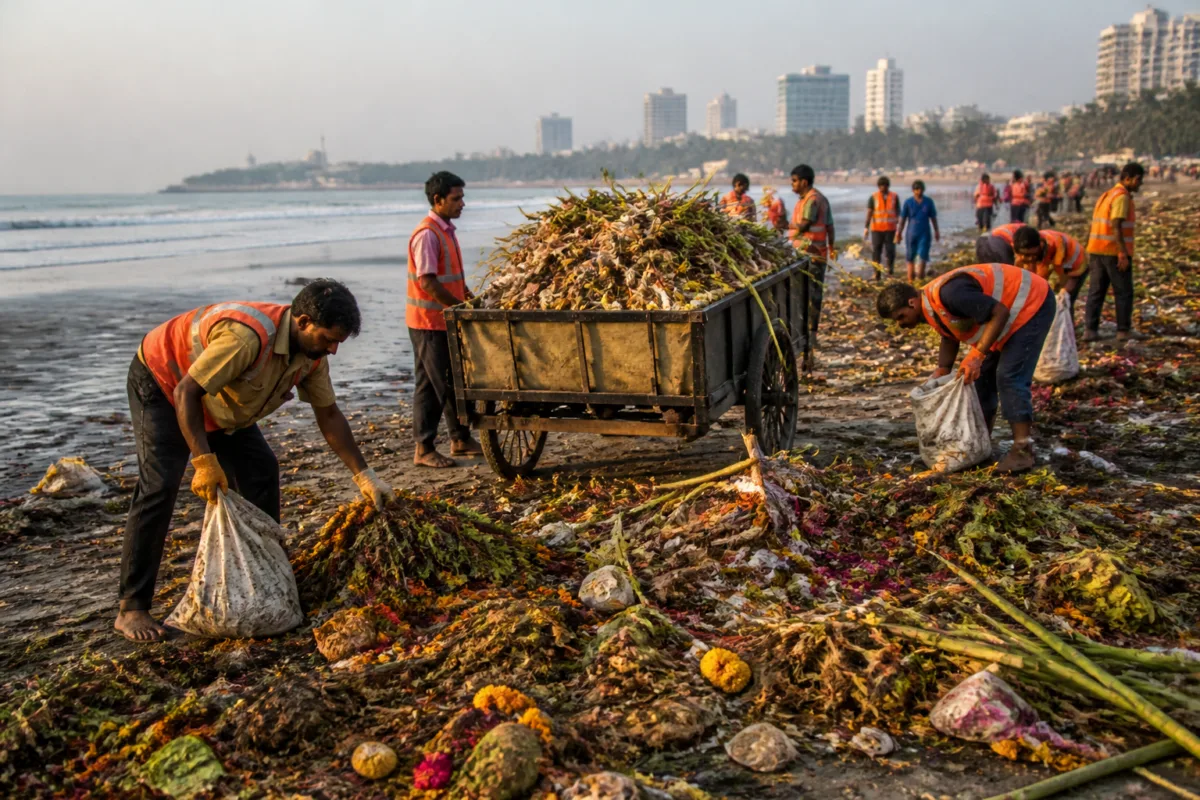
Juhu beach’s garbage collection rose fivefold to 150 tonnes on Monday after thousands of people gathered along Mumbai’s shoreline for Chhath Puja celebrations, overwhelming the timing and capacity of the clean-up operation.
The collection was 120 tonnes higher than the beach’s average daily waste collection of 30 tonnes recorded over the preceding eight days. The waste included discarded coconuts, flowers, sugarcane, food and other ritual offerings left across the sand after the celebrations.
A civic official said cleaning operations could not begin on Sunday evening because the beach remained packed with people. Workers and machinery were ready, but there was insufficient space to deploy them safely while the crowd occupied the shoreline.
“A conservative estimate puts the crowd at no fewer than four lakh people,” the official said. According to the official, people began arriving at around 3 pm on Sunday, carrying mats and other seating arrangements to secure places along the beach for the rituals and prayers.
“There was simply no space to even stand, let alone deploy cleaning staff and machinery. We could therefore begin the clean-up only after sunrise on Monday, once the crowds had dispersed,” the official said.
The clean-up began in full swing at around 8.30 am on Monday and continued into the evening. Work was still under way at 6 pm, with the operation requiring additional workers and machinery because of the volume of waste.
The official said the extra resources did not significantly accelerate the operation. “We had brought in additional workers and machinery expecting to clear the beach faster. However, the scale of the clean-up meant even these additional resources could not speed up the process as much as anticipated,” the official said.
The waste generated by the gathering has a direct bearing on the management of Mumbai’s heavily used public shorelines. Flowers, food, coconuts and other offerings can remain on the sand or enter the coastal environment if they are not collected promptly. The source report noted that such waste can contribute to coastal and marine pollution if it is not cleared in time.
The episode also highlights an operational constraint in managing large public gatherings: even when sanitation staff and equipment are available, crowd density can prevent cleaning work from starting until visitors leave. This shifts the main clean-up window to the following morning and leaves a large volume of waste to be handled in a compressed period.
The official said the entire stretch would eventually be cleared, but restoring the beach to its usual condition would take considerable time. The clean-up was continuing as of Monday evening.

