


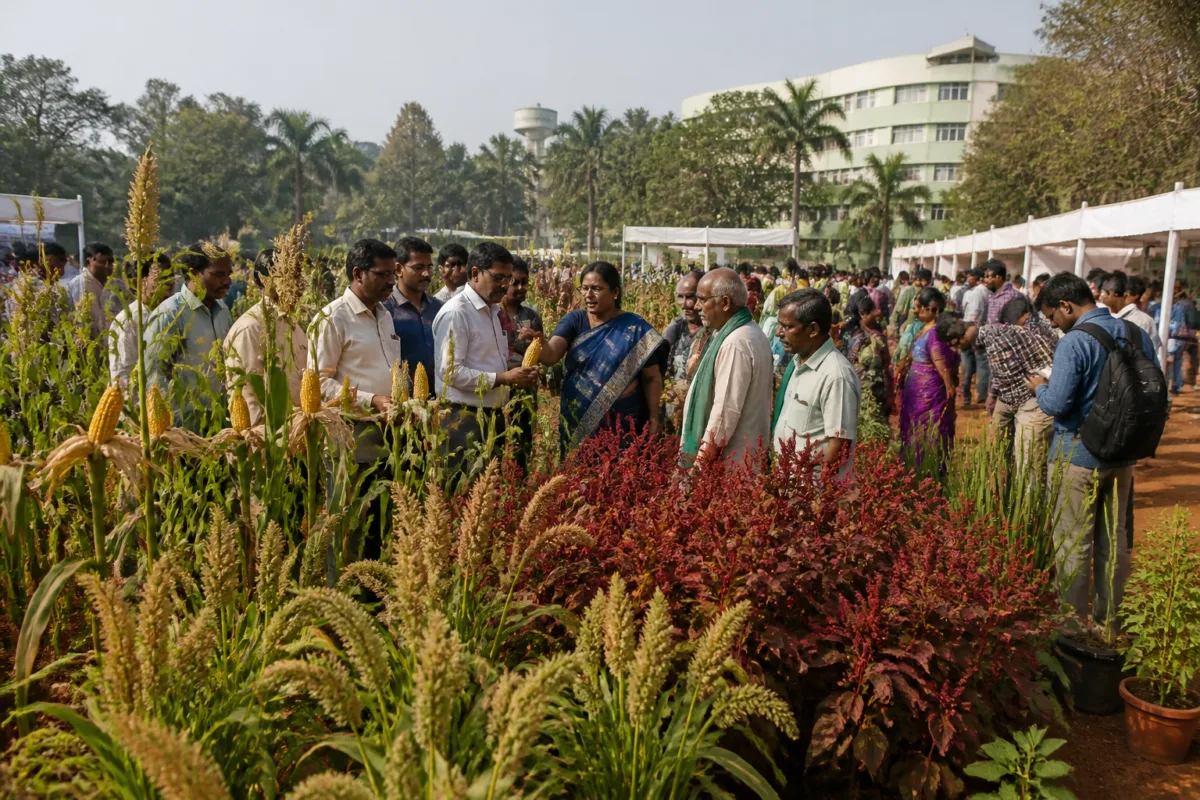
The Karnataka drought situation took centre stage at the inauguration of Krishi Mela 2026 in Bengaluru, where the University of Agricultural Sciences (UAS) unveiled three crop varieties designed to support farmers facing rainfall deficits and increasing climate uncertainty. The three-day event began at the Gandhi Krishi Vignana Kendra campus, with a focus on water conservation, drought-tolerant farming and technologies intended to improve farm incomes.
Agriculture Minister P M Narendra Swamy said 226 of Karnataka’s 240 taluks were facing drought conditions and that crop losses had been reported across several regions. He said the state government had decided to provide initial assistance of Rs 5,000 to every affected farmer.
The minister also said 37.5 lakh farmers had registered for crop insurance during the 2026 kharif season. Union Minister of State for MSME and Labour and Employment Shobha Karandlaje called for stronger implementation of crop insurance schemes and timely compensation for farmers affected by drought and floods.
The three varieties released at the fair are GPU 101, a drought-tolerant, medium-duration finger millet variety; KBGA 18, a high-protein amaranthus variety; and MH 2045, a hybrid maize variety known for its yield potential and suitability for fodder production. The releases are part of UAS Bengaluru’s wider agricultural research programme. The university, which has entered its 61st year, has developed more than 340 crop varieties so far.
The event’s water-management focus reflects the immediate pressure on farm systems across the state. Swamy urged farmers to adopt dryland farming, rainwater harvesting, farm ponds, lake revival and micro-irrigation. He also encouraged diversification into horticulture and allied activities, along with the use of digital agriculture, artificial intelligence and drone technology.
The minister announced plans for the proposed ‘Raitha Chaitanya’ initiative, which is intended to provide farmers with soil-health information and early alerts on crop diseases through mobile applications. Another proposed programme, ‘Negilu Yogi’, is expected to support small farmers with ploughing, sowing and harvesting services.
Karandlaje also highlighted value addition, food processing, cold storage and direct market linkages as measures to reduce post-harvest losses. These interventions were presented as part of a broader response to drought and farm-income pressures, alongside crop insurance and improved production practices.
Krishi Mela 2026 features around 100 technology stalls, agricultural demonstrations, an insect wonderland, a honey garden and a forest-themed display. The university also released publications on agricultural technologies and the achievements of successful farmers. Six state-level awards, district-level awards and recognitions for young and women farmers were presented at the inaugural programme.
UAS Vice-Chancellor P Venkataramana, agricultural scientists, senior officials and elected representatives attended the event. The fair will continue for three days at the GKVK campus, with farmers able to access the technology demonstrations and crop-related information presented by the university and participating institutions.

