


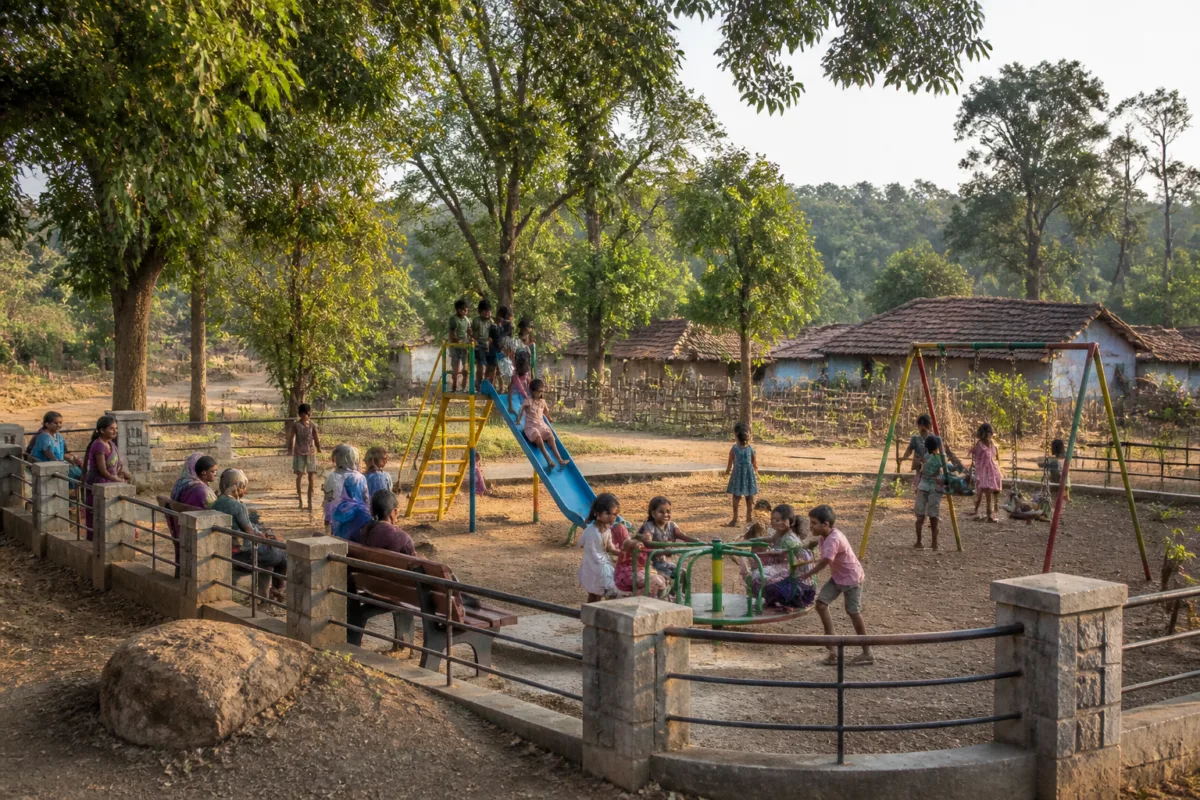
Kanha Tiger Reserve’s plan to build 51 children’s parks in villages along its buffer-zone fringe is more than a public-space project. It is an attempt to connect conservation with the everyday institutions and facilities that shape life in forest-edge settlements. By March 2027, the reserve management aims to establish the parks as places where children can play, learn about biodiversity and remain connected to the forests around them.
Three Kanha Bal Udyans have already been completed and handed over to Eco-Development Committees in Manori, Kuktisarai and Khursipar, under the Motinala buffer range of the Buffer Zone Forest Division. Four more are under construction. The projects are being taken up on proposals from village EDCs, making the initiative notable not only for its physical infrastructure but also for the mechanism through which the infrastructure is being selected and delivered.
That mechanism places the village committee between the forest administration and the community. The report describes EDCs as bodies formed under the Joint Forest Management framework and says they act as a link between forest officials and villagers. Regular meetings with EDC members have helped identify local requirements and convert them into projects. In this arrangement, the children’s parks are not presented as stand-alone recreational facilities. They are part of a wider effort to make conservation visible in the villages that live closest to the reserve.
The location matters. The parks are being developed in villages affected by human-wildlife interactions, where the relationship between protected forests and surrounding communities is experienced through daily contact with wildlife and forest administration. The source report does not provide figures on the frequency or nature of these interactions, nor does it establish whether the parks have already changed local attitudes. It does, however, show that the reserve management is treating community infrastructure as one part of its conservation approach.
The proposed parks also give the reserve a way to engage with residents beyond formal protection and enforcement activities. Their stated purpose includes nature education, with children expected to learn about forests, wildlife and biodiversity at an early age. The reserve management has described children as the custodians of the future of forests and wildlife. That statement reflects the programme’s underlying logic: conservation is being linked to education and public space so that the reserve is not understood only as a restricted landscape, but also as an institution participating in village life.
This is where the Kanha initiative raises a broader governance question. Protected areas often operate through boundaries, regulations and enforcement, while communities experience them through access, livelihoods, safety and public services. The report does not claim that parks can resolve these larger issues. It shows instead that the reserve is using a modest, visible form of local infrastructure to build a relationship with villages in its buffer zone. The effectiveness of that approach will depend on whether the facilities remain useful, locally managed and connected to wider community needs.
The handover of the completed parks to EDCs is therefore an important administrative detail. It indicates that construction and ownership are being separated from day-to-day community responsibility. The source does not specify the maintenance arrangements, budgets, staffing or standards for the parks. Those details will determine how the facilities function after construction. A park that is completed but not maintained would offer limited long-term value; the supplied report, however, does not provide evidence to assess that risk or describe the systems planned to address it.
The reserve’s parallel work in schools broadens the initiative. Desks and benches have been provided in 20 schools, smart classrooms have been developed in four schools, and more than 50 schools have received school bags, shoes, socks, tiffin boxes, water bottles and stationery. These interventions are also being implemented through EDCs. Together, the parks and school support suggest that the reserve management is using community committees to identify and deliver projects across both public space and basic educational infrastructure.
The numbers supplied in the report show the scale and the stage of implementation. The target is 51 parks by March 2027. Three have been completed and handed over, while four are under construction. This means seven parks are at some stage of delivery, leaving 44 still to be completed if the target is to be met. The report does not state whether land has been identified for all 51 sites, how much each park costs, or whether the March 2027 deadline is tied to a formal budget or implementation schedule. Those are significant gaps for evaluating delivery, but they do not change the central fact that the reserve has announced a defined expansion programme with early projects already completed.
The implementation model also illustrates how environmental governance can extend into the built environment. A children’s park is a small intervention compared with roads, schools or housing, but its location and management can affect how residents use village space. In the Kanha context, the facilities are intended to provide children with safe places to play and learn, while also offering women, young people and senior citizens a place to spend time within the village. The report does not provide usage data or independent assessments of safety. Its evidence is limited to the stated purpose of the parks and the reserve’s account of the programme.
The school projects add another layer to this civic approach. Desks and benches address the immediate physical setting in which children study, while smart classrooms introduce a technology component. The report does not identify the technology used, the number of students covered or how the classrooms are being operated. It also does not establish whether the school supplies were distributed uniformly or according to specific local needs. What it does establish is that the reserve is directing community-development support through the same EDC structure used for the parks.
This makes the EDC central to the programme’s institutional design. If the committees are able to communicate local priorities and participate in decisions, they can help ensure that projects reflect village requirements rather than being imposed uniformly from outside. At the same time, the available information does not explain the committees’ composition, decision-making rules, financial authority or accountability arrangements. Without those details, it is not possible to judge how representative the process is or how disputes over project selection would be handled.
The initiative also raises a question about how conservation benefits are understood. The source report presents the parks and school facilities as a way to link conservation with community development and create environmental awareness among children. That is a clear institutional objective. But awareness alone is not evidence of improved conservation outcomes. The report supplies no data on changes in wildlife conflict, forest dependence, local participation or attitudes towards the reserve. Those outcomes would need to be measured separately rather than inferred from the construction of parks or distribution of school materials.
The most immediate test, therefore, is implementation. Kanha’s target requires the reserve to move from seven parks completed or under construction to 51 by March 2027. The next milestones will include the completion of the four ongoing parks, identification and approval of additional village proposals, and clarification of how the completed facilities will be maintained by the EDCs. The quality of the school interventions and their continued operation will also matter, particularly for the smart classrooms.
Kanha’s plan confirms a shift towards treating community-facing infrastructure as part of conservation administration in buffer villages. It does not yet prove that the model will reduce human-wildlife conflict or produce measurable changes in environmental behaviour. What the available evidence establishes is narrower but important: the reserve is using EDC-led projects to combine children’s public spaces, nature education and school support, with 51 parks targeted by March 2027. The programme’s lasting significance will depend on whether the promised facilities are completed, maintained and meaningfully integrated into village life.

