


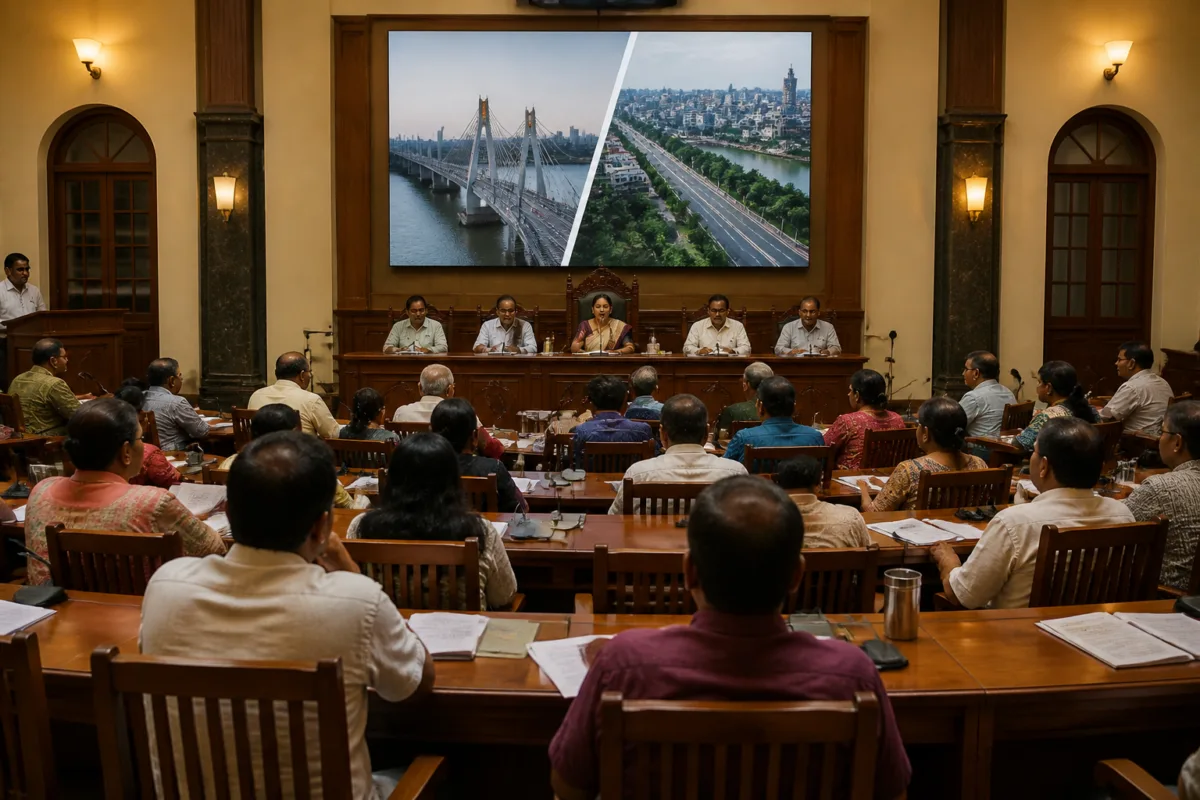
The proposed Thiruvananthapuram-Ahmedabad twin-city partnership is being presented as a mechanism for exchanging urban solutions, but its approval has immediately exposed the difficult question that often follows city-to-city learning: what exactly can be transferred from one municipal system to another without reproducing its political, social or administrative problems?
The Thiruvananthapuram corporation council approved the proposal despite opposition from LDF councillors, who questioned the need to adopt Ahmedabad’s development model and warned that the partnership could lead to large-scale displacement. The proposed collaboration is expected to cover scientific waste management, road infrastructure, water-body rejuvenation, technology transfer, traffic management, e-governance and resource mobilisation.
Mayor V V Rajesh said the partnership would allow the two cities to exchange development experience, administrative practices, innovative ideas, technology and urban development models. He also said the objective would not be limited to a study tour, but would involve identifying successful projects and adopting suitable models for Thiruvananthapuram.
That distinction is important. A city partnership can remain a symbolic exchange of delegations, presentations and memoranda, or it can become a structured mechanism for adapting specific municipal practices. The information available so far suggests that Thiruvananthapuram is considering the second route, but the council has not yet signed the proposed memorandum of understanding. The mayor said an all-party delegation would first be given an opportunity to visit Ahmedabad and study its projects firsthand.
The proposed areas of cooperation indicate that the pact is not limited to one civic service. Waste treatment plants and waste-to-energy facilities are among the Ahmedabad experiences that the corporation plans to examine. Road infrastructure, traffic management and water-body rejuvenation would extend the partnership into physical infrastructure, while e-governance and municipal bonds would address the administrative and financial systems needed to deliver projects.
This broad scope creates both opportunity and difficulty. Waste management, transport, water bodies and digital governance are not isolated functions. They depend on land, procurement, operating capacity, municipal finances and public acceptance. A technology or project model that works in one city cannot be transferred simply because it appears successful there. The receiving corporation would need to establish which conditions made the model viable and whether those conditions exist locally.
Waste management has already become the first major point of disagreement. CPM parliamentary party leader Deepak S P argued that the city should focus on smaller, decentralised projects rather than large-scale facilities. He also alleged that the partnership could result in large-scale displacement. The mayor challenged him to identify successful smaller waste-management models that could be replicated, while Deepak sought more time to provide details.
The exchange shows that the central policy question is not merely whether Thiruvananthapuram should improve waste processing. It is also about the scale, location and institutional design of the facilities chosen. Large treatment plants and waste-to-energy projects may be attractive as visible infrastructure, but their adoption would require the corporation to demonstrate how land requirements, neighbourhood impacts, operating arrangements and public accountability would be handled. The supplied report does not establish those details, which means they remain central issues for the proposed study and any later MoU.
The allegation regarding Ahmedabad’s urban development projects also remains contested within the council. Deepak said he had right to information documents indicating corruption, but did not produce them when BJP councillor V G Girikumar challenged him to submit the documents. On the evidence available, the allegation cannot be treated as established. It does, however, underline why the partnership will need a transparent basis for evaluating projects rather than relying on reputation or political messaging.
UDF parliamentary party leader K S Sabarinadhan said his front would support initiatives that benefit the city and argued that the corporation should study successful urban development models in other cities, including Indore, rather than limiting its focus to Ahmedabad. His position broadens the debate beyond a binary choice between support and opposition. The relevant question is whether the corporation will compare multiple models and publish the criteria used to select projects for adaptation.
The mayor’s stated willingness to explore development opportunities anywhere in the country also suggests that the Ahmedabad partnership is being treated as a starting point rather than the only source of policy ideas. However, the council’s approval currently provides a political mandate to explore the partnership, not evidence that any specific Ahmedabad project will be adopted. The next stage—an all-party delegation’s visit, project assessment and preparation of an MoU—will determine whether the arrangement develops into an implementation framework.
Municipal bonds and other innovative funding mechanisms are another significant element of the proposal. Their inclusion indicates that the corporation is considering not only how to build infrastructure but also how to finance major projects. Yet the report does not specify the size of any proposed borrowing, the projects that could be financed, the revenue model or the repayment arrangements. These omissions matter because a funding instrument is not a substitute for a financially viable project. Any future proposal would need to connect the financing mechanism to clearly identified assets, costs and municipal capacity.
The partnership also raises a question about the role of political consensus in municipal administration. The LDF members walked out after insisting that their dissent be officially recorded, while the BJP-led council proceeded with the agenda. The mayor’s offer of an all-party delegation creates an opportunity to bring opposition members into the fact-finding stage, but participation alone will not resolve disagreements. The council will still need to distinguish between verifiable project performance, political claims and models that are unsuitable for local conditions.
For residents, the practical significance of the pact will depend on whether it produces measurable improvements in everyday services. The proposed subjects—waste processing, roads, traffic, water bodies and e-governance—are all areas where municipal decisions become visible at street level. But the council has not announced a project list, implementation schedule, budget, performance indicators or public consultation process. Until those elements are defined, the partnership remains an approved framework for exploration rather than a confirmed programme of urban works.
The available evidence therefore supports a limited but important conclusion. Thiruvananthapuram has approved a broad city partnership with Ahmedabad, and the partnership could influence how the corporation approaches infrastructure, waste, technology and municipal finance. It has not yet established that Ahmedabad’s models will be adopted, that displacement will occur, or that alleged corruption took place. Those claims require documentary examination and clearer project-level evidence.
The next meaningful milestones are the proposed all-party visit, the assessment of Ahmedabad’s projects and the drafting of the memorandum of understanding. The quality of that process will determine whether the twin-city pact becomes a tool for evidence-based municipal learning or remains a politically contested study exercise.

