


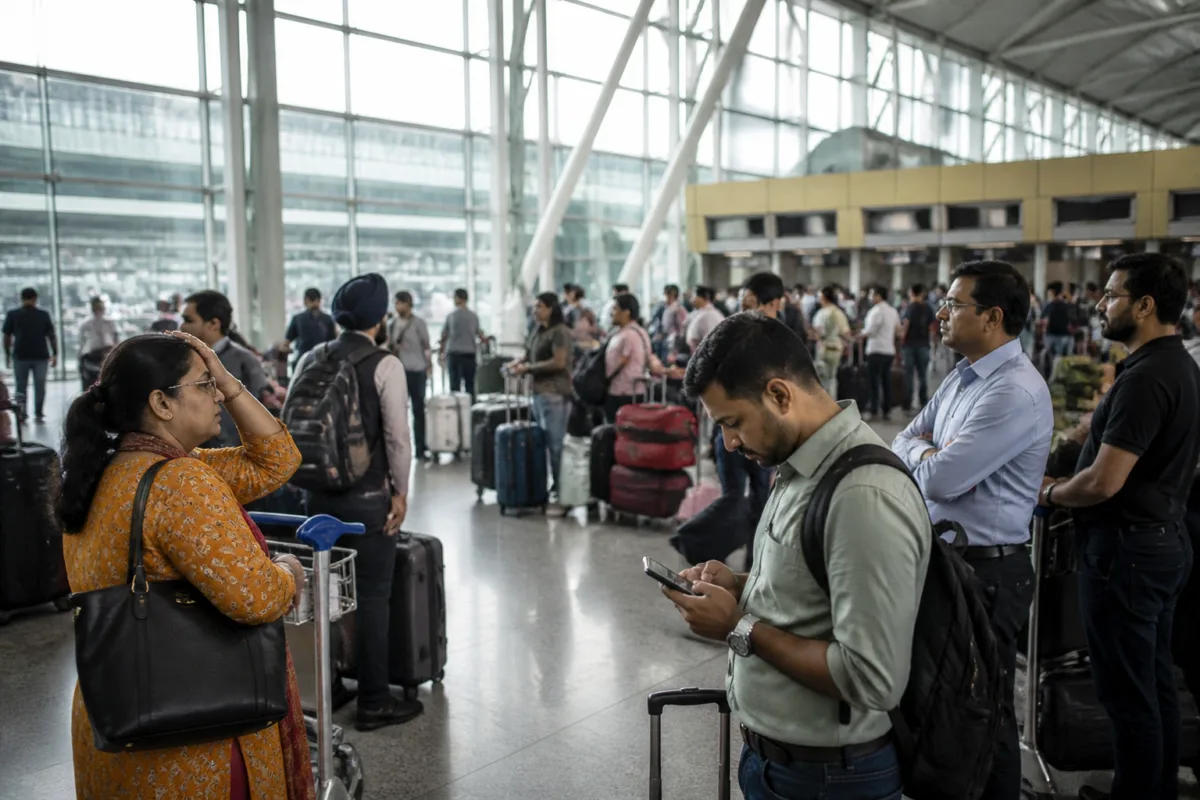
SpiceJet cancellations affecting Ahmedabad’s Srinagar, Dubai and Bagdogra connections during the festive travel period show how quickly a flight disruption can become a wider urban mobility failure. Passengers described lost hotel bookings, abandoned itineraries, expensive rerouting and journeys that stretched from a few hours to almost an entire day. The incidents also exposed the dependence of travellers, hotels, taxis and travel businesses on predictable air links.
The Times of India report, published on November 17, documented disruptions on several days during the second and third weeks of November. The affected routes included Ahmedabad-Srinagar, Ahmedabad-Dubai and services connecting the city with Siliguri, which serves the Bagdogra travel market. The report did not establish a single official reason for the cancellations. An email sent to SpiceJet seeking details of the disruptions, passenger assistance and compensation had not received a response when the report was published.
That unanswered question is important because the immediate experience of a cancelled flight is shaped not only by the loss of an aircraft movement. It also depends on how quickly the airline communicates, whether passengers can obtain workable alternatives, and how much of the resulting cost is transferred to travellers. In the cases described, passengers had to make those arrangements themselves, often at short notice and during a period of high travel demand.
For Ahmedabad passenger Dr Anand Thakkar, a trip to Srinagar lost an entire day after a flight scheduled to arrive around noon landed close to midnight. He had already paid Rs 20,000 for a hotel room. Plans to travel to Gulmarg also had to be cancelled and shifted to another day. The disruption therefore affected more than the flight sector: it altered the accommodation booking, local transport arrangements and the sequence of a multi-stop holiday.
Thakkar also described confusion outside Srinagar airport after cancellations, with local cab drivers waiting for passengers who did not arrive. He said a friend travelling from Srinagar to Ahmedabad found the return flight cancelled and eventually travelled to Udaipur before hiring a taxi to reach Ahmedabad. That route illustrates the practical gap between a formal cancellation and a usable replacement journey. A passenger may technically be able to reach the destination, but only by combining another flight with a long road transfer.
A second account involved Ahmedabad entrepreneur Nirjari Shah, who had booked her Dubai-Ahmedabad journey three months in advance after travelling to Abu Dhabi for a music concert. When the return flight was cancelled at the last minute, she bought a one-way ticket from Dubai to Mangalore for Rs 45,000. She then flew to Bengaluru and found another flight to Ahmedabad. The journey took nearly 14 hours, compared with the roughly three to three-and-a-half hours normally required for a direct Dubai-Ahmedabad trip.
These accounts reveal three distinct dimensions of air connectivity. The first is reliability: whether a scheduled service operates as promised. The second is network resilience: whether passengers have practical alternatives when it does not. The third is affordability: whether those alternatives remain financially accessible. A city’s connectivity is weak if it offers a direct route on paper but leaves passengers to pay heavily for indirect journeys when the service fails.
The disruption also travelled beyond the airport. Hotels in Srinagar and Gulmarg were affected when travellers lost or rearranged nights. Cab drivers waited for passengers whose flights had been cancelled. Travel companies had to manage customer uncertainty and search for alternatives. The report quoted Ankit Bajaj, an Ahmedabad travel-company owner, as saying that passengers often waited for hours to reach customer-care representatives and did not receive satisfactory solutions.
Bajaj described cancellations and chaos across routes including Srinagar, Delhi and Dubai. He said his company had avoided booking clients on the airline because it anticipated operational uncertainties. That statement is an industry participant’s assessment, not independent evidence of the airline’s overall performance. It nevertheless points to how concerns about reliability can influence booking decisions before passengers reach the airport.
The Ahmedabad cases therefore raise an institutional question: who is responsible for maintaining continuity when an airline cancels a service? The airline controls the flight operation and the first response to affected passengers. Travellers, however, also depend on airport processes, customer-care systems, alternative airline capacity, hotel policies, taxis and destination-side transport. When these links are poorly coordinated, a disruption becomes a chain of separate failures rather than a single cancelled booking.
The supplied report does not provide the number of cancelled flights, the total number of affected passengers, the cancellation rate on the routes, or the precise compensation offered in individual cases. It also does not include a response from SpiceJet explaining whether the incidents arose from aircraft availability, crew constraints, weather, technical issues or another cause. Those gaps limit what can be concluded about the scale and cause of the problem.
What the evidence does establish is the scale of impact on the passengers interviewed. One traveller lost a day and faced a Rs 20,000 hotel cost linked to a disrupted Srinagar itinerary. Another paid Rs 45,000 for an indirect Dubai-to-Ahmedabad journey and spent nearly 14 hours travelling. The report also records repeated cancellations on several routes over multiple days during the second and third weeks of November, rather than describing a single isolated incident.
The timing added pressure. The affected services coincided with the festive travel rush, when demand for holiday travel and available replacement seats can be expected to be particularly consequential. The report does not provide fare comparisons or capacity data, so it cannot establish how much prices increased across the wider market. The individual account from Dubai nevertheless shows the financial exposure faced by a passenger who must rebook at short notice.
For a city such as Ahmedabad, air connectivity links residents to tourism, business, family travel and other urban economies. The report specifically connects the disrupted journeys to Srinagar, Gulmarg, Dubai, Abu Dhabi, Mangalore, Bengaluru, Udaipur and the Bagdogra travel market. These links operate as a network: when one direct service fails, passengers may try to substitute another airport, another airline or a road journey. The quality of that substitution determines whether connectivity remains meaningful.
The passenger experience also shows why airport infrastructure cannot be assessed only through terminals, runways or route maps. Communication systems and customer support are part of the service infrastructure. A passenger waiting hours for a response is facing an access problem even if the airport itself remains operational. Similarly, a direct route that cannot be relied upon creates hidden costs for hotel bookings, local transport and time away from work or leisure.
The report does not establish whether airport authorities, aviation regulators or local administrations intervened in the affected cases. Nor does it record any formal direction on refunds, rebooking or compensation. This absence of documented response is itself a limit on the public record supplied for the report, not evidence that no action occurred.
The immediate policy and administrative issue is therefore not simply whether cancellations happen. Disruptions are a recognised risk in air travel, but passengers need clear information about what happens next. The evidence from Ahmedabad points to weaknesses in that transition: delayed assistance, expensive alternative routes and uncertainty about support. A fuller assessment would require the airline’s explanation, route-level operational data and details of the remedies made available to passengers.
The Ahmedabad incidents also underline the difference between nominal connectivity and dependable connectivity. A flight schedule can show that Ahmedabad is linked to a destination, but residents experience that link through punctuality, cancellation handling and the cost of recovery when plans fail. For travellers, hotels and local transport providers, the value of a route depends on all three.
The available evidence supports a cautious conclusion. SpiceJet disruptions on several Ahmedabad-linked routes during the November festive travel period imposed substantial costs on at least the passengers interviewed and affected connected urban services such as hotels, taxis and travel agencies. The wider scale and causes remain unestablished in the supplied material. The next facts to watch are the airline’s explanation, the extent of passenger assistance and whether the affected routes return to consistent operation.

