


Bengaluru’s decision to fund four startups to address ageing water pipelines is more than a technology pilot. It is an attempt by the Bangalore Water Supply and Sewerage Board (BWSSB) to confront a problem that remains largely invisible to residents until a road is dug up, a supply line fails or contaminated water reaches homes: much of the city’s water infrastructure is underground, old and difficult to monitor.
The four Karnataka-based startups have been shortlisted through the state government’s startup initiative and will receive Rs 25 lakh each from the IT department. Their names are expected to be announced at the Bengaluru Tech Summit. The pilot will have a total funding allocation of Rs 1 crore and will focus on three problems identified by BWSSB, although the supplied report does not specify the individual problem statements.
The board’s stated objective is to improve service delivery and reduce non-revenue water, which refers to water supplied into the network but not billed. In the report, BWSSB chairperson Manjula N said the pilot would seek solutions that the board does not currently have. Depending on the results, BWSSB may develop one of the ideas further or invite a tender for a full-scale proposal.
That proposed sequence matters. The pilot is not yet a citywide infrastructure contract, nor is it a guarantee that any of the four technologies will be adopted permanently. It is an effort to test whether startup-led solutions can solve operational problems that conventional maintenance has struggled to address. The institutional question is therefore not only whether a technology can detect a leak, but whether BWSSB can integrate it into routine inspections, repairs, procurement and accountability.
The immediate target is the difficult space between water production and water billing. Non-revenue water can result from physical losses such as leaks, as well as unauthorised consumption and weaknesses in measurement or billing. The supplied report focuses primarily on leakages, particularly those that are hard to locate because pipelines are old, underground and sometimes fail without producing visible signs at the surface.
This makes leak detection a governance problem as much as an engineering problem. A visible burst pipe creates an obvious maintenance request. A slow leak below a paved road, however, may continue without a clear public signal. Locating it can require excavation, traffic management and repeated disruption. Until the leak is identified and repaired, the board may continue supplying water that does not reach a paying consumer.
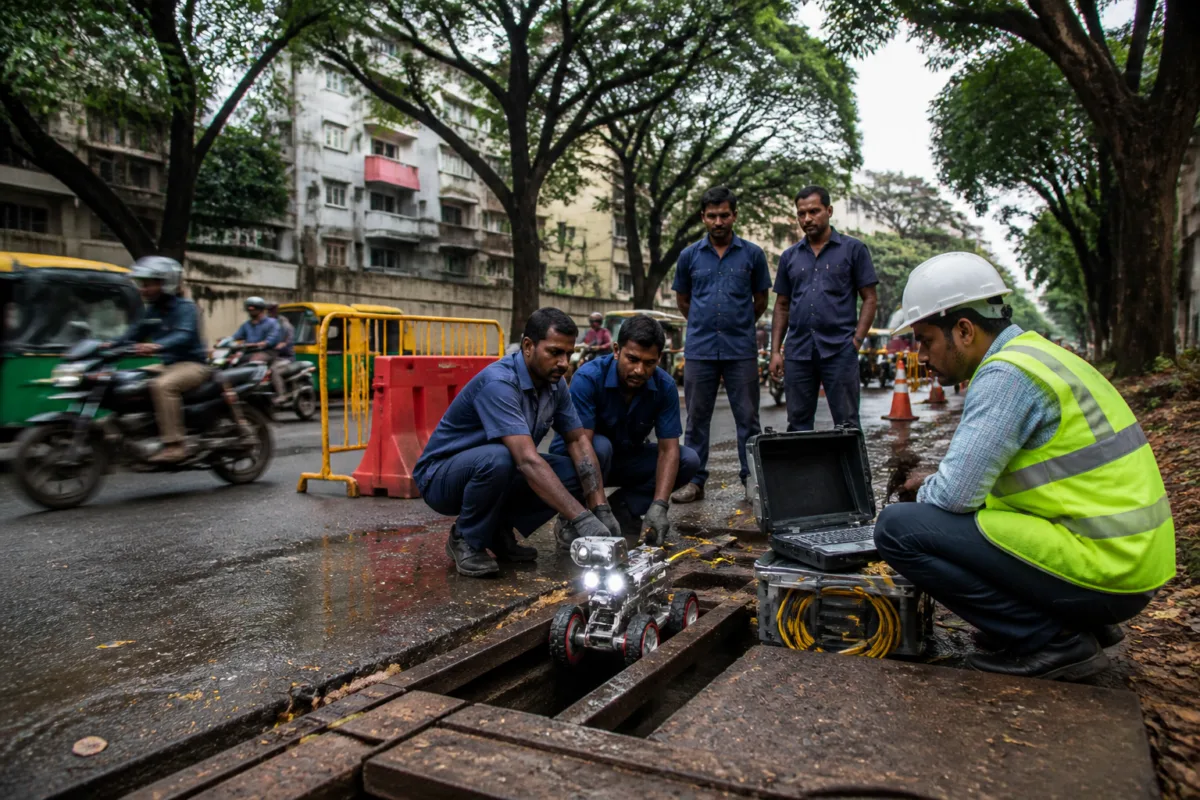
BWSSB has already experimented with technology. The report states that the board’s chairperson launched artificial-intelligence-based tools last year to help identify leakages. The new pilot is intended to look beyond that earlier effort, particularly at technologies that can detect problems without digging up roads. This indicates a shift from treating excavation as the default investigative method towards using information and inspection tools before opening the carriageway.
The distinction is important for a dense city. Road digging is not a single-agency activity. It can slow traffic, generate dust and extend inconvenience for residents and businesses. It can also create a chain of secondary problems when reinstatement is delayed or when multiple utilities occupy the same corridor. The article does not provide a citywide estimate of the time or cost associated with such disruption, but it records that BWSSB engineers previously relied on trial-and-error excavation to locate leaks, sewer blockages and structural defects.
There is evidence in the report that targeted inspection can reduce unnecessary excavation. BWSSB officials had previously said robotic inspection of underground pipelines helped avoid road digging at 399 locations across Bengaluru. Between November 2025 and May 2026, the robotic units covered about 32.7 km of pipeline and detected 394 defects, including leakages, blockages, fractures and structural damage.
Those figures describe the value of inspection, but they also reveal the scale of the challenge. The inspected network covered 32.7 km, while 394 defects were detected across that length. The report does not state the total length of BWSSB’s water and sewerage network, so the findings cannot be treated as a citywide defect rate. They do, however, show that underground inspection can identify multiple types of failure in a relatively limited stretch of pipeline and allow repairs to be targeted rather than exploratory.
The pilot’s potential significance lies in connecting three functions that are often treated separately: detecting an asset problem, locating it accurately and deciding how to repair it. A tool that identifies a leak but cannot provide a usable location may not reduce excavation. A robotic system that detects structural damage but does not feed information into BWSSB’s maintenance records may produce a one-time survey rather than a durable management system. The supplied material does not establish whether the four startups will be evaluated against such integrated criteria, making the eventual pilot design important.
The risks of ageing infrastructure are not limited to water loss. The report cites an incident in Lingarajapuram involving a rusted 40-year-old cast iron drinking-water pipeline connected to an individual house. Sewage entered the drinking-water line through a corroded galvanised iron house connection while water and sewage lines ran alongside each other. People fell sick after the contamination.
That incident shows how network risk can emerge at the interface between public infrastructure and private connections. Replacing a main pipeline alone may not eliminate contamination if household connections remain old, damaged or incorrectly configured. Conversely, a problem that appears to originate inside a house can expose weaknesses in how water and sewage lines are separated, inspected and maintained across the wider network.
The case also places the startup programme within a broader service-delivery framework. BWSSB is not simply looking for a device that finds leaks. It is dealing with a combination of ageing mains, underground assets, household connections, structural defects, blockages and the operational consequences of opening roads. The board’s three identified problem areas may therefore determine whether the programme produces a narrow technology demonstration or a more useful maintenance system.
Funding arrangements will shape that outcome. The pilot is funded by the IT department rather than described as a conventional BWSSB capital project. Each startup is to receive Rs 25 lakh, with the total allocation capped at Rs 1 crore. This structure lowers the entry barrier for smaller firms and allows the state to test several approaches at once. It also means that the pilot will need a clear path from experimentation to public procurement if a solution proves effective.
BWSSB’s stated plan to build on a successful idea or invite a tender for a full-scale proposal recognises that pilot funding and municipal deployment are different stages. A technology may work under controlled conditions but require additional investment, staff training, data standards and maintenance contracts before it can be used across the city. The report does not specify the proposed duration, performance indicators or procurement conditions, so those details will be central to judging the programme once the startups and pilot terms are made public.
The numbers currently available suggest an infrastructure system moving towards more systematic diagnosis, but not yet one that can be assessed comprehensively. The robotics programme inspected 32.7 km and recorded 394 defects over seven months from November 2025 to May 2026. The new pilot will involve four startups and Rs 1 crore in funding. What remains unavailable in the supplied material is equally important: the volume of water lost through non-revenue water, the proportion attributable to physical leakage, the total length and age profile of the network, and the cost of previous excavation-led repairs.
Without those baseline figures, it will be difficult to determine whether the pilot reduces water losses or merely improves the detection of known defects. A credible evaluation would need to establish what was found, how quickly it was repaired, whether excavation was avoided, and whether service reliability or billing recovery improved. These are not claims established by the current announcement; they are the measurable questions that follow from BWSSB’s stated objectives.
For Bengaluru residents, the practical test will be visible in less disruptive maintenance and safer water, rather than in the novelty of the technology itself. A successful system would help the board identify underground failures before they become surface emergencies, reduce the need for repeated road cutting and improve its understanding of the condition of assets that residents cannot see. The Lingarajapuram contamination incident also shows why inspection must include connections and the relationship between water and sewage lines, not only large public mains.
The larger urban question is whether Bengaluru can manage water infrastructure as a continuously monitored network rather than as a collection of emergencies. The startup pilot creates an opportunity to test that approach, but its outcome will depend on what BWSSB chooses to measure and what happens after the pilot ends. The immediate milestones are the announcement of the four startups, disclosure of the three problem statements and the publication of results that show whether the tested solutions can move from demonstration to full-scale public use.

