


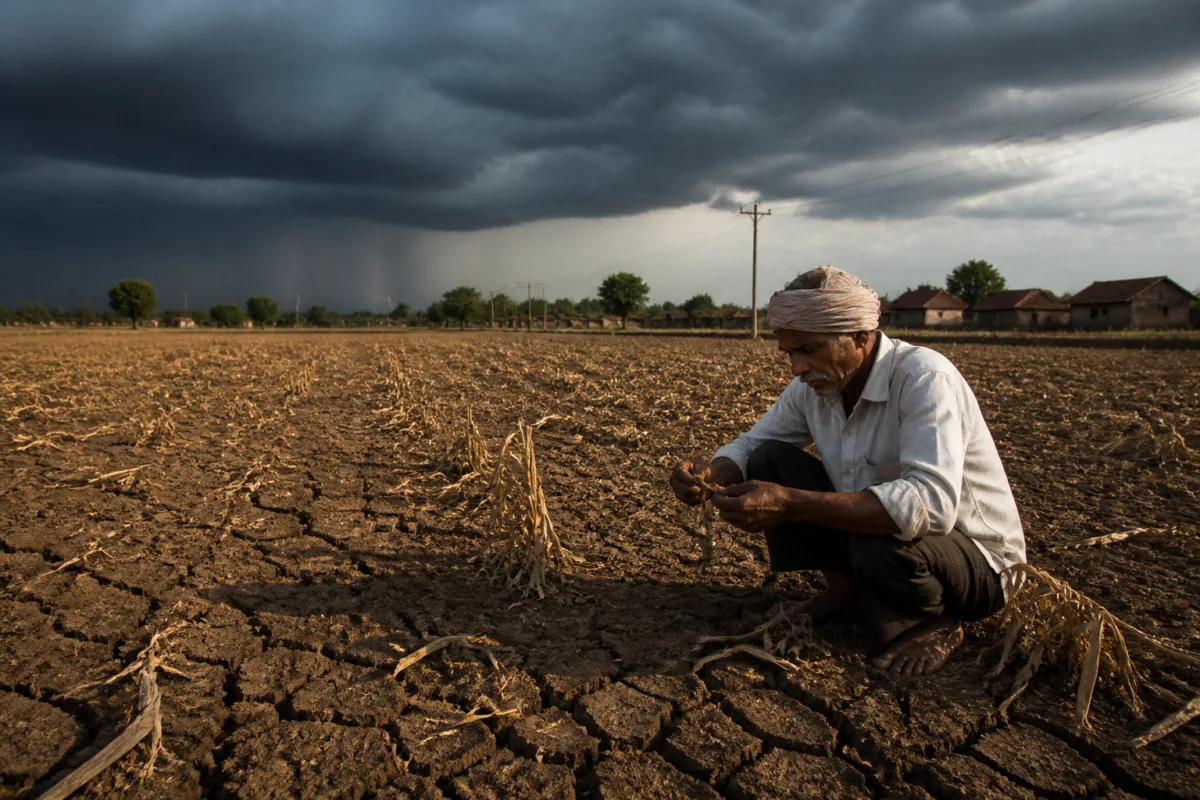
An RTI response has exposed a large gap between Maharashtra’s disaster-relief demands and the funds it received from the Centre between 2014 and 2024. The state sought Rs 28,251 crore for drought, crop losses, cyclone damage and pest attacks, but received Rs 11,051 crore, or 39.12 per cent of the amount sought.
The figures matter beyond the immediate dispute over one funding decision. They show how disaster response depends on an administrative chain in which damage must be assessed, a state must submit a demand, central authorities must examine it, and assistance must then be released. The numbers supplied in the RTI response make the gap visible, but they do not by themselves establish why each demand was reduced or rejected. That limitation is important: the data documents the outcome of the process more clearly than the reasoning behind every allocation.
According to the report published by Loksatta – Mumbai, the information emerged from a response by the Union Ministry of Agriculture and Farmers Welfare to an RTI application. The demands covered drought, excessive rainfall, the Ockhi cyclone and crop damage caused by pests and snails. The reported period extends from 2014 to 2024, allowing the figures to be read as a pattern across multiple agricultural seasons rather than as an isolated shortfall.
The widest gap cited in the supplied data concerns 2017-18. Maharashtra sought Rs 3,373.31 crore for losses linked to pest and snail infestations and the Ockhi cyclone. The assistance recorded in the RTI response was only Rs 60.76 crore. That amounts to a small fraction of the demand and represents the sharpest example in the information provided of the distance between assessed need and released support.
The comparison is less severe, though still substantial, for the two drought years specifically detailed in the report. For drought relief in 2014-15, the state sought Rs 6,013.28 crore and received Rs 1,962.99 crore. In 2015-16, it sought Rs 8,272.02 crore for drought conditions affecting the kharif and rabi seasons and received Rs 4,318.37 crore.
These figures should not be read as a simple accounting exercise. Disaster relief is an institutional response to a loss that has already occurred, but the speed and scale of that response influence how households, local economies and public systems absorb the shock. When a demand is only partly met, the difference has to be managed somewhere else. The supplied material does not identify how Maharashtra covered the gap in each year, whether through its own resources, other relief mechanisms or delayed assistance. It does, however, establish that the state’s requested amount and the Centre’s recorded assistance were often far apart.
The RTI disclosure also draws attention to the distinction between a disaster event and the administrative recognition of that event. A drought, cyclone or pest attack may affect different districts and crops in different ways, while a financial demand is presented as a consolidated figure. The final allocation therefore reflects not only the scale of damage reported by the state but also the rules, assessments and decisions applied during the review process. The available report does not provide the detailed assessment criteria or the central government’s year-wise explanations for the reductions.
That missing layer is central to understanding the numbers. The aggregate figure of Rs 11,051 crore against a demand of Rs 28,251 crore establishes a 60.88 per cent gap. It does not establish that every shortfall represented an administrative error, nor does it show whether the state’s original demands were accepted in full as eligible claims. A rigorous reading of the data must therefore separate three questions: how much damage the state reported, how much it requested, and how much assistance was ultimately approved and released. The supplied figures answer the second and third questions, but not the entire chain between them.
The report identifies one particularly significant decision from 2023-24. During the drought situation that year, the state was reportedly told that sufficient funds were available with the State Disaster Response Fund and that assistance would not be provided directly. This introduces a different dimension to the funding gap. The issue was not only the amount of a central allocation, but also the institutional decision about which relief channel should be used.
A State Disaster Response Fund is mentioned in the supplied material as the basis for the refusal in 2023-24. The report does not provide the fund’s balance, the state’s specific request for that year, or the official reasoning beyond the statement that sufficient funds were available. Those details would be necessary to determine whether the decision reflected a funding rule, an assessment of available state resources, a dispute over eligibility or another administrative consideration.
That distinction is important for disaster governance. A state may seek additional assistance because the scale, timing or nature of a disaster exceeds its available resources. The central response may then depend on whether the event is handled through an existing state-level fund or through a separate allocation. If the public record shows only the amount demanded and the amount received, citizens can see the financial outcome but cannot fully evaluate the decision-making process. Transparency therefore requires more than a headline total; it requires the criteria, assessments and reasons attached to each major claim.
The year-wise details supplied by the report also show why a single average can conceal very different experiences. The 2014-15 drought demand was reduced from Rs 6,013.28 crore to Rs 1,962.99 crore. In 2015-16, the requested amount was higher at Rs 8,272.02 crore and the assistance was also higher at Rs 4,318.37 crore. In 2017-18, however, a demand of Rs 3,373.31 crore was followed by assistance of just Rs 60.76 crore. The absolute size of a demand did not therefore translate automatically into a comparable proportion of support.
The figures also span different kinds of shocks. Drought affects agricultural production over an extended period and can cover successive seasons. A cyclone creates a more concentrated event, while pest and snail attacks affect crops through biological damage that may vary by location and timing. Grouping these events into one decade-long total makes the overall shortfall clear, but it also means that the totals cannot explain how each category of disaster was assessed. A stronger public record would show the demand, approved amount, released amount, affected area, affected crops and stated reason for any reduction for every event.
For cities, the issue is not remote simply because the reported losses concern agriculture. Disaster relief is part of the wider resilience system that connects rural production, regional economies and public administration. Maharashtra’s urban centres are tied to districts through food supply, labour movement, markets and public finance. The supplied article does not quantify these connections, and it does not claim a direct urban impact. But it does show how the capacity to respond to shocks is shaped by decisions taken across levels of government rather than by local administration alone.
The disclosure also raises a question about how fiscal responsibility is distributed during repeated disasters. Maharashtra’s demands were made over ten years and covered several forms of loss. The state received less than half of the total amount requested. Without the underlying assessment documents, it is not possible to conclude whether the pattern resulted from consistently high state estimates, restrictive eligibility decisions, inadequate documentation, limited central resources or a combination of factors. The available evidence supports the existence of a sustained gap, not a definitive explanation for it.
That is precisely why the RTI figures deserve closer scrutiny. They create a starting point for examining the full relief process: the damage surveys conducted after each event, the basis on which the state calculated its demands, the central review of those demands, the movement of funds, and the time taken for assistance to reach affected households. Each stage can alter the final distance between loss and compensation.
The immediate public record therefore confirms three things. Maharashtra sought Rs 28,251 crore for specified natural-disaster and crop-loss events between 2014 and 2024. The Centre provided Rs 11,051 crore, equivalent to 39.12 per cent of the demand. And in 2023-24, the state was reportedly told that its State Disaster Response Fund had sufficient resources, resulting in a direct refusal of assistance. What remains unresolved in the supplied material is the year-wise rationale behind the reductions and the extent to which other funding channels covered the unmet need.
The next meaningful step is not simply another comparison between demanded and released funds. It is the publication of the supporting assessments and decisions that explain the difference. Until those documents are available, the RTI response establishes a serious funding gap in Maharashtra’s disaster-relief record, while leaving the administrative reasons for that gap only partly explained.

