


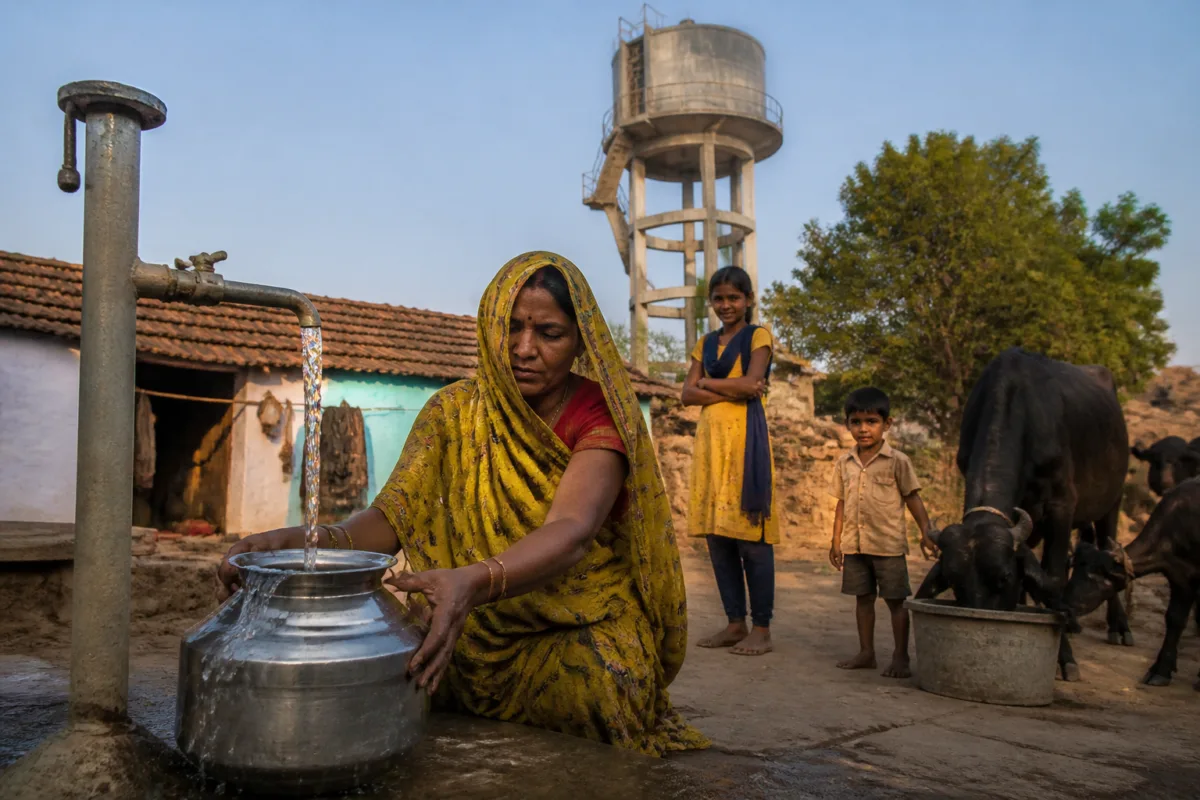
In parts of Bundelkhand, household water connections are changing more than the daily task of collecting drinking water. They are altering the conditions under which families assess marriage, education, work and the future of young people. A report by The Times of India describes villages where reliable tap supply has reduced the burden on women, helped children spend more time in school and eased a longstanding obstacle in the search for brides for local men.
The transformation is closely linked to the expansion of the Jal Jeevan Mission, which aims to provide tap connections to rural households. The report says that water scarcity in Bundelkhand once affected nearly every part of village life. Women walked several kilometres to wells, sometimes drawing water from depths of 70 to 80 feet. Children were pulled away from school to help. Agricultural activity and household incomes suffered, while men from poorer families migrated in search of work.
The water problem also entered the marriage market. Families were reluctant to send their daughters to villages where water collection was a daily and physically demanding responsibility. Some hamlets acquired a reputation as villages of bachelors. The burden was especially sharp for families with little or no land, whose sons had fewer economic assets to offset the difficulty of village life.
This was not simply a question of convenience. Water access determined how much time women could devote to education, paid work, childcare and rest. It also shaped how families judged the safety and dignity of a household. The report’s accounts show that the absence of water infrastructure became a private household burden, even though its causes and solutions were fundamentally public and administrative.
The contrast between two generations illustrates the shift. Bitto Singh, now the head of Bhabhaura village, recalls entering marriage after her father prioritised a match within their caste and in a relatively prosperous family. She had hoped to continue her education, but the water crisis consumed daily life. Her account connects water scarcity with the limited choices available to women and with the economic pressures faced by families arranging marriages.
For younger women, the experience can be different. Jyoti, a newly married resident cited in the report, receives water at home three times a day. Her family stores it for drinking and household needs, including for animals, and she describes the supply as clean enough for those uses. The difference between her routine and that of older women is not merely technological. It represents a transfer of time and physical effort from households to a public delivery system.
The available programme data indicates the scale of that transfer, although it also shows that coverage is not yet complete. According to data from the Union Jal Shakti Department cited by The Times of India, 2.47 crore rural households in Uttar Pradesh had tap connections against a target of 2.67 crore set on 15 August 2019. The Uttar Pradesh Jal Shakti department’s website lists households across 63,100 villages, including 9,344 villages covered through Jal Nigam. In 19,725 villages, all households are reported to have tap connections, while the remaining villages have coverage above 90%.
These figures describe connections and reported coverage, not necessarily identical household experiences of pressure, quality, reliability or frequency. The report, however, offers examples of how access is experienced at village level. In some homes, water is available at set times and stored for later use. That predictability matters because a source that can be reached at home reduces the uncertainty built into long walks, queues, wells and handpumps.
The institutional significance is that the Jal Jeevan Mission converts water from an individual coping exercise into a service-delivery responsibility. The Uttar Pradesh Jal Shakti minister, Swatantra Dev Singh, said the mission was saving women and girls the time and labour previously spent fetching water and that the government’s goal was to provide clean drinking water to every rural family. The statement places women’s labour at the centre of the programme’s public justification.
Yet a household tap does not automatically erase every inequality associated with water. The report records that some older men remain unmarried even as conditions improve for younger residents. In Hasaupur Sehsa and Bhabhaura, men in their late 20s, early 30s and 40s continue to look for matches. Their experiences reflect the cumulative effect of earlier economic hardship, limited landownership and the village’s previous reputation as a difficult place to live.
This lag is important. Infrastructure can change the conditions surrounding a social problem without immediately reversing the consequences of decades of deprivation. A young man who reached marriageable age when water was scarce may still carry the economic and social disadvantages created during that period. A village may gain a tap network, but household incomes, land access, migration patterns and social preferences do not change at the same speed.
The report also shows how water scarcity was reproduced across generations. Suman, now in her 40s, recalls that her village once had one well for drinking water, while a nearby pond was used for bathing and washing clothes. Drawing water from nearly 80 feet required the combined effort of three people. Women queued, sometimes fought over access and developed calluses from repeated labour. In Hasaupur Sehsa, women walked to the Burma river, while children helped with collection or missed school.
The newer arrangement creates time that can be used differently. Sangeeta, who once queued at the village handpump, is now able to devote more time to her studies. Women interviewed for the report describe being able to rest instead of making another trip. These changes are difficult to capture in a coverage percentage, but they are central to the value of a water connection. The infrastructure is visible as a tap, while its social effect appears as hours returned to households.
There is also a safety dimension. The report says women faced harassment while walking to collect water and that some people endured thirst rather than make another journey. Bringing supply closer to the home reduces exposure to those risks, although the material supplied does not establish how consistently this has occurred across all covered villages.
The Uttar Pradesh figures point to a large administrative effort, but they also underline the importance of the final stretch. A target of 2.67 crore rural households and reported connections for 2.47 crore households indicate substantial coverage alongside a remaining gap. Village-level coverage above 90% in places can coexist with households that are still excluded, irregularly served or dependent on storage. The programme’s urban and rural infrastructure challenge therefore extends beyond building distribution systems to sustaining them.
The marriage stories make this administrative question unusually visible. Water supply is rarely presented as a factor in matrimonial decisions, yet in these villages it affected whether families considered a location acceptable for their daughters. The connection between a public utility and marriage prospects reveals how infrastructure enters social institutions. A road, water line or electricity network is not only an engineering asset; it can influence migration, education, household labour and the perceived viability of a settlement.
For policymakers, the evidence in the report offers a reminder that the benefits of rural water systems should be assessed through household time, women’s labour, school attendance, safety and local economic stability, alongside the number of connections installed. For residents, the practical test is whether water reaches the home with enough regularity and quality to replace the old system of wells, queues and long-distance collection.
The supplied evidence confirms a significant shift in the reported experience of several Bundelkhand villages: household water access has reduced daily collection burdens and is associated with changed expectations around education, domestic life and marriage. It does not establish that every social or economic problem has been resolved, nor that connections alone can reverse older disadvantages. The next measure of the programme’s success will be whether reported coverage translates into dependable service for the households still outside full access and whether the time returned to women and children is sustained over the long term.

