


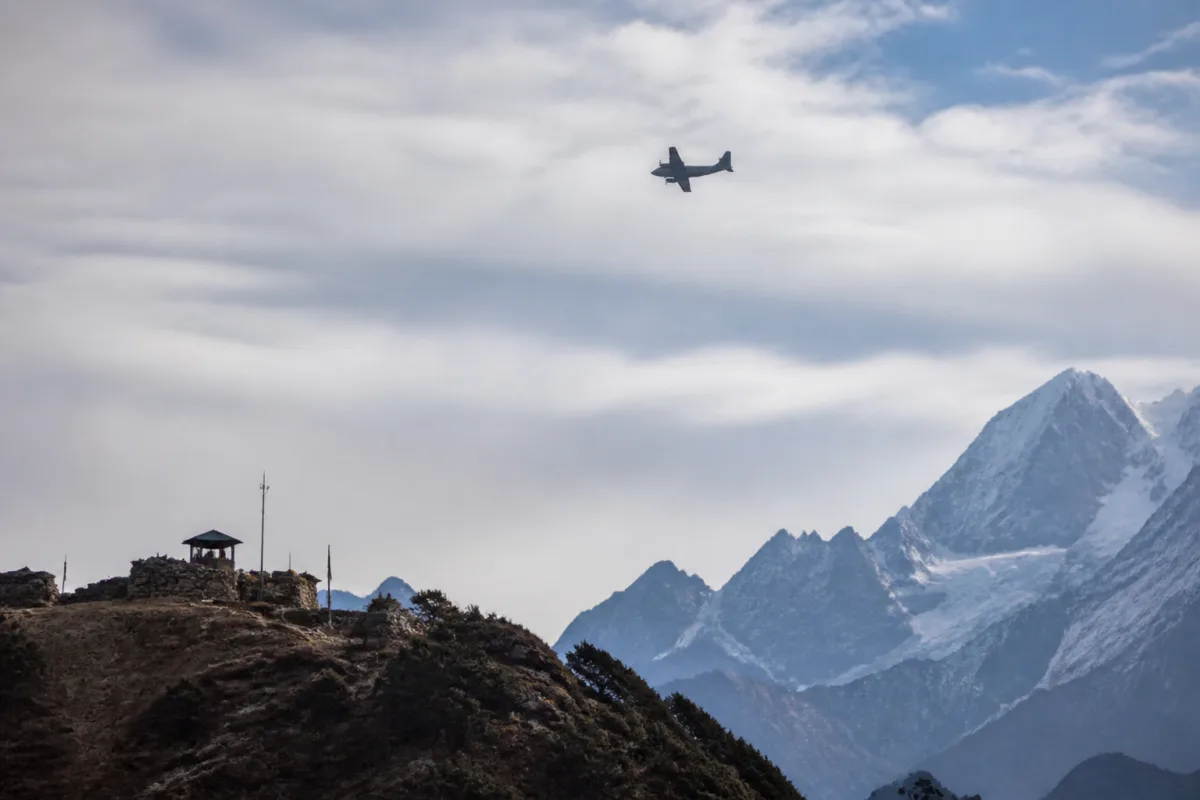
An aircraft reportedly entered Indian airspace near the India-China border in Sikkim on 12 November and remained in the area for about 20 to 25 minutes, according to a report by Anandabazar.com. The aircraft’s identity, purpose and precise flight path have not been officially established, and the Indian Air Force has not publicly commented on the incident.
The report, citing multiple unnamed sources, said the aircraft was detected at around 8am at an altitude of approximately 25,000 feet. Indian Air Force personnel reportedly sent repeated radio warnings instructing it to leave Indian airspace, but the aircraft allegedly continued circling for at least 20 minutes before returning towards the Chinese side.
Those details could not be independently confirmed from an official statement or publicly available document included in the report. The account therefore remains a reported incident rather than an established breach of Indian airspace.
Some local residents cited by the report speculated that the aircraft could have been a Chinese military aircraft or a surveillance plane. No evidence supporting that identification was provided. The report also noted that the Indian Air Force had not officially confirmed whether the aircraft was military, civilian or from another category.
The reported location is significant because the area offers visibility towards the Siliguri Corridor, the narrow land link connecting much of northeastern India with the rest of the country. The corridor passes through northern West Bengal and is a major route for the movement of people, goods and security forces to the northeastern states. Any confirmed airspace incident in the surrounding region would therefore have implications beyond a single aircraft movement, although the supplied report does not establish that the aircraft was conducting surveillance or targeting the corridor.
The report said the aircraft’s presence was first published by Outlook, which also cited sources. It further linked the timing to a series of recent high-level military engagements in Sikkim and northern West Bengal. Defence Minister Rajnath Singh had joined Indian Army personnel for Diwali celebrations in Sikkim on 8 November, while senior military officials were present. The report also said Singh had met the Chief of the Air Staff in Siliguri a day earlier.
That sequence has led some observers to attach greater significance to the reported aircraft movement. The available account, however, does not provide an official assessment connecting the November 12 incident to those engagements. Timing alone cannot establish such a link.
Former Indian Air Force officials cited in the report also questioned whether an aircraft could have remained in Indian airspace for 20 to 25 minutes without a visible interception response. They reportedly said that a brief incursion was possible, but that a longer presence could have allowed aircraft from bases including Hasimara to respond. They nevertheless described even a short unauthorised entry, if confirmed, as a matter of concern.
The key unresolved questions are whether the aircraft crossed into Indian airspace, whether it was detected by military radar, how long it remained within the country’s airspace, and what action was taken after the reported radio warnings. None of these points has been confirmed in an official public statement supplied with the report. Further clarity would require a statement from the Indian Air Force, the Ministry of Defence or another authorised government agency.

