


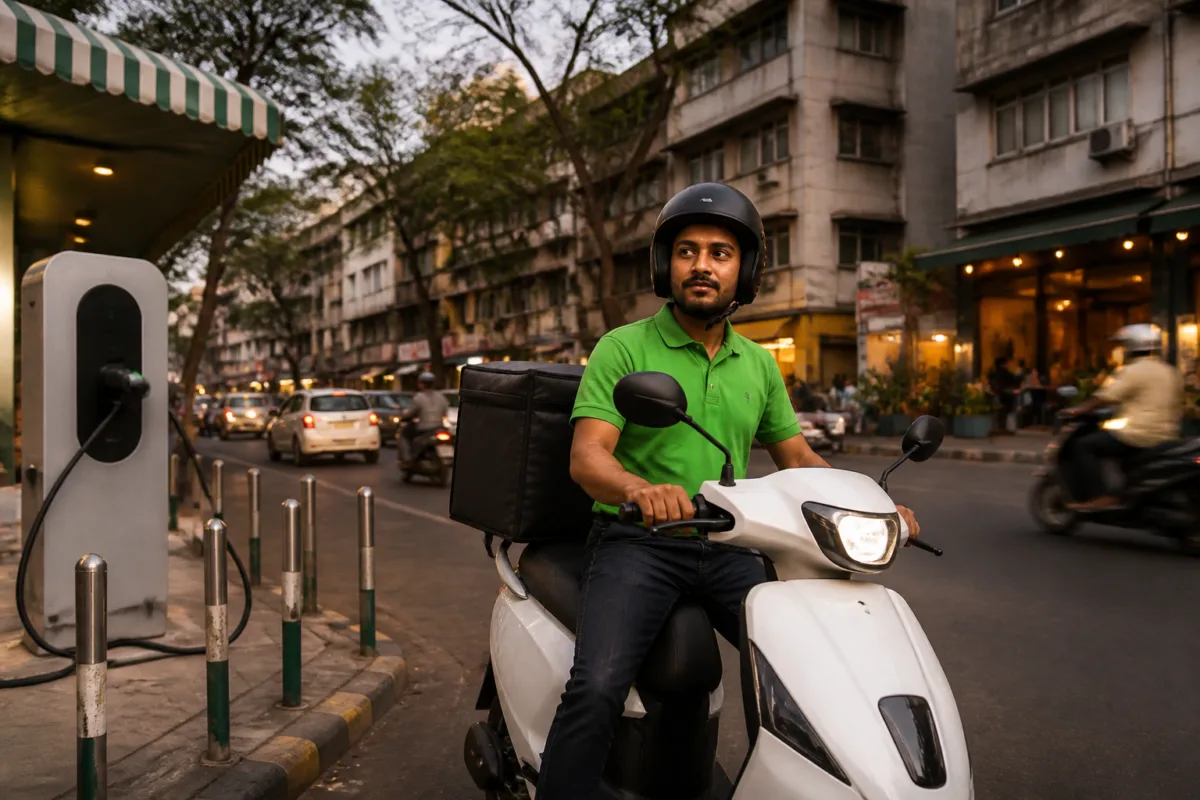
Eternal’s reconsideration of its 2030 target for a fully electric delivery fleet is not simply a change in corporate scheduling. It reveals a harder urban mobility problem: India’s platform-delivery economy is expanding faster than the vehicle, charging, financing and policy systems needed to shift it away from petrol.
The Zomato and Blinkit parent remains committed to electrification, according to Anjalli Ravi Kumar, Eternal’s chief sustainability officer, but is working towards a revised timeline. The company is assessing electric vehicle availability, government policy implementation and the requirements of its different businesses before setting a new date. A target such as 2035 is under consideration, but no revised deadline has been confirmed.
That uncertainty matters because delivery fleets are among the most visible and intensive users of urban roads. Their vehicles travel through neighbourhoods throughout the day, linking restaurants, homes, offices, warehouses and retail outlets. The transition of this fleet can reduce fuel use and tailpipe emissions, but it also depends on whether workers can obtain suitable vehicles at a manageable cost and keep them operating across very different city markets.
Eternal’s own scale has changed sharply since the original target was set. Kumar said Zomato had about 1.5 lakh monthly active riders when the goal was formulated. The group now has 12 lakh riders across Zomato and Blinkit. Maintaining that monthly base requires the company to onboard around 30 lakh people each year, across approximately 900 cities.
This changes the nature of the electrification challenge. A company may be able to accelerate EV adoption in a limited number of large metropolitan markets, where rental providers, service networks, charging points and financing options are more readily available. Guaranteeing access for every new delivery partner across hundreds of cities is a different operational proposition. Kumar said the company could not currently guarantee that all 30 lakh people joining in a year would be able to access a reliable EV.
The distinction between a corporate fleet and a conventional fleet is also important. Delivery partners generally arrange their own vehicles. The company can influence their choices through incentives, rentals and information, but it does not simply purchase and allocate every vehicle. Electrification therefore depends on the financial circumstances of workers, the availability of credit and rental options, local maintenance capacity and the daily operating range required by each delivery model.
Eternal’s approach has so far been to encourage rather than mandate EV adoption. Kumar said the company offers financial incentives, facilitates rental access through its delivery partner application and runs initiatives such as EV Bazaar to familiarise partners with available models. Under its equal-benefit policy, partners using electric vehicles are paid as much as those using petrol-powered vehicles, even though EV operating costs may be lower.
The company reported that EV adoption within its delivery fleet was already higher than in the broader Indian two-wheeler market. Kumar said a previous estimate placed market-wide EV penetration at around 6-7 per cent, while about 12-13 per cent of Eternal’s partners were using EVs. On that comparison, the company’s fleet was close to twice as electrified as the wider two-wheeler market at the time of the estimate.
Those figures indicate that platform companies can create demand for electric mobility, but they also show the limits of demand-side pressure. Higher fleet adoption does not remove the supply-side barriers faced by workers. If a partner cannot find an affordable vehicle, arrange financing, charge it conveniently or obtain repairs locally, a corporate incentive may not be enough to change the vehicle choice.
The challenge becomes more complex because Eternal is no longer considering only two-wheelers used for food and quick-commerce deliveries. Its Hyperpure business uses four-wheelers, including trucks and smaller commercial vehicles, to supply restaurants. Kumar said the group’s next EV target would need to include all forms of transportation rather than focus only on individual businesses or two-wheelers.
This broadening of the target has an institutional implication. A group-wide commitment cannot be measured only through the percentage of Zomato delivery partners using electric scooters. It must also account for commercial vehicles, delivery routes, payloads and the different charging and financing requirements of restaurant supply operations. The revised goal may therefore be more comprehensive, but it will also be harder to achieve and assess.
Government policy is central to the timeline. Kumar said the company would consider whether EV policies had been rolled out sufficiently across the country before committing to a 2035 target. The statement places part of the responsibility outside the company: national and state policy must create conditions in which workers can access vehicles and businesses can operate them at scale.
For cities, this means EV policy cannot be treated only as a vehicle-purchase issue. It also involves charging infrastructure, electricity connections, parking and charging space, vehicle registration, battery servicing, financing and the treatment of commercial users. These systems are often managed by different institutions. A policy announced at the national level may not translate into equal access across cities if local infrastructure and service markets remain uneven.
The worker dimension is equally significant. Delivery partners are not a standard corporate fleet that can be replaced through a centrally managed procurement programme. A transition that makes vehicle access more expensive or unreliable could affect who is able to enter the sector. Kumar said Eternal was advocating worker-friendly EV policies so that cleaner mobility would not restrict employment opportunities for people who may not be able to purchase electric vehicles.
That concern connects the climate objective to the urban labour market. Food delivery, quick commerce and restaurant supply depend on large numbers of workers moving through cities, often on individually owned or rented vehicles. The environmental performance of the system is therefore linked to the economic security of the people operating it. A transition that ignores ownership and affordability could deliver uneven results, with better-served cities and higher-income workers adopting EVs first while others remain dependent on petrol vehicles.
Eternal’s numbers also show why the issue will remain difficult even if adoption rates rise. A fleet penetration rate can improve while the absolute requirement for vehicles grows rapidly. The company has moved from 1.5 lakh monthly active riders on Zomato to 12 lakh across two businesses, and it expects to onboard about 30 lakh people in one year to maintain its rider base. If the business expands further, the number of vehicles required will increase even when the proportion of EVs rises.
The same tension appears in the company’s packaging initiatives. Eternal is working with restaurants through PackSwitch, an interactive platform intended to help businesses identify alternatives to plastic packaging, find suppliers and connect with startups. Through Hyperpure, it sold more than 3,000 metric tonnes of sustainable packaging to 50,000 restaurants in the previous year. More than 10,000 restaurants across over 400 cities received Zomato’s low-plastic packaging tag after the company verified that the packaging used for their main menu was sustainable.
Packaging and mobility are different environmental problems, but they share an implementation pattern. Corporate programmes can create information, incentives and supply links, yet adoption depends on thousands of independent businesses and workers operating under different financial and logistical conditions. The scale of the network makes standardisation difficult, while the lack of standardisation makes a single deadline harder to deliver.
The evidence currently establishes three points. Eternal has not abandoned electrification; it is reassessing the deadline. Its delivery fleet had higher EV penetration than the broader two-wheeler market according to the company’s cited estimate. And the company does not yet believe it can guarantee reliable EV access for the large number of partners it must onboard across 900 cities.
What remains unresolved is the revised target, the share of commercial vehicles it will cover, the policy conditions the company considers sufficient and the mechanisms that will protect access for workers who cannot immediately buy an EV. Those details will determine whether the next commitment is a measurable transition plan or only a longer-term ambition. For India’s cities, the larger question is whether clean last-mile mobility can expand at the same speed as the platform economy without transferring the cost and risk of transition to individual workers.

