


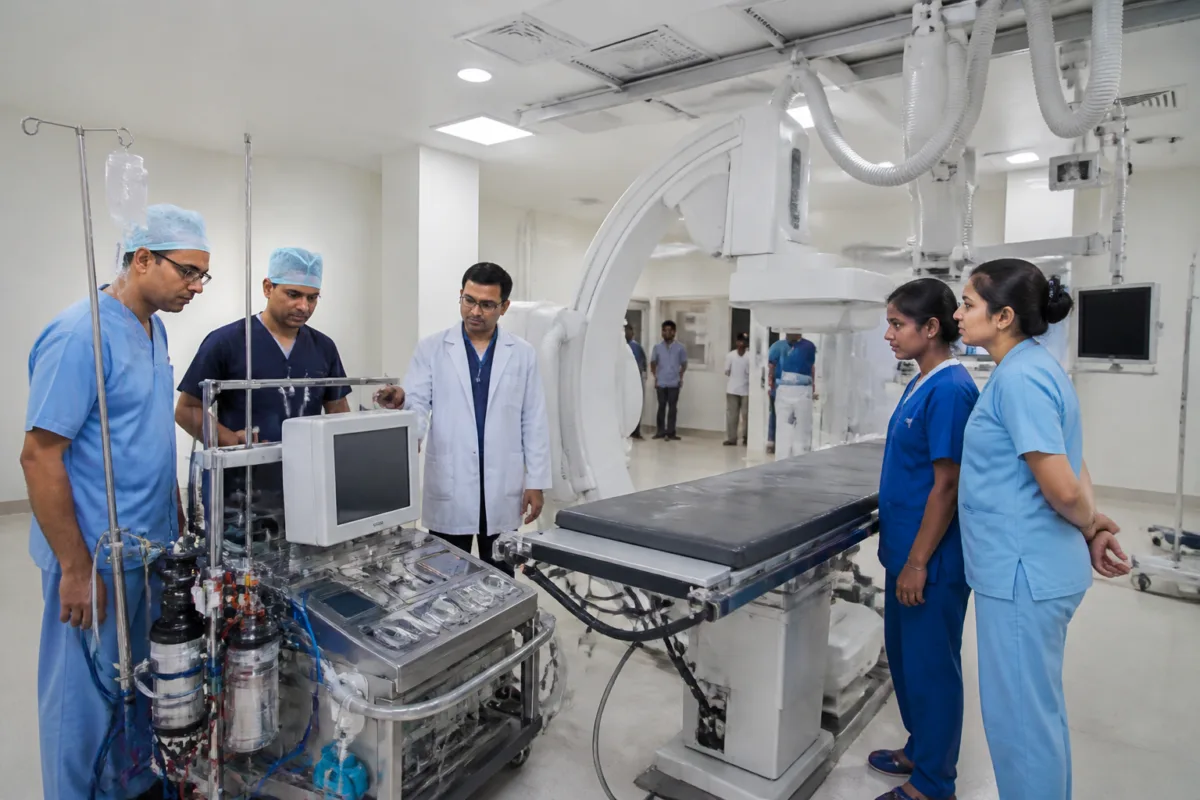
North Bengal Medical College and Hospital is preparing to begin comprehensive cardiac care services from March, a move that could give patients across north Bengal access to advanced treatment at a government hospital instead of requiring costly travel to private facilities.
The state-run referral hospital has received a cardiopulmonary bypass machine, commonly called a heart-lung machine, and is expected to receive two catheterisation laboratories shortly. The equipment will support cardiac procedures and investigations, although the hospital has not provided a detailed public schedule for commissioning the facilities or starting individual services.
The heart-lung machine temporarily performs the functions of the heart and lungs during certain operations. It maintains blood circulation and supplies oxygen to the body while surgeons operate on the heart. The two cath labs will allow doctors to examine blood vessels and treat several cardiac conditions, including blocked coronary arteries.
Cath labs use specialised imaging equipment to guide procedures such as angioplasty, in which narrowed arteries are opened using balloons and stents. The facilities are expected to serve patients from Darjeeling, Jalpaiguri, Alipurduar and Cooch Behar, as well as neighbouring areas who currently depend on North Bengal Medical College for specialised medical care.
A source cited in the report said the new facilities could provide major relief to economically weaker patients who now travel to private hospitals for expensive cardiac treatment. The expansion could also reduce the financial burden associated with treatment and travel, but the final scale of relief will depend on when the services become operational, the procedures offered and the hospital’s capacity to manage demand.
The planned cardiac expansion also brings attention to the administrative requirements of sustaining specialist services in a large public hospital. Advanced equipment must be supported by trained doctors, technicians, nursing staff, maintenance systems, operating protocols and patient referral arrangements. The report does not specify the sanctioned staffing position, the expected number of procedures or the funding arrangements for running the new units.
The development follows difficulties with another specialised service at the hospital. NBMCH launched north Bengal’s first government eye bank and cornea transplantation service in January 2024, offering free treatment for economically weaker patients with corneal blindness. The service was subsequently stopped.
According to a source cited by the report, the eye-care initiative was launched without adequate infrastructure and manpower. The National Programme for Control of Blindness requires counsellors to explain posthumous eye donation to families and obtain their consent, but the hospital began the service without appointing one.
Kaushik Ishore, the medical superintendent-cum-vice principal of NBMCH, said the authorities were examining the issue. He said the state health department was considering appointing a counsellor and that the hospital would take steps to revive the eye bank and cornea transplantation service while strengthening cardiac care.
The next milestone for the cardiac programme is the arrival and installation of the two cath labs, followed by the hospital’s planned introduction of comprehensive cardiac services from March. The hospital’s ability to staff and sustain both the cardiac programme and the proposed revival of eye services will determine how far the new infrastructure translates into reliable public healthcare access.

