


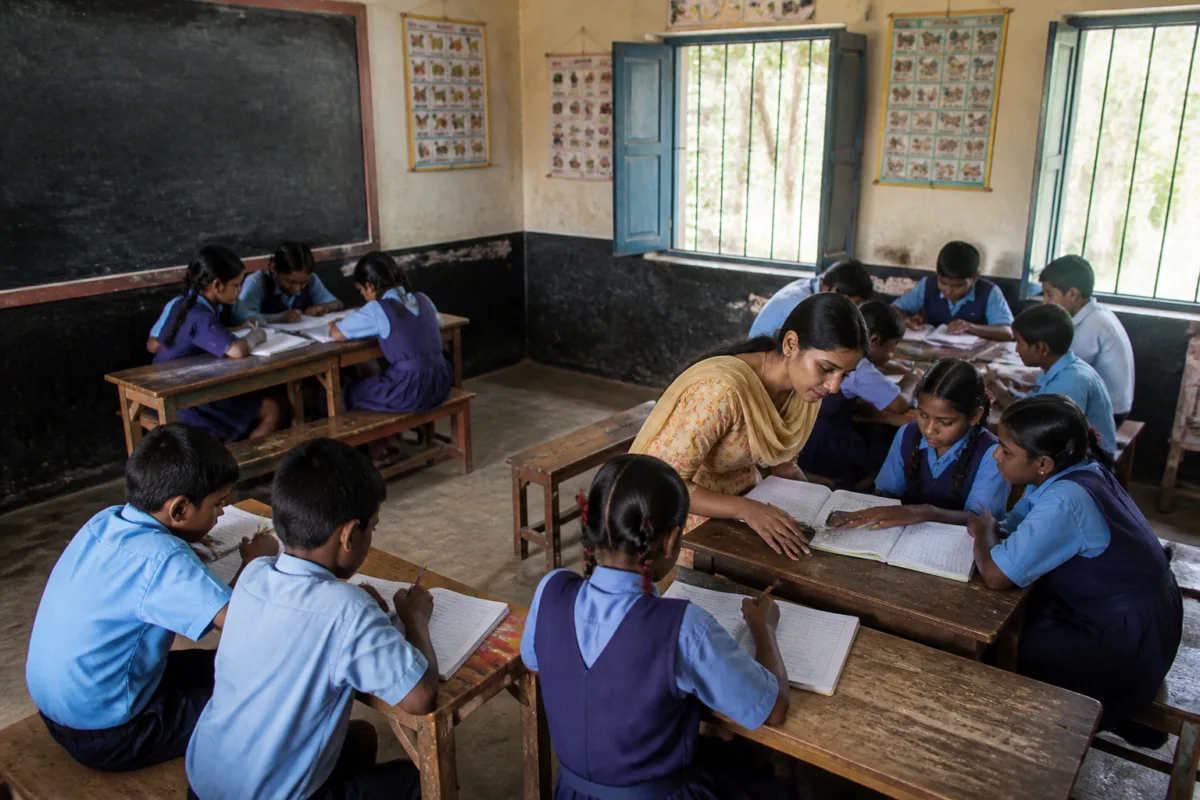
Nearly 80% of students in Classes 2 to 5 in Madhya Pradesh government schools are below the learning level expected for their grades, according to an assessment cited in a State Education Centre letter. The finding covers around 25 lakh children and has prompted the state to order a 90-day remedial programme focused on basic reading, writing and mathematics skills.
The learning-reinforcement programme will run from November 16 to February 16 in government schools across Madhya Pradesh. It will cover foundational competencies in Hindi, English and mathematics, including letter recognition, phonics, vocabulary, sentence formation, reading, writing and basic mathematical understanding.
The State Education Centre has directed schools to assess each child’s current learning level before beginning the programme. Students will then be placed in subject-specific groups according to their needs. The instructions state that a child may be at different learning levels in Hindi, English and mathematics, meaning the groups can vary between subjects.
Class 1 students have been excluded from the exercise because their formal education is still considered to be at an initial foundational stage. After the first 90 days, teachers will reassess students to measure progress. The letter also allows reinforcement activities to continue beyond the programme wherever additional support is required.
The assessment indicates that many children in Classes 2 to 5 have not acquired basic competencies expected at their grade levels. These include adequate command over letters, words, numbers and other fundamental concepts. The scale of the reported deficit makes the programme a system-wide intervention rather than a limited exercise involving individual schools or districts.
The State Education Centre’s instructions ask teachers to begin with each child’s existing level of learning. They have also been told to avoid scolding or comparing students while conducting the remedial work. The approach is competency-based instead of applying a uniform curriculum to all children, according to the letter cited by The Times of India.
The report also highlights conditions that educationists say can deepen learning gaps. Madhya Pradesh has around 75,000 primary and middle schools, many of which reportedly lack basic infrastructure. Large classrooms, teacher shortages and weak monitoring have been identified as additional challenges, particularly in rural and economically disadvantaged areas.
Implementation will depend partly on the functioning of district-level administrative offices. District Project Coordinator offices operate under the State Education Centre and are responsible for implementing several school-education schemes. In Bhopal district, allegations of irregularities in school repair and construction works have surfaced, with school in-charges reportedly submitting written complaints and supporting documents to the District Project Coordinator.
Critics cited in the report said that state and central education schemes can fail during implementation because of poor oversight, delayed action and weak accountability. These concerns place the 90-day initiative’s administrative execution alongside classroom instruction as a key issue. The programme requires schools to conduct initial assessments, create flexible learning groups, provide subject-specific remediation and reassess students after the intervention.
State Education Centre officials declined to comment when contacted. The next formal milestone is the start of the remedial programme on November 16, followed by the scheduled completion of its first phase on February 16 and a subsequent review of student progress.

