


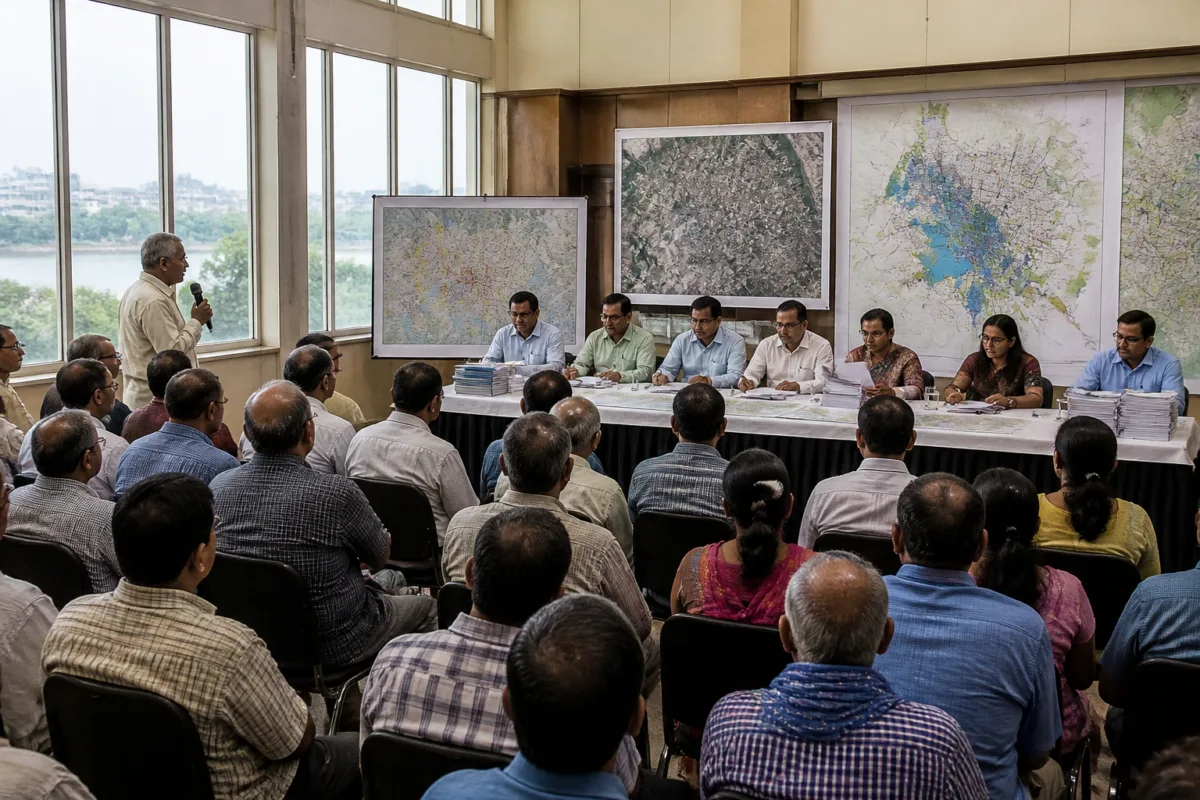
The Bhopal Master Plan 2047 hearings are beginning under a cloud that could matter as much as the objections themselves: a complaint has alleged that the process used to receive and examine public participation did not fully follow statutory provisions and government rules. With around 13,000 objections and suggestions on the draft plan, the dispute is not a procedural footnote. It goes to the credibility of the document that will guide Bhopal’s future growth.
The hearings are scheduled to begin on Monday through the Town and Country Planning Department. The complaint, submitted to Bhopal MP Alok Sharma by environmentalist Nitin Saxena, asks Sharma to intervene, halt the existing process and order fresh hearings in accordance with the applicable statutory provisions. Sharma also chairs the district planning committee, giving the complaint an institutional route into the planning process.
The allegations remain claims made in the complaint and have not been established as findings by a court or an adjudicating authority in the material available. However, they identify several points at which public planning can become vulnerable: the time given to residents to respond, the format used to notify them, who is allowed to participate in committee proceedings, whether relevant consultations are repeated when a draft changes, and whether the evidence behind the plan is available for public scrutiny.
That distinction is important because a master plan is not simply a technical map. It influences how land is allocated, where infrastructure is expected to go, how environmental constraints are treated and what kinds of development become permissible over time. The plan’s legitimacy therefore depends not only on its final contents but also on whether affected residents, institutions and local bodies had a meaningful opportunity to examine and challenge the proposals before they were settled.
The scale of the response is the first indication that the draft has generated substantial public engagement. Around 13,000 objections and suggestions have been received. The supplied report does not provide a subject-wise breakdown of these submissions, nor does it say how many are related to land use, transport, environmental protection, public facilities or development permissions. It also does not establish how many objections have been accepted, rejected or partially incorporated. Those details will be central to judging whether the hearings are a substantive review or primarily an administrative step before approval.
The complaint’s most concrete allegation concerns notice periods. It says hearing notices were issued only two to four days in advance, rather than the prescribed seven days. If established, such a gap would directly affect the ability of residents and organisations to prepare. A hearing on a planning objection may require an applicant to examine maps, ownership records, zoning provisions, environmental material or earlier representations. Short notice can therefore turn a formal opportunity to be heard into a limited one, especially for people who do not routinely track departmental notices.
The complaint also alleges that mandatory Form-7 notices were not used. The significance of that allegation lies in the role that prescribed forms and notices play in standardising public participation. They create a common process through which affected parties are informed about what is being considered and how they can respond. The report does not reproduce the relevant rule or explain the department’s position on the alleged omission, so it is not possible from the available material to determine whether the absence of Form-7 notices invalidates the proceedings. It does, however, make the notification mechanism a key issue for the hearings.
Another concern relates to who attended committee meetings. The complaint alleges that unauthorised representatives participated in meetings of the committee dealing with the objections. The report does not identify the representatives, specify which meetings they attended or explain what decisions they took part in. Those unanswered questions matter. Participation rules are intended to clarify who can speak, advise, record proceedings or influence recommendations. Without a clear account of attendance and authority, it becomes difficult for the public to assess whether the committee’s deliberations were properly constituted.
The complaint further questions the absence of fresh stakeholder consultations. This raises a broader planning issue: whether consultation is treated as a one-time exercise or as an ongoing process when new information, revised proposals or unresolved objections remain. The supplied report does not say whether the draft Master Plan 2047 was altered after earlier consultations, or whether the department considers previous consultations sufficient. It only records the complainant’s demand for a renewed process. That distinction will need to be addressed by the authorities before conclusions can be drawn about compliance.
The alleged disregard of district planning committee recommendations adds another institutional layer. District-level planning bodies can connect a technical planning department with local administrative priorities and elected representation. In this case, the complaint was addressed to the chair of the district planning committee and alleges that the committee’s recommendations were not properly considered. The report does not provide the recommendations, the date on which they were made or the department’s response. Those documents would be necessary to establish whether the recommendations were ignored, differed from the draft plan, or were considered but not accepted.
The non-disclosure of the CEPT report cited in the draft plan is potentially significant for a different reason. A planning document that relies on an underlying report creates an expectation that the evidence can be examined by those being asked to comment on the plan. The available report does not describe the CEPT report’s subject, methodology or findings, and it does not state whether the document has been formally requested or withheld. As a result, the allegation cannot be assessed on the present material. But if the report is a substantive basis for the draft, its accessibility could affect the quality of objections and the public’s ability to test the plan’s assumptions.
These allegations point to a central tension in urban planning: the difference between procedural completion and meaningful participation. A department may receive a large number of objections and hold hearings, yet the process can still be questioned if people were not given adequate notice, if the relevant documents were not available, or if the authority of participants was unclear. Conversely, allegations of irregularity do not by themselves prove that the draft plan is legally defective. The next stage must therefore establish what notices were issued, under which rules, who participated, what records were maintained and how each category of objection will be handled.
The Bhopal case also shows why the administrative record matters. For a plan extending to 2047, the record should make it possible to trace the movement from draft proposal to public objection, hearing, recommendation and final decision. That chain is especially important when the number of objections is large. Without transparent records, residents may not know whether their submissions were read, whether similar objections were grouped together, or why a particular planning decision prevailed.
The available report does not establish the final status of the hearings, whether the Town and Country Planning Department has responded to the complaint, or whether Alok Sharma has ordered any intervention. It also does not provide the draft plan, the statutory provisions cited in the complaint, the Form-7 requirement, the district planning committee’s recommendations or the CEPT report. Those gaps limit what can responsibly be concluded at this stage.
What is clear is that the hearings have become a test of more than the draft Bhopal Master Plan 2047. They will test whether the authorities can demonstrate that participation was timely, properly notified, institutionally authorised and supported by accessible evidence. The immediate developments to watch are the department’s response to the allegations, the decision on whether the scheduled hearings will proceed, and whether the authorities release the documents needed to evaluate the objections and the planning process itself.

