


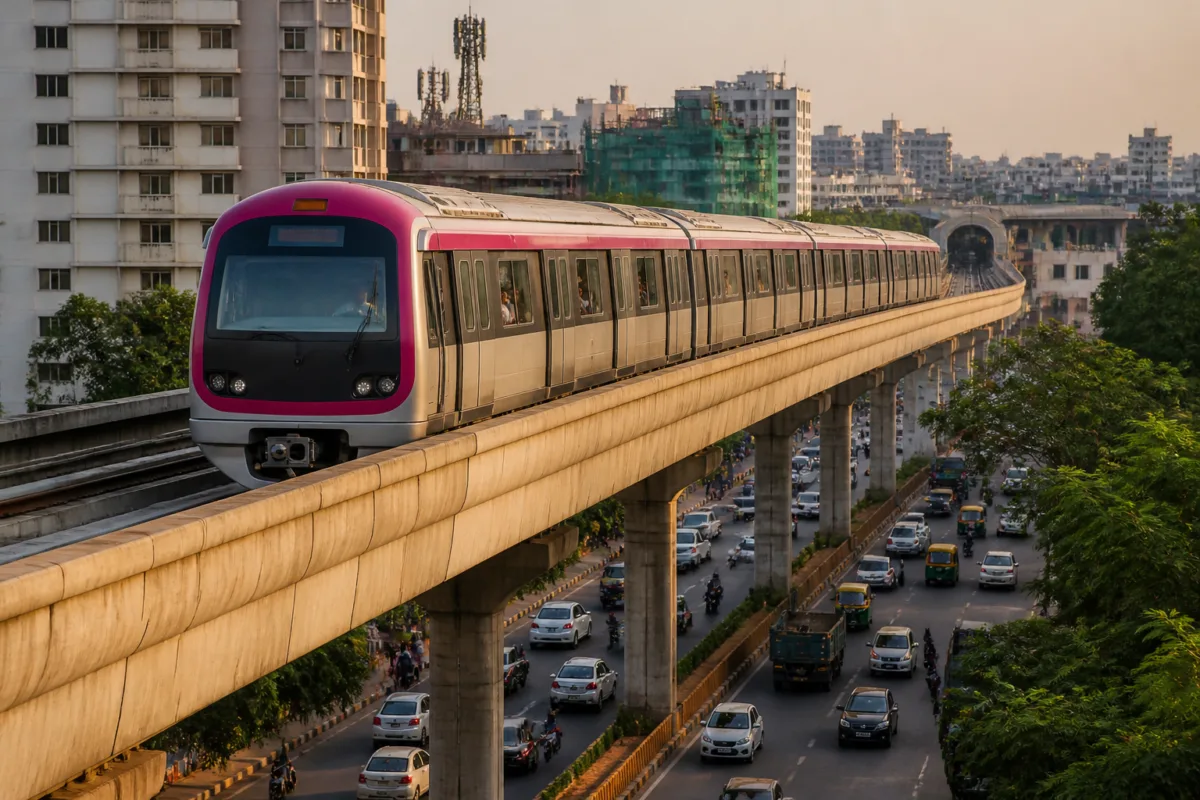
Bengaluru Metro’s Pink Line began operations on its 7.5-km elevated section between Sadduguntepalya and Kalena Agrahara, giving passengers a new rail option aimed at reducing road congestion, travel time and the cost of short urban journeys. The section has six stations and opened for official passenger service on November 14.
The launch was marked by the presence of Karnataka Chief Minister D.K. Shivakumar and other dignitaries, who travelled on the Metro as the new route was formally inaugurated. The opening places the elevated stretch into the city’s expanding mass-transit network and provides an alternative to road-based travel for residents along the corridor.
According to the report by Prajavani, fares on the new section have been fixed between ₹10 and ₹30. The fare structure gives passengers a public transport option that may cost less than comparable auto-rickshaw journeys, particularly for trips within or close to the newly operational corridor. The report does not provide station-wise fares or details of any integrated ticketing arrangements.
Passengers who travelled on the first day spoke about the possible savings in time and money. Their responses focused on three practical concerns that shape daily mobility in Bengaluru: the cost of auto-rickshaw travel, congestion on roads and the time required to complete regular journeys. The passenger feedback indicates that the value of the new line will be judged not only by its infrastructure but also by how effectively it changes everyday travel choices.
The 7.5-km stretch is elevated and includes six stations between Sadduguntepalya and Kalena Agrahara. The report does not specify the operating frequency, daily ridership target, first and last train timings or the connecting bus services available at the stations. Those operational details will be important for assessing how easily the new Metro section can be used for complete journeys rather than only for trips between stations.
The opening also highlights the role of fare affordability in public transport adoption. A Metro service can provide a faster and more predictable alternative to congested roads, but its usefulness depends on the full journey, including access to stations and onward travel after a passenger exits. For residents along this corridor, the immediate comparison is likely to be between the new rail service, auto-rickshaw costs and the delays experienced on surrounding roads.
For Bengaluru’s transport system, the first day of operations offers an early public test of whether the new elevated section can shift routine travel from road vehicles to mass transit. The next phase of attention will be on passenger use, service operations and how the six stations perform as access points for nearby neighbourhoods. The available report does not yet include ridership figures or an official assessment of the line’s first-day performance.

