


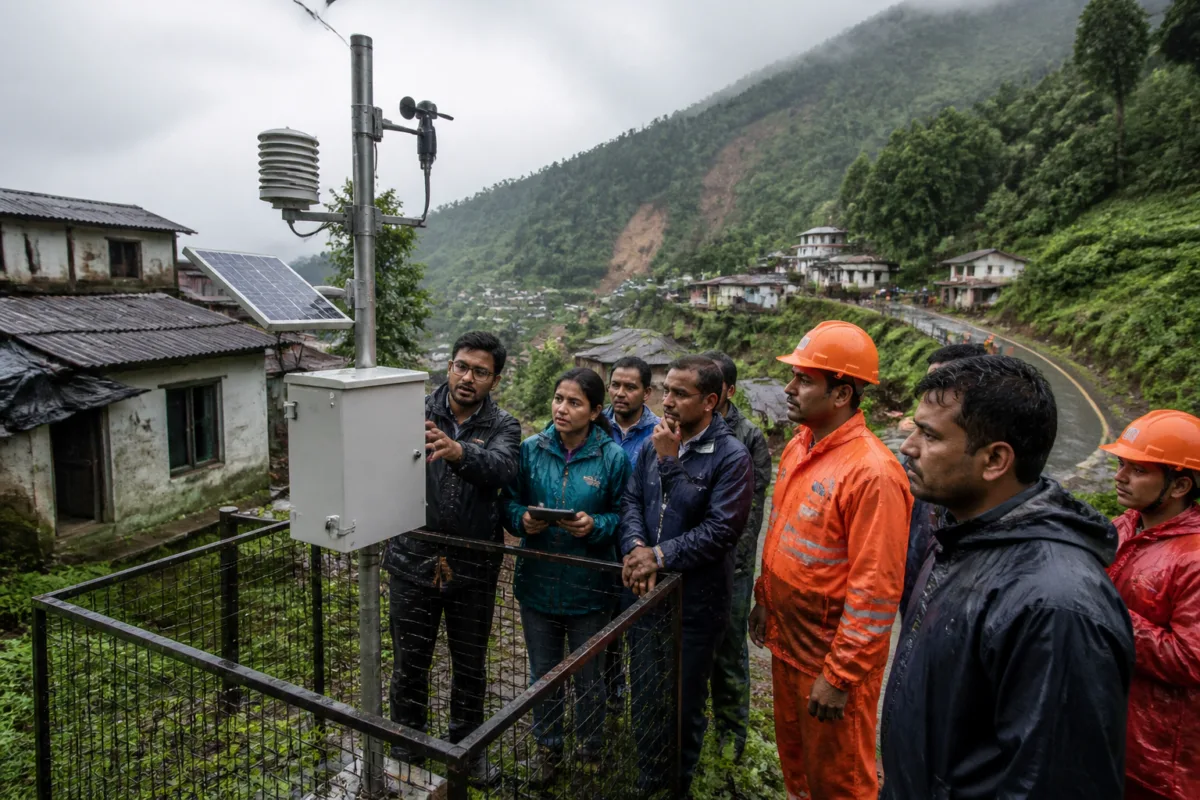
The call made at COP31 for early warning systems to reach every village and every person exposes a practical weakness in climate adaptation: detecting danger is only the first link in a much longer chain. A sensor can identify landslide conditions, a forecast can indicate extreme weather, and an artificial intelligence system can help translate a message. None of that guarantees that a local authority will act, that residents will understand the warning or that people with disabilities will receive it in an accessible form.
That gap was the focus of a roundtable held on 10 November at the YÖK Pavilion in the COP31 Blue Zone in Antalya, Türkiye. Convened by Amrita Vishwa Vidyapeetham and hosted by the Council of Higher Education of Türkiye, the session brought together university representatives and disaster-risk experts from India, Nepal, Thailand and Kenya. Its central proposition was that universities should move beyond laboratory research and remain involved through deployment, training and long-term engagement with communities.
The discussion is significant because early-warning systems are often presented as technology projects, while the evidence described at the session points to an institutional problem. Warnings become useful only when scientific information is connected to public agencies, local knowledge, communication systems and clearly understood action. In that sense, the issue is not simply whether cities and villages have sensors. It is whether the institutions around those sensors can convert information into timely decisions.
### From detection to action
The session’s title, “From Sensor to Settlement: Operationalising University-Led Disaster Risk Reduction and Locally Led Climate Resilience”, captured this wider challenge. Dr. Maneesha Vinodini Ramesh, Pro Vice Chancellor of Amrita Vishwa Vidyapeetham and a UNESCO Chairholder, described the requirements for converting a sensor reading into action as reliable technology, local authorities that trust the data and communities that understand what an alert means.
Those requirements represent three different systems. The first is technical: instruments must detect a risk and transmit information reliably. The second is administrative: an authority must assess the information, decide what response is needed and have the ability to communicate or act. The third is social: residents must receive the warning, understand its seriousness and know what to do next. A failure in any one of these systems can make the warning ineffective even when the underlying forecast is accurate.
The source material describes Amrita’s work on wireless sensor networks for landslide detection in Munnar, Kerala, beginning in 2009 and later extending to Sikkim. It does not provide figures on the number of sensors, the communities covered, warning accuracy, response times or lives saved. That absence matters. A demonstration of technical capability is not the same as evidence of a functioning, scaled early-warning service.
The distinction is especially important for urban and peri-urban areas. Settlements exposed to landslides, flooding, extreme heat or other hazards are governed through multiple agencies, while residents often depend on informal networks and local institutions for information. A warning system therefore has to operate across administrative boundaries and communication channels, not only within a university or a specialised disaster-management department.
### The last-mile problem is institutional
Dr. Senaka Basnayake, programme lead for climate services at the Asian Disaster Preparedness Center in Bangkok, argued for people-centred early-warning systems and impact-based forecasting. The approach described at the meeting links forecasts with local risk information so that warnings lead to early action rather than simply announcing a weather condition.
That distinction changes the question asked of a warning system. A technical forecast may indicate that heavy rain, high winds or changing ground conditions are likely. An impact-based warning must also address what those conditions could mean for a particular settlement, road, school, hospital, livelihood or household. The source does not set out a specific operational model or provide performance data from the systems discussed, but the institutional implication is clear: information has to be translated into decisions that local responders and residents can use.
Universities can occupy a distinctive position in this chain. According to the participants, they can build and test technology, train students and responders, and continue working with communities over time. They can also help connect national disaster agencies with local institutions. This role is different from that of a vendor that supplies equipment or a government department that issues an official warning. It suggests a long-term intermediary function combining research, training and field support.
But that function also raises questions about continuity and accountability. The material supplied for the session records a shared commitment to closer links with national disaster agencies and the sharing of open technology and training across the Global South. It does not identify a funding mechanism, a common operating protocol, a timetable or a formal intergovernmental arrangement. Without those details, the commitment remains a direction of travel rather than an established regional system.
### Inclusion cannot be added at the end
The discussion also placed people with disabilities at the centre of warning design. Dr. Raghu Raman, speaking on behalf of Amrita’s UNESCO Chair on Assistive Technologies in Education, said a warning works only if everyone can receive and understand it. He pointed to communication through voice, text and sign language, as well as the responsible use of artificial intelligence to improve accessibility.
This is more than a communications preference. It is a test of whether an early-warning system has been designed around the full population exposed to risk. A message delivered through only one channel can leave out people with hearing, visual, speech or cognitive disabilities. It can also exclude residents who do not have reliable internet access, smartphones or familiarity with official terminology. The session’s emphasis on multiple formats recognises that accessibility has to be built into the warning architecture from the beginning.
The source does not provide details of a specific accessible-alert platform, user testing or coverage levels. It therefore cannot establish whether the proposed channels are already functioning at scale. What it does establish is that inclusion was treated as part of the operational definition of a successful warning, rather than as a separate social-policy concern.
That approach has implications for municipal administration. Local governments and disaster agencies are generally responsible for communicating with residents, organising emergency responses and coordinating public services. If universities are to support these functions, their tools and training must fit existing authority structures. Data that cannot be trusted by officials, or an alert that does not connect to evacuation, shelter, transport and emergency-health procedures, will have limited practical value.
### Climate risk crosses borders and departments
The Antalya meeting brought together hazards that are often managed separately. The article refers to floods, landslides, cyclones, glacial lake outbursts and extreme heat across South Asia, Southeast Asia and the wider Global South. Dr. Dhiraj Pradhananga of Tribhuvan University described risks linked to melting glaciers and changing snow in Himalayan communities, while the ADPC contribution addressed climate services and impact-based forecasting.
These risks do not respect national boundaries or the divisions between academic disciplines and government departments. Mountain hazards can affect downstream settlements and infrastructure. Floods and cyclones can disrupt transport, housing, utilities and livelihoods. Extreme heat can place pressure on public health and the functioning of urban systems. A warning system built around one hazard, one agency or one district may not match the way climate impacts move through connected regions.
The regional composition of the session is therefore part of its substance. Participants from India, Nepal, Thailand and Kenya discussed cooperation across the Global South, while the session was held within a global climate-conference process focused on adaptation, finance and implementation. The event links local warning delivery with international climate policy, but it also shows the distance between those levels. A commitment made at a conference still has to become a protocol, a budget, a trained response team and a message that reaches a household in time.
COP31 President-Designate Murat Kurum’s call for an “Implementation COP” and his reference to the Turkish idea of imece, or collective work, provided the political setting for the discussion. The university participants used a similar logic: climate resilience requires cooperation among researchers, governments, responders and communities. The practical test will be whether such cooperation produces arrangements that survive beyond a conference and remain operational between disasters.
### What the evidence confirms—and what it does not
The material supports three conclusions. First, the roundtable treated early warning as an end-to-end public system rather than a standalone sensor or forecast. Second, it placed universities in a continuing role that includes technology development, training and community engagement. Third, it identified accessibility and local ownership as necessary conditions for warnings to reach people who are often left out of formal climate planning.
The material does not establish that the systems described have achieved broad coverage or measurable reductions in loss. It provides no comparative data on warning times, response rates, false alerts, communication reach or operational costs. It also does not specify how responsibilities would be divided among universities, national disaster agencies, local governments and communities. Those are not minor implementation details; they determine whether a research project becomes public infrastructure.
Amrita’s institutional profile is part of the university’s case for involvement. The article states that the institution is ranked among India’s top ten universities, that Times Higher Education placed it 37th globally in its Sustainability Impact Ratings this year, and that it hosts three UNESCO Chairs. These credentials show research and institutional capacity, but they do not by themselves demonstrate the performance of a particular warning network. The distinction between institutional reputation and field-level outcomes should remain clear.
The next phase of this agenda will therefore be judged less by the number of conference commitments than by the systems that can be documented afterwards. Relevant evidence would include formal links with disaster agencies, open technical standards, training arrangements, accessible communication protocols and measurable community-level outcomes. None of those milestones is reported as completed in the supplied material.
The larger urban question is whether cities and settlements are prepared to treat early warnings as shared civic infrastructure. The Antalya discussion argues that science must travel from the laboratory to the settlement and from the settlement to every resident. That journey depends on technology, but also on trust, authority, inclusion and sustained local capacity. COP31 was scheduled to continue in Antalya until 20 November 2026, with adaptation, finance and implementation among the issues under discussion. The commitments described at the YÖK Pavilion will matter most if they can be translated into durable arrangements that communities can use before the next hazard arrives.

