


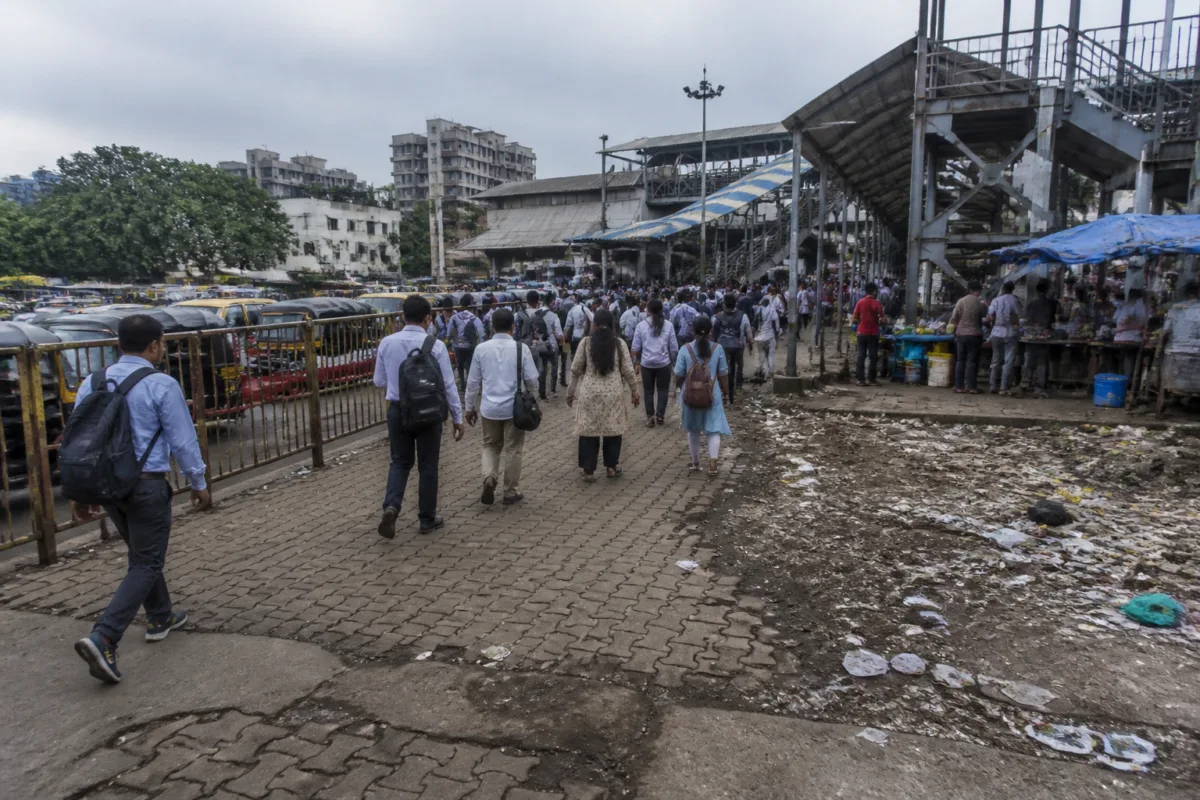
Navi Mumbai’s clean-city award has placed a persistent urban contradiction in sharper view: the city can be recognised for municipal cleanliness while several of its railway stations continue to face garbage, poorly maintained toilets, encroachments, inadequate lighting and deteriorating basic facilities. The gap is not merely about appearance. It reveals how a city’s public realm is divided between institutions that may operate with different responsibilities, contracts and standards.
The issue has gained significance after the transfer of 17 railway stations developed by the City and Industrial Development Corporation, or CIDCO, to Central Railway was completed in August 2026. The handover shifted responsibility for the stations’ maintenance and management to Central Railway. According to the report, the cleaning contract remained with CIDCO until September 30, after which Central Railway was expected to take over the cleaning responsibility from October 1. Yet the reported condition at the stations has not visibly improved.
That sequence matters because it separates a change in ownership or administrative control from an improvement in public service. A transfer can clarify who is responsible on paper, but it does not automatically provide continuity in contracts, staffing, supervision, funding or day-to-day enforcement. For passengers, however, these distinctions are largely invisible. They experience one station, one entrance, one footpath and one journey. If waste remains uncleared or toilets remain unusable during a transition, the institutional explanation does not reduce the inconvenience.
The stations named in the report span much of Navi Mumbai’s suburban rail network: Vashi, Sanpada, Juinagar, Nerul, Seawoods-Darave, Belapur, Kharghar, Airoli, Ghansoli and Koparkhairane. These stations are not isolated transport assets. They are points where rail travel meets roads, auto-rickshaws, footpaths, hawkers, parking, street lighting and the surrounding neighbourhood. Their condition therefore affects both the railway system and the functioning of the city around it.
The reported problems extend beyond cleaning inside station buildings. Toilets require maintenance, waste disposal is described as inadequate, pedestrian paths are not sufficiently clean and lighting is reported to be deficient. Outside the stations, hawker encroachments on footpaths and pedestrian routes can force passengers to walk on the road. Unregulated auto-rickshaw queues and competition to pick up passengers are reported to contribute to congestion around station areas.
This combination is important. Cleanliness is often measured as a municipal outcome, but the passenger’s experience of a clean city is shaped by the full access chain. A station may be located within a city that has received a cleanliness award, yet the route to the platform may involve a blocked footpath, unmanaged traffic, poor lighting or an unusable public toilet. The result is a fragmented public realm in which the boundary between municipal responsibility, railway responsibility and local enforcement becomes visible through everyday inconvenience.
The report also refers to earlier complaints concerning homelessness, unhygienic conditions and security around Nerul and Seawoods stations. These concerns suggest that the problem is not confined to a single cleaning cycle or one isolated facility. At the same time, the supplied material does not provide inspection records, passenger counts, complaint data, expenditure figures or independent measurements of cleanliness. It establishes the presence of reported problems, but it does not establish their scale across every station or quantify how conditions changed before and after the handover.
That limitation is significant for understanding the administrative problem. The report identifies a list of visible failures, but the available evidence does not show whether the primary cause is a delayed contract, inadequate staffing, weak supervision, unclear division of duties or enforcement failures outside railway land. These possibilities should not be treated as established explanations without records from the responsible agencies. What can be established is that the handover has not, according to the report, translated into a noticeable improvement for passengers.
The transfer from CIDCO to Central Railway also highlights a recurring challenge in India’s urban infrastructure: the asset, the service and the surrounding public space may belong to different administrative systems. CIDCO developed the stations, while Central Railway assumed their maintenance and management after the handover. The municipality operates within the same urban area, but the report does not specify which agency is responsible for each external issue, such as footpath encroachments, auto-rickshaw management, street lighting or the condition of areas outside railway premises.
For citizens, this institutional division creates a practical accountability problem. A passenger who encounters a dirty toilet, a blocked pedestrian route and traffic obstruction may need to approach different authorities, even though all three problems occur within a single station trip. Where responsibilities overlap, each agency may address only its own defined asset while the combined experience remains poor. The absence of a clearly visible, integrated service standard can make a station appear neglected even when individual departments are carrying out limited tasks.
The cleaning-contract timeline makes continuity particularly important. The report says that CIDCO’s cleaning responsibility was to continue until September 30, with Central Railway expected to assume it from October 1. A handover of this kind requires more than a formal transfer document. It requires an operational transition: contracts must be awarded or extended, workers must know their reporting structure, equipment and inventories must be accounted for, and inspection systems must remain active. The supplied report does not state which of these steps were completed or where any delay occurred. That missing information is central to assessing the transfer’s performance.
The issue also complicates the meaning of a clean-city award. Such recognition may reflect the performance of the municipal system under the criteria used for the award, but a city’s public image is not experienced only through municipal services. Railway stations are gateways for residents, workers and visitors. Their condition influences how the city is perceived and how comfortably people can access employment, education, commerce and other daily activities. A clean urban identity that stops at the railway boundary is therefore incomplete from the passenger’s point of view.
The available evidence does not permit a statistical comparison between Navi Mumbai and other suburban rail networks. It does, however, identify a mismatch between civic recognition and the condition of transport nodes that thousands of passengers use every day. That mismatch is more useful as a governance signal than as a simple accusation against one agency. It asks whether urban performance is being assessed in separate departmental compartments instead of through the complete journey of a resident.
The next stage of accountability should be tied to the handover itself. Central Railway’s post-October cleaning arrangements, station-wise maintenance schedules, inspection procedures and response to passenger complaints would help establish whether the transition has stabilised. Clarification is also needed on the responsibilities of the Navi Mumbai Municipal Corporation, Central Railway, CIDCO and local enforcement agencies in the areas surrounding the stations. Without that information, public complaints can continue while responsibility remains dispersed.
Navi Mumbai’s railway-station problem therefore sits at the intersection of cleanliness, mobility and urban administration. The supplied report confirms that a change in station control has not yet produced a visible improvement in several passenger-facing conditions. It does not establish the precise administrative cause or the full extent of the problem. What deserves monitoring is whether the post-handover system produces measurable improvements in toilets, waste removal, lighting, pedestrian access, encroachment control and station-area traffic management. The credibility of the city’s clean image will depend not only on awards, but on whether passengers experience that standard at the places where their journeys begin and end.

