


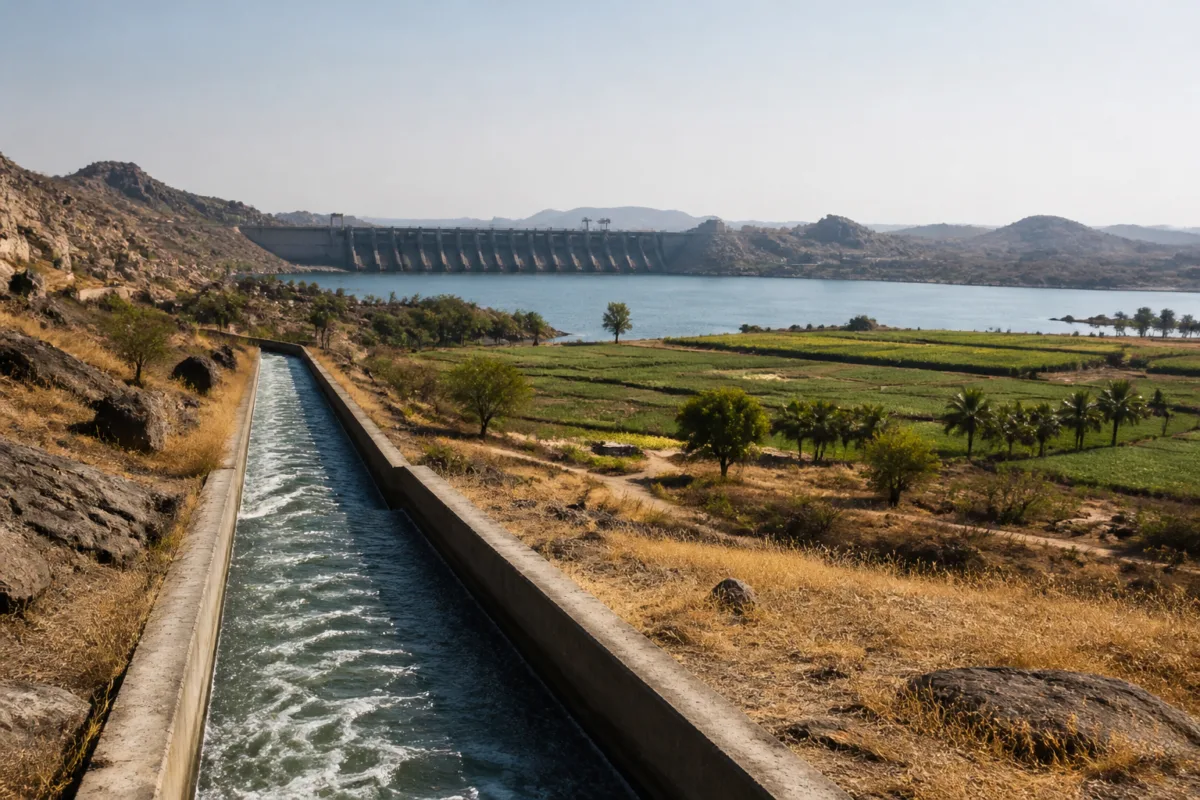
Karnataka’s irrigation projects have transformed large parts of the state, but the next phase cannot be judged only by the number of dams, canals or lift-irrigation schemes completed. The state’s own water history shows that infrastructure creates agricultural and economic opportunity only when storage, distribution, management, legal agreements and local needs are planned together.
That is the central question raised by a Prajavani article authored by a retired chief engineer of the Water Resources Department. The article traces Karnataka’s irrigation development from tanks, wells and traditional water structures to large reservoirs and canal systems, while arguing that future projects must be completed within a legal and time-bound framework and supported by the experience of irrigation specialists.
The argument is significant because irrigation in Karnataka is not only an agricultural issue. Water from reservoirs and river systems is also used for drinking water, electricity generation and tourism. Decisions about where water is stored, how it is released and which districts receive it therefore affect several parts of the urban and rural economy at the same time. Delays or disputes in one project can also create financial and administrative pressures that extend well beyond the construction site.
Karnataka’s irrigation system has deep historical roots. The article refers to the irrigation works associated with the Vijayanagara, Hoysala, Chalukya and Mysore periods, when tanks, bunds, wells and canals supported cultivation. In the 19th and early 20th centuries, larger reservoirs became more important. The Vanivilas Sagar project in Chitradurga and the Krishna Raja Sagar reservoir in Mandya marked a shift towards major storage infrastructure, with the latter developed under the technical guidance of Sir M. Visvesvaraya during the rule of Nalwadi Krishnaraja Wadiyar.
The KRS reservoir, described in the article as having a capacity of 49 TMC, strengthened irrigation in the Mysuru and Mandya regions and contributed to their economic development. Its history also illustrates why water infrastructure cannot be separated from inter-state governance. The Cauvery dispute existed even when the reservoir was being developed, and agreements made during that period continue to shape present-day disagreements.
After Independence, Karnataka entered what the article describes as an era of major irrigation construction. Projects were developed on the Krishna, Cauvery, Tungabhadra, Bhima, Ghataprabha, Malaprabha and Sharavathi river systems. The list includes the Tungabhadra reservoir near Hospet, the Bhadra reservoir near Lakkavalli in Chikkamagaluru district, the Almatti and Basava Sagar reservoirs, Linganamakki, Kabini, Hemavathi, Harangi, Hidkal, Naviluteertha and Supa.
The article states that more than 50 reservoirs and barrages have been built across Karnataka. These projects expanded the reach of canals, while lift irrigation and drip irrigation extended the system beyond conventional gravity-fed networks. Areas that previously depended largely on rainfall began cultivating multiple crops suited to local soil and climate conditions. The article identifies sugarcane, paddy, grapes, cotton and other commercial crops among the products associated with this transition.
This transformation also produced distinct regional agricultural economies. The KRS, Kabini, Hemavathi basin and Tungabhadra regions developed as important paddy-growing areas, according to the article, while parts of the Almatti and Hidkal command areas became associated with sugarcane cultivation. Such changes show the productive power of irrigation, but they also underline the importance of matching water availability with cropping patterns and long-term basin conditions. The supplied material does not provide current figures on water consumption, crop-wise demand or groundwater levels, so the scale of those pressures cannot be independently assessed from this article alone.
The wider national picture is similarly mixed. The article notes that irrigation helped bring large areas of land under cultivation and contributed to India’s food production gains. At the same time, it says that only around half of India’s cultivated land is irrigated, leaving a substantial share dependent on rainfall. That contrast is important for Karnataka, where major reservoirs and canal systems coexist with drought-prone districts and regions that remain vulnerable to uneven rainfall.
The institutional challenge is therefore not simply to build more infrastructure. It is to manage a network in which water must serve agriculture, drinking-water supply, energy and other public purposes. The article says successive governments have increased funding for irrigation, built canals and worked to fill tanks so that people can access water. It also refers to the Yettinahole project, intended to provide drinking water to drought-prone districts including Kolar, Chikkaballapur and Tumakuru.
Yettinahole also illustrates the gap between announcing a water project and completing it. According to the article, the project began about a decade ago but has remained incomplete because of issues including land acquisition. The resulting delay has created an economic burden. The article does not provide the project’s current cost, completion percentage or latest official schedule, but its inclusion points to a recurring administrative problem: projects that remain in construction for years can continue to absorb public money without delivering their planned water supply.
Land acquisition is only one part of this implementation problem. Large irrigation works require coordination between water-resource agencies, revenue authorities, local administrations, affected landowners and, in some cases, neighbouring states. Delays can arise when technical design, environmental permissions, legal disputes, compensation and political commitments move at different speeds. A project may be financially sanctioned yet remain operationally incomplete because the institutions responsible for its separate components are not working to one time-bound plan.
Inter-state relations add another layer. Karnataka faces pressure from neighbouring states over shared river waters, while demand within Karnataka is also divided between regions and sectors. The article refers to continuing pressure over reservoir management and river-diversion proposals, as well as the need to explain through dialogue how the proposed Mekedatu project could benefit both Karnataka and Tamil Nadu. The source presents dialogue as necessary for implementation, but it does not establish the current legal or regulatory status of the project.
This is where the future of irrigation becomes a governance question. Reservoir capacity alone does not guarantee reliable water access. The public value of a dam depends on whether water can be conveyed through functioning canals, released according to transparent rules, allocated among competing uses and managed during both drought and excess-rainfall conditions. The article calls for local management plans for reservoirs and a stronger legal framework with fixed timelines.
The emphasis on local management is especially relevant because reservoirs are not isolated engineering structures. They affect settlements, farms, downstream users, tourism economies and drinking-water systems. Their operation also creates recurring responsibilities after construction is over: maintenance of canals, management of silt and outlets, monitoring of demand, and coordination between departments. The supplied article does not provide performance data on these functions, but it identifies them as part of the need for a more systematic approach.
Karnataka’s irrigation debate therefore contains two different tasks. The first is to complete projects that have already been announced or substantially built, particularly where delays have imposed costs without delivering intended benefits. The second is to decide whether new projects fit within the state’s available water, legal obligations and long-term demand. Treating both tasks as construction targets risks overlooking the operational institutions that determine whether infrastructure performs after inauguration.
The evidence in the article confirms the historic contribution of irrigation to Karnataka’s agricultural expansion and identifies a continuing pipeline of competing demands. It also shows what remains unclear: the current status and cost of individual projects, the actual command area receiving water, the performance of canal networks, the balance between irrigation and drinking-water requirements, and the legal position of proposed inter-state projects. Those are the measurements that will determine whether the next phase of Karnataka’s water policy becomes a durable public system or another cycle of delayed construction and unresolved allocation disputes.

