


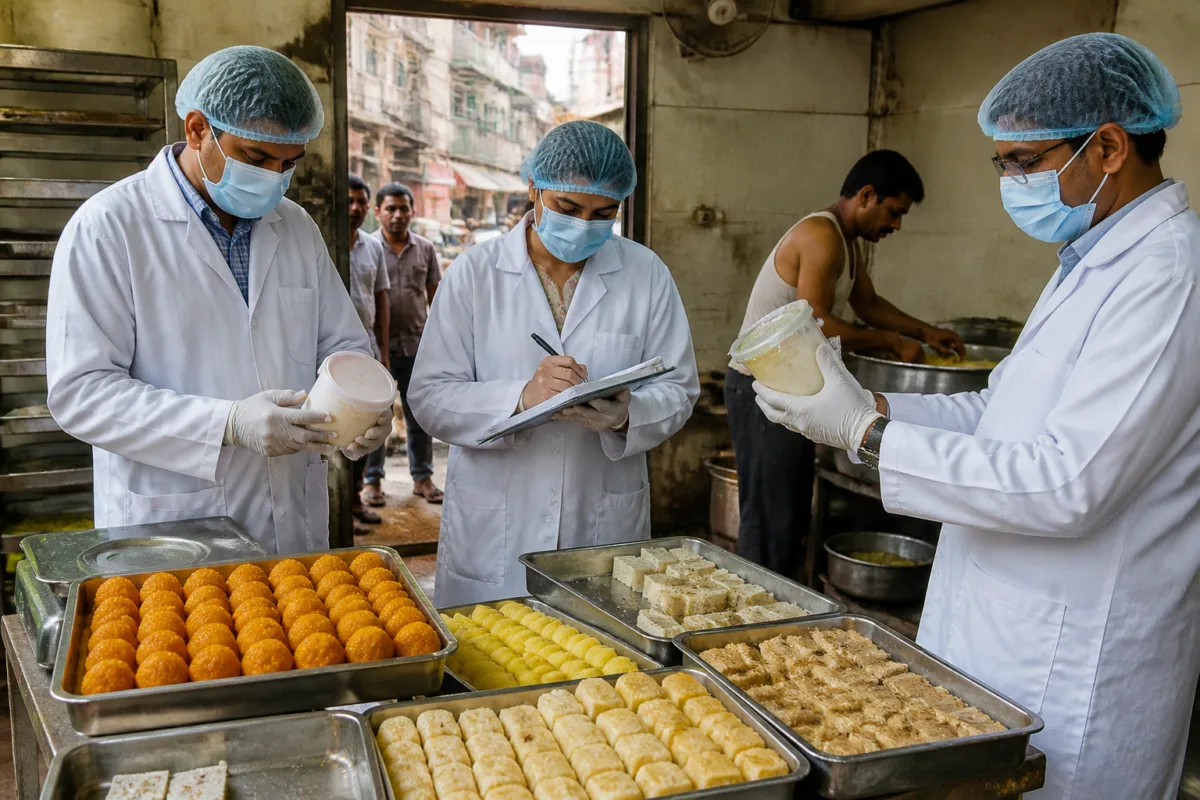
The Pune Food and Drug Administration’s seizure of 93 kg of suspected laddus and barfi from two sweet-manufacturing units in Wanwadi is more than a festival-season enforcement update. It shows how urban food safety depends on inspections taking place inside neighbourhood production units, how quickly perishable evidence must be handled, and how regulatory action can affect both consumers and local businesses.
The action was carried out on November 10 by a Pune FDA Division 1 team during a special campaign focused on sweets being produced and sold during the Diwali season. Officials inspected Ma Karachi Sweets Mart and Shri Mohan Karachi Sweets Mart at Jambhulkar Chowk in Wanwadi village. The seized stock was valued at ₹50,860 and was destroyed at the premises because it was perishable and its quality was considered suspicious, according to the report by Lokmat – Pune.
The central fact remains specific but important: the sweets were suspected to be of doubtful quality, not conclusively declared unsafe in the material supplied. Samples were sent to a laboratory for examination. The final status of the seized products will therefore depend on those test results. The immediate enforcement action was based on the inspection findings and alleged violations of food safety standards, while laboratory analysis is intended to establish the nature of the suspected problem.
That distinction matters in food regulation. Destroying a perishable stock prevents its continued sale while the inspection and testing process proceeds, but it does not by itself establish what caused the suspected quality failure. The report does not provide the laboratory results, identify the specific contaminants or defects suspected by inspectors, or state whether consumers had reported illness. Any assessment beyond the seizure, destruction and licence action would therefore go beyond the evidence currently available.
The quantities recorded by the FDA show the scale of the operation at each unit. At Ma Karachi Sweets Mart, officials seized 18 kg of motichoor laddus valued at ₹10,800 and 5 kg of barfi valued at ₹5,000. The total from that unit was 23 kg, worth ₹15,800. At Shri Mohan Karachi Sweets Mart, the team seized 41 kg of motichoor boondi valued at ₹14,760 and 29 kg of barfi valued at ₹20,300. That unit accounted for 70 kg, valued at ₹35,060.
These figures also show why neighbourhood-level inspections matter in a city. The enforcement action was not limited to a retail counter or a single packaged product. It involved two manufacturing units operating in the same local area and covered different types of traditional sweets. Such units are part of the everyday food network through which festival demand is met, making production conditions and compliance at the source relevant to consumers far beyond the premises inspected.
The FDA’s response followed a sequence of administrative steps. Inspectors entered and examined the two units, seized the suspected stock, sent samples for laboratory testing and destroyed the remaining perishable material under the applicable legal process. The food licences of both manufacturers were also suspended immediately for non-compliance with food safety standards. The report does not state the duration of the suspensions, the conditions for reinstatement or whether further prosecution or penalties will follow.
The named officials indicate the chain of responsibility behind the operation. Food safety officers P. N. Chavan and P. J. Jadhav carried out the action. Pune Division Assistant Commissioner N. B. Khose supervised the campaign, while FDA Joint Commissioner S. R. Karkale issued directions. This establishes that the operation was conducted through the department’s regional enforcement structure rather than as an isolated action by individual inspectors.
The case also highlights the difference between visible enforcement and completed enforcement. The seizure and destruction are immediate and observable actions. Laboratory testing is a later evidentiary step, and its result will determine whether the suspicion recorded during the inspection is confirmed. The licence suspensions are likewise an immediate regulatory measure, but the supplied report does not explain the subsequent hearing, review or corrective process available to the manufacturers.
For consumers, the immediate impact is the removal of a specific stock from sale. The report does not establish that all products from the two units were affected, nor does it say whether the manufacturers’ entire operations were closed. It records the destruction of 93 kg of sweets and the suspension of both food licences. Consumers should therefore distinguish between the identified seized stock and any broader claim about all sweets produced by the establishments.
For the administration, the operation illustrates the operational difficulty of regulating food during a short period of sharply increased demand. The FDA had to act while products were still perishable. Once sweets deteriorate or are sold, the opportunity to preserve physical evidence and prevent further distribution becomes more difficult. In this case, the department’s decision to send samples for testing while destroying the remaining stock reflects that tension between evidentiary procedure and the practical handling of food that cannot be stored indefinitely.
The available information does not reveal how the units came to the attention of the authorities, whether the inspections were routine or complaint-driven, or whether similar action was taken elsewhere in Pune. It also does not provide the number of inspections conducted under the special campaign, the total quantity seized across the city or the number of licences suspended. Those missing details limit what can be concluded about the wider scale of the problem.
Still, the action raises a broader urban governance question: how effectively can a city monitor the many small production points that supply food to a large and mobile consumer base? In the Wanwadi case, the regulatory system reached two units operating at the same urban location, identified suspected non-compliance and removed the stock before it could continue through the market. The report does not establish whether that level of enforcement is typical across Pune, but it demonstrates the importance of local inspection capacity.
The case also shows why public communication should continue after the initial raid. The report identifies the quantities, product categories, premises and officers involved, but the laboratory findings and the next administrative steps are not yet available. Publishing those results would help clarify whether the suspicion was confirmed, what violations were established and what conditions apply to the suspended licences.
What the evidence confirms is that Pune FDA officials seized and destroyed 93 kg of suspected laddus and barfi from two Wanwadi manufacturers, valued at ₹50,860, after an inspection conducted during the Diwali-season campaign. Samples have been sent for laboratory testing and both food licences have been suspended. The key developments still to monitor are the test results and the subsequent regulatory action against the two units.

