


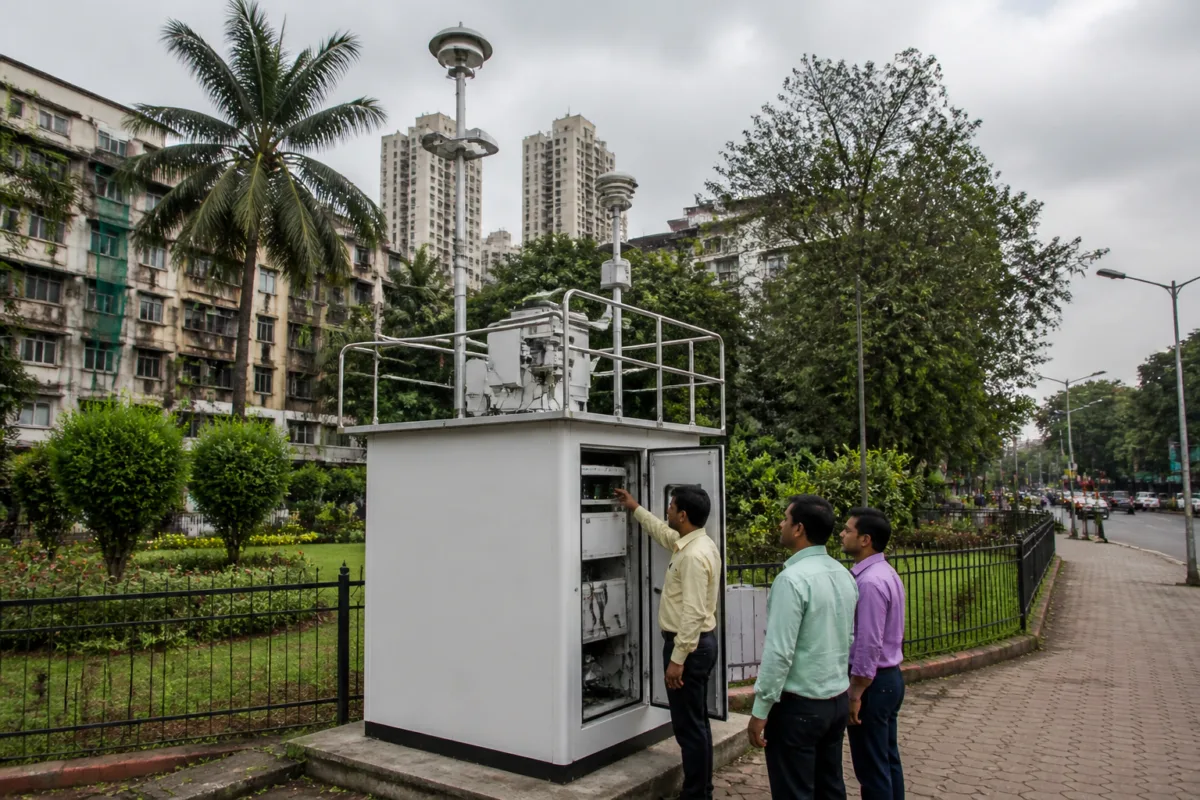
Mumbai’s air quality monitoring network will expand by five stations under a Rs 22-crore Brihanmumbai Municipal Corporation project aimed at improving pollution data coverage across the city, civic officials said on Friday. The Continuous Ambient Air Quality Monitoring Stations will be installed in Mulund, Dadar, Goregaon, Charni Road and Santacruz.
The project includes the installation, operation and maintenance of all five facilities for five years. The stations are expected to become operational within six months, according to a senior civic official cited in the announcement.
Two of the proposed stations will replace existing BMC facilities, while the other three will be installed in locations where there is currently no monitoring facility within a five-kilometre radius. Civic officials said the selected sites comply with guidelines issued by the Central Pollution Control Board.
The new facilities are planned as urban background monitoring stations. Their purpose will be to measure general ambient air quality in surrounding neighbourhoods rather than monitor a single industrial or traffic source. Each automatic station will require between 300 and 700 square feet of land.
Mumbai currently has 29 Continuous Ambient Air Quality Monitoring Stations monitored by the BMC, the Maharashtra Pollution Control Board and the Indian Institute of Tropical Meteorology. The readings from these facilities are sent to Sameer, the CPCB’s national air-quality monitoring dashboard.
The planned locations include areas where officials say additional monitoring coverage is needed. Dadar, Charni Road and Mulund currently do not have monitoring stations, despite being among the locations identified for the new facilities. The proposed additions are intended to provide more localised information on ambient conditions across different parts of the city.
The expansion comes as Mumbai’s overall Air Quality Index has fluctuated between moderate and poor to very poor over the past week. The readings from monitoring stations are used to track changes in air quality and provide publicly available information through national and civic pollution-monitoring systems.
The civic official said the station locations were selected after considering CPCB requirements and available sites. “We have selected the best possible locations for installing the new proposed stations, taking the CPCB guidelines into consideration,” the official said.
The BMC’s five-year contract will cover not only the construction and installation of the stations but also their operation and maintenance. The facilities are expected to begin functioning within six months of the project’s implementation.

