


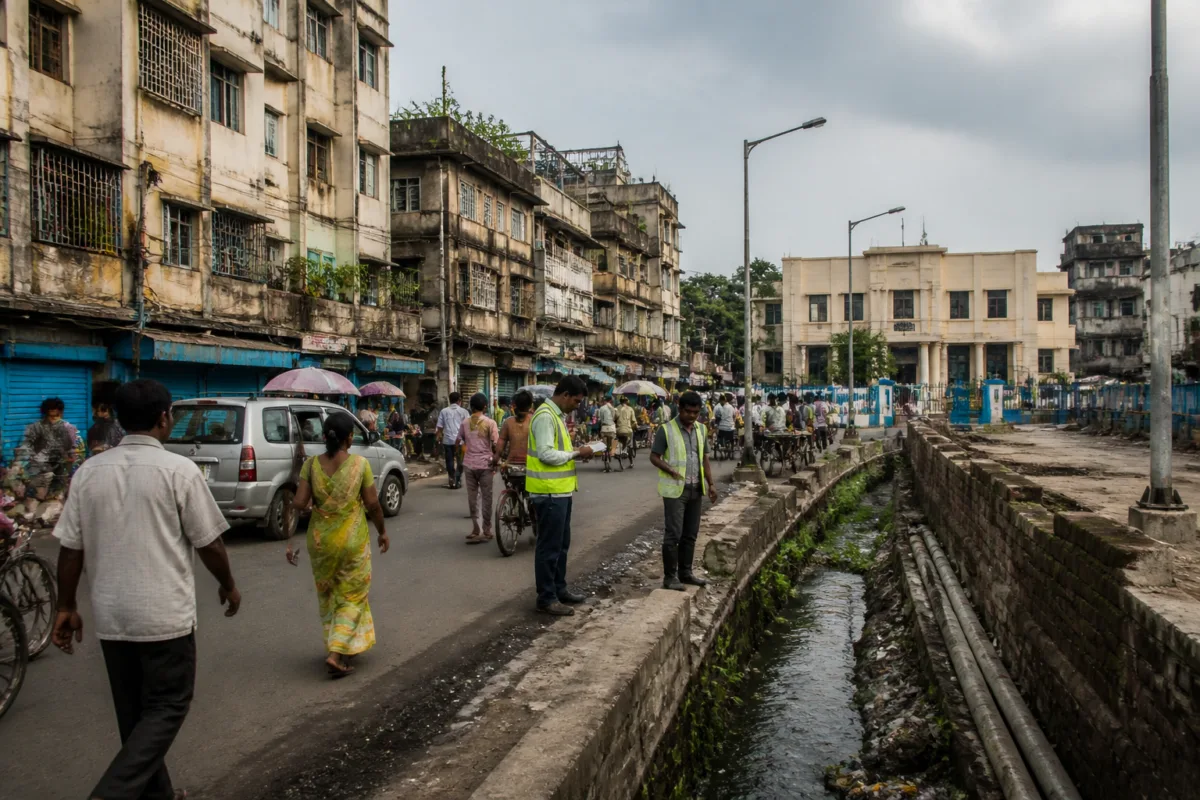
Howrah civic polls have become the latest test of whether urban services can be administered without an elected municipal board. A petition challenging the proposed expansion of Howrah Municipal Corporation from 50 wards to 68 has brought the city’s prolonged absence of elections, the legality of ward delimitation and the proposed appointment of political coordinators into the same dispute.
The petition has been filed in Calcutta High Court by Imteaz Ahmed, a former member of the Howrah mayor-in-council. Ahmed has questioned the delimitation exercise and argued that Section 219 of the Howrah Municipal Corporation Act allows the ward list to be changed only on the recommendation of the corporation. The challenge comes as the state government considers arrangements for running civic bodies whose elections have been delayed.
Howrah has not held municipal elections since 2013. According to the report, administrators have been running the civic body since 2018. That gap has turned what might ordinarily be a technical question about ward boundaries into a broader dispute over the chain of accountability in a large urban jurisdiction. The immediate issue is the proposed increase in wards. The deeper issue is who has the authority to reshape electoral constituencies when there is no elected corporation in place to make or recommend that change.
The dispute is linked to a separate legal challenge involving the Kolkata Municipal Corporation. The Calcutta High Court has restrained the state government from issuing notifications for civic polls in Kolkata until a petition challenging the delimitation of wards is decided by a regular bench. Kolkata’s wards were increased from 144 to 209. The petition filed by a former CPM councillor alleges uneven population distribution among wards and claims that some of the new arrangements could provide an unfair advantage to the BJP.
The Kolkata case has created an immediate administrative question for the state. Chief minister Suvendu Adhikari said the government would appoint people from the BJP as “coordinators” to manage civic services until elections are held. The proposal was presented as a stop-gap arrangement, but it has also raised questions about the difference between service administration and political control of a civic institution.
Agnimitra Paul, the state’s urban development and municipal affairs minister, told The Telegraph Online that the arrangement was necessary to continue civic services. “Me and my office cannot keep a watch on where streetlights are not functioning. Providing civic amenities is the responsibility of the civic bodies and the councillors. We have to keep providing civic services,” she said. Paul added that the party would decide on the coordinators.
That formulation captures the administrative problem while leaving the accountability problem unresolved. Streetlights, drainage, roads, sanitation and other municipal functions require continuous supervision. But an arrangement that substitutes appointed or politically selected coordinators for elected councillors changes who residents can hold responsible for failures and who exercises influence over civic priorities. The supplied report does not establish the final legal form, powers or tenure of the proposed coordinators. It does show that the government’s plan is being discussed while the delimitation questions remain before the court.
In Howrah, the petition raises a more specific institutional objection. Ahmed said there was no corporation board or mayoral council when the delimitation exercise was carried out and asked whose recommendation had authorised it. His argument links the validity of the new ward map to the existence of the elected institution referred to in the municipal law. Until the court considers that argument, the proposed move from 50 to 68 wards remains contested rather than settled.
The population distribution issue in Kolkata adds another layer to the debate. Ward delimitation is not simply a question of drawing new boundaries. It determines the scale of representation, the number of elected councillors and the political geography through which municipal services are administered. If wards have significantly uneven populations, residents may not have comparable access to representation. If boundaries are challenged as politically advantageous to one party, the legitimacy of the election process itself can become part of the dispute.
The two cases therefore connect electoral timing with the design of the municipal system. A city may continue to receive services through administrators, but the absence of an elected board removes a formal channel through which residents can question decisions, demand explanations and change representatives. The longer that gap continues, the more routine administration becomes entangled with questions about mandate.
The report places Howrah’s civic crisis in a longer timeline. Elections have not been held there for 13 years, while administrators have reportedly run the corporation since 2018. Ahmed described the period as “executive adventurism” and said the city had “completely collapsed” over the last decade. Those are the petitioner’s characterisations, not independently established findings in the supplied material, but they point to the ground-level concerns that make the institutional dispute consequential: whether the city’s roads, drainage, cleanliness and street lighting are being maintained and how residents can seek redress when they are not.
Political representatives have offered sharply different explanations for the condition of civic services. Shibpur MLA Rudranil Ghosh blamed previous Left and Trinamool-run boards for inadequate roads and drainage upgrades. He said the existing system was inadequate in most wards and argued that civic amenities could not be provided without coordinators. The report also records allegations by Ghosh against former Trinamool councillors. Those allegations are political claims and are not independently substantiated in the supplied material.
The competing statements reveal how the absence of elections can shift debate away from measurable municipal performance and towards competing accounts of responsibility. The previous boards are blamed for infrastructure failures; administrators are questioned over the lack of an elected mandate; and the proposed coordinators are presented as necessary for daily management even as their political selection raises concerns about institutional independence. Without publicly established information on budgets, service levels, project completion or ward-wise outcomes, the report does not permit a definitive assessment of which administration is responsible for which failure.
The legal question is consequently central. The court is being asked to examine whether the delimitation process complied with the Howrah Municipal Corporation Act and whether the proposed ward structure can support a lawful election. In Kolkata, the court has already restrained the state from issuing civic poll notifications until the delimitation challenge is considered. Howrah is likely to be included in the list once the petition is taken up, making the court’s handling of the ward disputes important for the timing and structure of elections in both cities.
The proposed coordinators also expose a distinction that urban governance often obscures: keeping services running is not the same as restoring representative government. A municipal administration needs officials capable of managing operations, but elected councillors provide a different function. They represent wards, scrutinise local priorities and give residents a direct political route to demand action. The report does not specify whether the coordinators would possess the same powers as councillors, how they would be monitored or what formal mechanism would govern their decisions. Those unanswered questions matter because the arrangement is being considered precisely when the election process is under legal scrutiny.
The immediate political context is also significant. The chief minister said coordinators would be appointed from the BJP and that those who opposed the government would not be selected. That statement, as reported, makes the proposed mechanism explicitly political rather than purely administrative. It also places the service-delivery argument alongside a question about whether an unelected civic arrangement can remain neutral during a pending electoral process. The report says BJP insiders had not taken a final decision, and one BJP legislator who had also served as a councillor said he had not heard about the appointments.
The chronology suggests that the state’s administrative response is moving alongside, rather than after, the resolution of the legal dispute. The government floated the coordinator proposal after the high court restrained civic poll notifications in Kolkata. The BJP had already begun selecting candidates for civic polls before the delimitation challenges emerged. It is now waiting for the court before proceeding with the proposed appointments, according to sources cited in the report. This sequence means that the ward map, the election schedule and the interim management structure are connected decisions rather than separate administrative matters.
For Howrah residents, the practical consequence is uncertainty over both services and representation. The city’s municipal machinery must continue to handle routine functions, but the election that would renew its political leadership has not taken place since 2013. At the same time, the proposed increase to 68 wards could alter the structure through which residents elect councillors. Until the legal challenge is decided, residents cannot know whether the new map will stand or how quickly an election based on it can proceed.
The larger urban question is whether prolonged administrative control can be treated as a temporary exception when it lasts for years. The report establishes a 13-year gap since Howrah’s last civic election and a period of administration since 2018. It does not establish why each delay occurred or identify the full procedural history. But the duration alone changes the character of the arrangement. What begins as an interim solution can become the normal way a city is governed, while accountability remains divided among administrators, state departments and political actors.
The next stage will depend on the court’s consideration of the Howrah petition and the pending challenge to Kolkata’s ward delimitation. The legal findings will determine whether the proposed ward structures can proceed, while the state’s decision on coordinators will determine how civic services are managed in the interim. Until those questions are resolved, Howrah’s civic polls remain more than an overdue election: they are a test of whether urban administration can retain operational continuity without losing representative accountability.

