


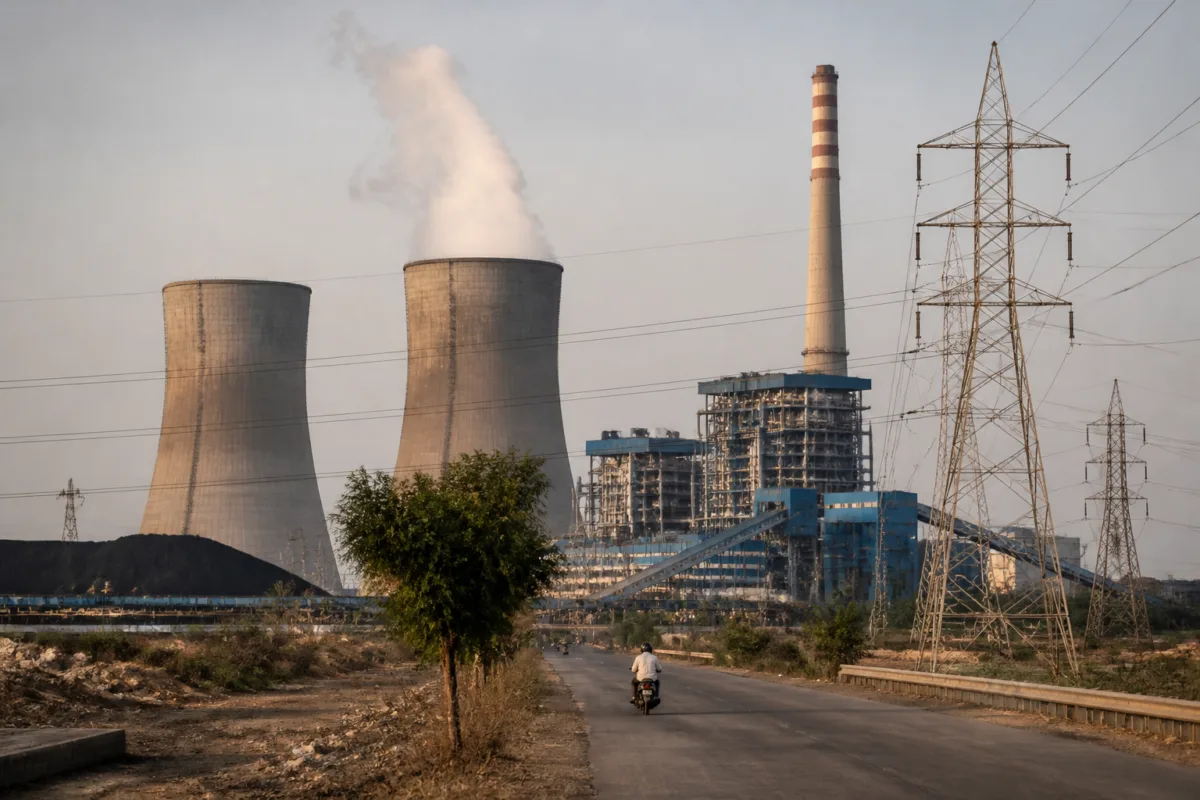
Telangana’s thermal power plant utilisation fell from 65.01 per cent in 2024-25 to 56.86 per cent in 2025-26, according to figures attributed to TGGENCO and the Central Electricity Authority’s March 2026 performance report. The decline has placed the focus not only on the State’s power availability, but also on a more basic question of how effectively its installed generation capacity is being used.
Plant Load Factor, or PLF, measures the electricity generated by a power plant against the power it could have produced if it operated at its installed capacity for the relevant period. A PLF of 100 per cent represents full utilisation, while a PLF of 50 per cent means that only half of the plant’s potential generation has been used. The measure does not, by itself, explain why generation rose or fell. It does, however, indicate whether the available thermal fleet is operating close to its potential.
That distinction matters in Telangana because the State’s contracted power generation capacity expanded substantially during the period cited in the report. Total contracted capacity rose from 7,778 MW in 2014 to 18,567 MW by May 2023. The reported fall in PLF therefore presents a capacity-utilisation problem: the State has more contracted generation capacity than it had a decade earlier, but a smaller share of its thermal potential is being converted into electricity.
The figures also mark a change from the performance described for the previous decade. Between 2014 and 2023, Telangana’s thermal power plants were reported to have maintained PLFs above the national average, with the gap reaching 10 to 20 percentage points on several occasions. During the same period, the national average PLF did not exceed 69.5 per cent, according to the material cited in the report.
Since the Congress government assumed office in December 2023, the State’s thermal PLF has reportedly fallen below the national average. The reported figure of 65.01 per cent for 2024-25 declined further to 56.86 per cent in 2025-26. The figures were cited by social media user Pasham Raghunandan Reddy, who attributed them to TGGENCO statistics and the Central Electricity Authority’s March 2026 performance report.
The source report does not establish the operational cause of the decline. It records that Telangana has access to coal from Singareni collieries and asks why generation has reduced despite what it describes as sufficient installed thermal capacity. That question is important, but the available material does not identify whether the lower PLF resulted from plant outages, maintenance schedules, coal logistics, transmission constraints, demand patterns, contractual decisions, financial considerations or other operational factors.
A lower PLF also should not be read automatically as proof that consumers received less electricity at every point in the period. Power systems can meet demand through multiple sources, including purchases from the market, hydropower, renewable generation and electricity sourced through contracts. Conversely, installed capacity may exist on paper while remaining unavailable at a particular time because of technical or fuel-related constraints. The supplied report does not provide the generation mix, plant-wise availability, outage data or power procurement details needed to distinguish between these possibilities.
The distinction between capacity and availability is central to the public debate. Installed capacity describes the maximum output that generating assets can theoretically provide. PLF captures actual generation over a period. A State may add capacity but still record a lower PLF if the plants operate fewer hours, run below their rated output or remain unavailable. For consumers, the practical issue is not the capacity number alone, but whether electricity is available when households, farms, businesses and public services require it.
The report places the discussion against Telangana’s earlier energy-sector record. It describes the State as having been recognised as a model for reforms and measures associated with quality and uninterrupted power supply during the previous BRS government. It also says that higher thermal generation helped provide electricity to domestic consumers, agriculture and industries. These are broad claims in the supplied report and are presented as part of the political contrast between the two administrations.
The present government, according to the report, has repeatedly warned of the effects of the El Nino weather pattern and the possibility of severe water and power shortages over the following eight to 10 months. Chief Minister A Revanth Reddy is also reported to have said that the government was prepared to purchase power at higher prices, but that electricity was not available in the open market. Those remarks point to a second layer of the issue: power adequacy is determined not only by generation assets within the State, but also by the availability and price of electricity outside it.
The Opposition has accused the Congress government of failing to anticipate power requirements and make alternative arrangements. Raghunandan Reddy described the reported decline as a possible administrative failure and questioned who would be responsible for losses suffered by farmers and residents. These allegations are political claims and cannot, on the evidence supplied, be treated as a demonstrated explanation for the fall in PLF.
What can be established from the available figures is the direction of change. Telangana’s reported thermal PLF declined by 8.15 percentage points between 2024-25 and 2025-26. It also moved from a period in which the State was described as performing above the national average to one in which it was reported to be below that benchmark. The size of the change makes the issue relevant beyond an annual performance statistic, particularly because power reliability affects irrigation, industrial production, commercial activity and urban services.
For cities, the consequences of power-system performance are often indirect but widespread. Electricity supports water treatment and pumping, sewage systems, hospitals, transport operations, telecommunications, office districts, retail activity and housing. Industrial and agricultural consumers depend on predictable supply for production and irrigation. When supply is uncertain, the response may involve additional procurement, backup generation or changes in operating schedules. The supplied material does not quantify these effects in Telangana, but it identifies domestic consumers, farmers and industries as the sectors linked to the State’s power supply performance.
The institutional question is therefore larger than whether Telangana has enough megawatts on paper. It concerns coordination among the State government, TGGENCO, the Central Electricity Authority, coal suppliers, distribution utilities and power markets. It also concerns how demand is forecast, how maintenance is scheduled, how fuel availability is managed and how procurement decisions are made when market power is scarce. The report raises these questions but does not provide the underlying administrative records required to answer them.
The March 2026 CEA performance report is significant because it provides the benchmark cited for the 2025-26 PLF figure. However, a complete assessment would require plant-wise data, including each station’s installed capacity, actual generation, technical availability, outage duration, fuel supply and dispatch instructions. It would also require a comparison with the State’s demand, peak load and electricity purchases during the same period. Without those details, the reported PLF decline is a clear signal of weaker thermal utilisation, but not a complete diagnosis of the power system.
The available evidence also does not show whether the decline was concentrated in a particular plant or spread across the thermal fleet. That distinction would materially change the interpretation. A problem at one large station could have a different institutional cause from a broad decline across several facilities. Similarly, a lower PLF could reflect deliberate dispatch decisions if cheaper or cleaner sources were available, although the supplied report does not provide evidence to establish that explanation.
The immediate policy challenge is to connect the headline number with operational evidence. Telangana’s expansion from 7,778 MW of contracted capacity in 2014 to 18,567 MW by May 2023 created a much larger generation base. The reported fall in utilisation suggests that capacity expansion alone cannot guarantee supply performance. The State must also ensure that plants are available, fuel reaches them, electricity can be transmitted and generation is dispatched in line with demand.
The evidence currently confirms three points: Telangana’s reported thermal PLF fell to 56.86 per cent in 2025-26; the figure was below the national average cited in the report; and the decline followed a period in which the State’s thermal plants were described as outperforming the national benchmark. What remains unresolved is why the decline occurred and how it affected actual supply to different categories of consumers. Those answers depend on plant-level operational records, demand data and procurement information that are not included in the supplied material. Until those details are examined, the PLF figures should be treated as an important warning about capacity utilisation, not as a standalone verdict on the entire State power system.

