


India’s Production-Linked Incentive schemes have succeeded in expanding investment, output and exports in selected industries, but the latest Niti Aayog assessment shows that the programme has not yet produced jobs at the pace promised. That gap matters beyond industrial policy: it affects the quality of urban employment, the demand for industrial land and infrastructure, and the ability of manufacturing growth to reshape cities and regional economies.
The assessment, released by Niti Aayog after reviewing 14 PLI sectors with the Indian Institute of Management, Ahmedabad, found that only four sectors—large-scale electronics, pharmaceutical drugs, telecom and networking products, and food products—were “on track” across investment, production, jobs and exports. The report examined whether each sector had performed better than it might have without the incentive and whether it had reached at least half of its full-term target.
The programme is still in progress. The schemes had completed about 58% of their total time when the assessment was prepared, with results covered up to March 2026. Yet the interim findings already show a clear pattern: capital formation and production have moved faster than employment creation, while performance varies sharply between sectors.
That unevenness is important because PLI is not only a fiscal programme for companies. It is also an attempt to build new industrial capacity, create manufacturing ecosystems and connect domestic production to global supply chains. Such ecosystems require more than factories. They depend on land, power, logistics, worker housing, transport links, supplier networks and public services. When investment rises without a comparable increase in jobs or local value addition, the urban and regional benefits of industrial expansion can be narrower than headline production figures suggest.
The scale of the investment and output numbers is substantial. Companies covered by the schemes have invested ₹2.40 lakh crore, around 76% of the target, while production and sales have reached ₹22.66 lakh crore, or 64% of the target. The government has paid ₹35,354 crore to companies, equivalent to 18.51% of the total budget of ₹1.91 lakh crore. The report and officials said payments are released only after companies meet their targets, and that production has been taking place for about three years on average while payments have covered roughly two years.
Employment, however, is the weakest of the four main indicators. The schemes have generated 8.49 lakh jobs against a target of 30.19 lakh, achieving 28% of the promised figure. In the automobile sector, 67,820 jobs have been created against a target of more than 1.48 lakh. These figures do not establish that the programme cannot create employment, since the schemes are incomplete, but they do show that investment and production cannot be treated as automatic substitutes for jobs.
For cities, the distinction is critical. A factory’s investment value may be recorded at the national level, while its employment impact is experienced locally through household incomes, commuting patterns, rental demand, informal services and municipal revenues. If industrial output grows through automation, imported components or a limited number of large facilities, the associated urban multiplier may be smaller than expected. The assessment does not provide a city-by-city breakdown, so it cannot establish which urban regions have gained most or whether local infrastructure has kept pace with new industrial activity. It does, however, identify the employment gap as a central weakness in the programme’s performance.
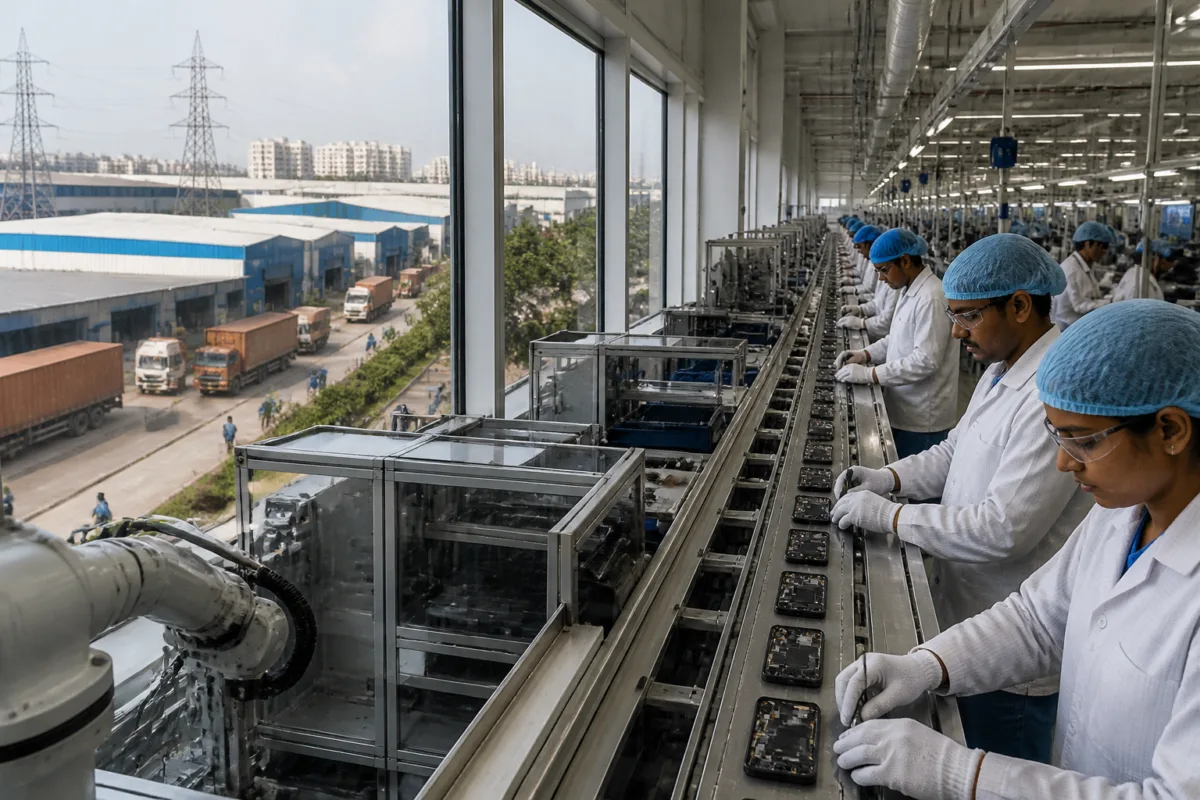
The strongest result has come from large-scale electronics, particularly mobile phones. Phone exports increased from ₹22,868 crore in financial year 2020-21 to about ₹2 lakh crore in 2024-25, while phone imports fell by 77%. This is a major change in India’s trade profile and shows how targeted incentives can support the rapid expansion of a manufacturing segment.
The same result also exposes the limits of measuring industrial success through assembly and export values alone. The report noted that much of the mobile-phone activity still involves assembling imported parts. This means that export growth can be substantial even when domestic production of components and deeper supplier capabilities remain limited. For industrial cities and clusters, the difference matters: assembly may create a certain type and volume of employment, while component manufacturing can generate broader networks of suppliers, specialised skills and supporting services.
The pharmaceutical story is different. India exported more bulk drugs than it imported in 2024-25, recording a surplus of ₹2,280 crore. That outcome suggests progress in an area where domestic capacity can affect supply security as well as trade. But the supplied assessment does not establish whether this improvement is evenly distributed across industrial locations, how many jobs it has generated or what infrastructure constraints companies face. Those questions remain important for understanding the full urban and regional effect of the scheme.
The weakest performance is concentrated in sectors where design, demand or production conditions appear less favourable. Textiles and speciality steel have each used less than 4% of their budgets. The report described the design of the speciality steel scheme as “faulty”. It also flagged a structural concern in telecom: the scheme does not require companies to use locally produced parts, allowing firms to import all components while still receiving incentives.
These findings point to a difference between attracting production and building an industrial ecosystem. A company may meet an output target without creating a broad domestic supplier base. It may also expand capacity in a location where the required workforce, housing, transport or logistics systems are not yet available. The report does not quantify these local constraints, but its concerns over imported components and uneven sectoral performance show why output alone is an incomplete measure of industrial development.
Two sectors—advanced chemistry cell batteries and high-efficiency solar photovoltaic modules—remain in their gestation period. The report suggested that the government should support demand for such products, including through public procurement. This brings the policy beyond the question of supply-side incentives. Factories may not scale sustainably if domestic demand, procurement systems and downstream markets do not develop alongside them.
That issue has direct implications for public infrastructure. Government purchases can create an initial market for strategic products, but procurement also requires clear technical standards, reliable payment systems, storage and distribution capacity, and institutions capable of evaluating performance. The assessment does not specify the form or scale of the proposed demand support. It does establish, however, that incentives paid to producers may not be sufficient where the market itself is still developing.
The fiscal design of PLI also makes timing important. Only 18.51% of the total budget has been paid because disbursement is linked to verified performance. This limits immediate public expenditure, but it also means that headline budget allocations do not equal money already received by companies. The assessment’s distinction between production timelines and payment timelines is therefore essential to reading the programme accurately.
Niti Aayog officials said the concerned ministries would examine schemes that require changes. Chief Executive Officer Anurag Jain said some PLIs needed “tweaking”, while Vice Chairman Ashok Kumar Lahiri said the agency would review each scheme and assess how it could be improved. The report also called for ministries to urgently adopt a common method for collecting data on jobs, production and exports.
The data issue is not a technical footnote. Comparisons between sectors depend on consistent definitions of employment, production and exports. Without a common method, it becomes difficult to determine whether a scheme is creating direct jobs, supporting indirect employment, replacing imports or merely shifting existing production into an incentivised category. Better measurement would also make it easier to connect national industrial results with local outcomes in cities and manufacturing districts.
The evidence currently supports a mixed conclusion. PLI has helped accelerate investment and production in several sectors, with mobile-phone exports providing the clearest example. It has also contributed to a shift in bulk-drug trade. At the same time, job creation remains far below the aggregate target, some schemes have made limited use of their budgets, and domestic value addition is incomplete in at least one leading sector.
The larger urban question is whether India’s industrial incentives are producing complete economic ecosystems or mainly higher output from selected firms. The answer will depend on the next phase of implementation: how ministries redesign weaker schemes, whether local components and supplier networks expand, whether demand support reaches emerging sectors, and whether employment data becomes more consistent. The Niti Aayog assessment provides a detailed interim signal, but the final impact of the programme will be judged by what remains after incentives end: productive capacity, durable jobs and stronger industrial regions.

