


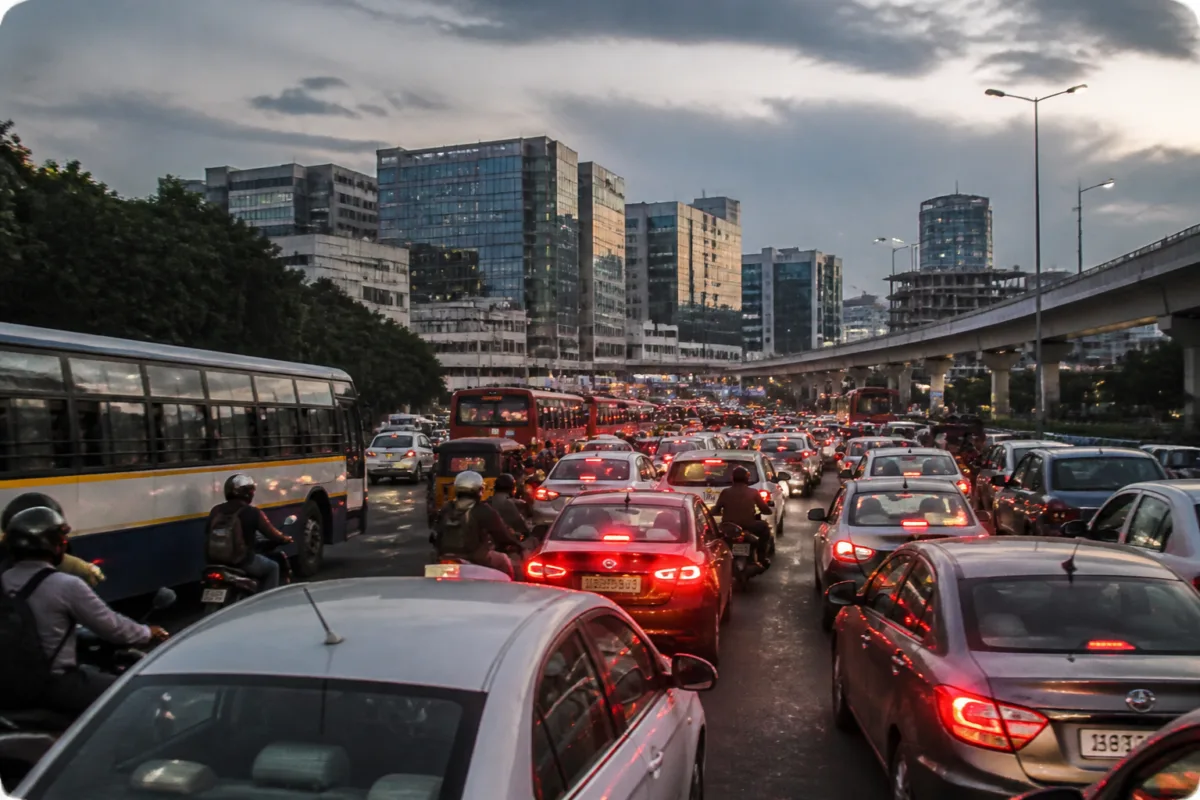
Hyderabad traffic congestion is no longer limited to a few notorious junctions. The city’s expanding vehicle fleet, concentrated employment in the western IT corridor and limited road and parking capacity are combining to make routine travel slower and less predictable across a growing part of the metropolitan region.
The scale of the problem is visible in the gap between different measures of average speed. The Telangana Socio-Economic Outlook puts Hyderabad’s average vehicle speed at 23.4 kmph in 2025, compared with 20.1 kmph in 2024. The Netherlands-based TomTom Traffic Index, however, records the city’s average speed at 18.4 kmph. During evening peak hours, that figure falls to 15.2 kmph, meaning commuters take roughly four minutes to cover every kilometre.
The difference between the two estimates reflects the way traffic performance is measured, but both point to the same urban condition: movement across Hyderabad is becoming increasingly dependent on when and where a journey takes place. A city may record an improvement in an annual or citywide average while particular corridors remain severely congested during the hours when most people travel to and from work.
According to the TomTom Traffic Index 2025, Hyderabad commuters lose around 123 hours a year in congestion. That is more than five full days spent in traffic. The index also estimates that a 10-km journey takes about 40 minutes in traffic. A 10-km trip under an average urban speed of 25 to 30 kmph would ordinarily take approximately 20 to 25 minutes, according to the benchmark cited in the report.
For commuters, the problem is not expressed only in annual averages. It appears as unreliable last-mile travel, missed time and the inability to estimate when a short trip will end. Vaishnavi Dhulipala, an IT professional who travels from Chaitanyapuri to the Financial District, told The Times of India that the metro journey to Raidurg takes around 40 minutes to cover 25 km, but the remaining six-kilometre trip through the IT corridor can take another 30 to 40 minutes. She identified the stretch towards Wipro Circle and the junction there as a particular bottleneck.
A commuter travelling from Beeramguda to Gachibowli reported that a journey which took about 35 minutes until 2024 now takes nearly an hour. Sai Kaushik, a private employee in Gachibowli, said that a stretch of less than a kilometre at Gowlidoddi can take 15 to 20 minutes to cross. These accounts show how congestion is experienced at the level of individual links and junctions, rather than as a single citywide condition.
The deeper pressure comes from the continued growth of private vehicles. Hyderabad is adding nearly 2,000 vehicles every day, including approximately 1,600 two-wheelers and 400 cars, according to the report. Telangana Regional Transport Authority commissioner K Ilambarithi said around 4.5 lakh two-wheelers and 1.5 lakh cars are being added annually, taking the total additions in the two categories to more than six lakh vehicles a year.
That rate of growth is close to Bengaluru’s reported addition of around 2,100 vehicles a day. The comparison is significant because both cities have large technology and service-sector employment centres, but the immediate urban consequence is similar: more people and vehicles are travelling towards concentrated job locations at broadly overlapping times.
The RTA estimates cited by The Times of India put road utilisation at 35% to 40% under normal traffic conditions and 60% to 65% during peak hours. These figures do not mean that all roads are uniformly full. Congestion is shaped by junction design, lane width, turning movements, traffic composition, bottlenecks and the interaction between through traffic and local access. A corridor can therefore experience severe delay even when the wider network retains unused capacity elsewhere.
Traffic counts on Hyderabad’s busiest corridors illustrate this uneven pressure. The Punjagutta-Paradise corridor recorded about 3.65 lakh vehicle movements over a 24-hour period in an assessment conducted on November 10. Between 5 pm and 8 pm, the corridor recorded 45,033 vehicles, or an average of about 15,011 vehicles an hour.
The Cyber Towers stretch in Hi-Tech City receives more than 10,000 vehicles an hour, according to traffic counts by Cyberabad traffic police. Around 6,550 of these are single-rider vehicles, while nearly 3,500 carry two riders. Jubilee Hills Road No. 45 and the Film Nagar junction each record around 9,500 vehicles an hour.
The Gachibowli-Kondapur corridor records about 10,000 to 11,000 vehicles an hour during peak periods. The volume falls to approximately 6,000 to 7,000 vehicles during non-peak hours. The reported traffic is associated with commuting towards Gachibowli, the Financial District and surrounding commercial establishments, as well as residential movement from Kondapur and neighbouring areas.
This geography matters because the congestion problem is closely tied to the location of jobs and housing. The western IT corridor draws large daily flows from residential areas across Hyderabad and from settlements beyond the core employment zone. When a large number of journeys converge on a limited set of corridors, even improvements on individual roads may not resolve the underlying demand concentration.
The city’s metro network can absorb part of this demand, but the commuter experience described in the report also exposes the importance of connections beyond the rail journey. Dhulipala’s account shows that a metro trip can be followed by a long and unpredictable road journey through the IT corridor. The issue is therefore not simply whether a commuter has access to a metro station, but whether the entire trip can be completed efficiently after leaving the station.
This is where Hyderabad’s mobility challenge becomes an institutional and land-use question. Road agencies, the transport authority, traffic police, metro operators, employers and local planning bodies influence different parts of the journey. Vehicle registration is one responsibility; junction management, parking regulation, public transport integration and the location of offices and housing involve other institutions. Without coordination between them, the city can add capacity in one place while congestion shifts to the next constrained link.
Parking is another expression of the same imbalance. Ilambarithi said accommodating the annual growth in two-wheelers and cars would require around 200 acres of parking space. Urban transport expert Prashanth Bachu said an analysis of vehicle additions indicated that nearly six acres of land would be needed every day to park the approximately 2,000 vehicles added in Hyderabad.
These estimates frame vehicle growth as a land-use problem, not only a traffic problem. Every additional vehicle requires road space when it moves and storage space when it stops. In a city where land is also needed for housing, commercial activity, public facilities and open space, parking demand competes directly with other urban uses. The report does not establish how much of this parking is currently provided formally or where the estimated requirement would be met, but it demonstrates the scale of the pressure created by continued private vehicle ownership.
The capacity benchmark cited by traffic experts is around 1,200 passenger car units per lane per hour, although actual capacity varies according to lane width, junction design, traffic composition and operating conditions. This qualification is important. Counting vehicles alone cannot explain every delay. Two-wheelers, cars, buses, commercial vehicles, turning movements and roadside activity affect how effectively a lane can carry traffic. The high counts at the city’s major junctions nevertheless show that demand is pressing against the practical limits of the network at peak times.
The Times of India has launched the Hyderabad Next campaign to examine congestion and long-term mobility solutions through a Mobility Ideathon organised with the International Institute of Information Technology, Hyderabad. The best ideas are to be recognised at a conclave to be headlined by Chief Minister A Revanth Reddy. The initiative places the traffic crisis within a wider discussion about sustainable mobility, although the supplied report does not specify which proposals will be adopted or how they will be financed and implemented.
The evidence currently confirms three linked trends. Hyderabad’s vehicle population is rising rapidly; peak-hour speeds are low on major routes; and employment-driven travel is concentrated in corridors such as Gachibowli, Kondapur, Hi-Tech City and the Financial District. The data also shows why a single measure of average speed can conceal the experience of commuters travelling through particular bottlenecks.
What remains unresolved is how the city will manage the next stage of growth without treating road expansion as the only response. The immediate urban question is not merely how to move more vehicles, but how to reduce the number of journeys forced onto the same corridors, improve connections to high-capacity public transport and manage the land required to store vehicles. The Mobility Ideathon and the planned conclave will indicate whether Hyderabad’s response addresses those system-level pressures or remains focused on individual traffic points.

